

Singapore warehouses likely to fill up more quickly if oil prices keep rising

FURTHER increases in oil prices are expected to push occupancy levels for warehouses higher, according to an analysis by the Institute of Real Estate and Urban Studies (IREUS) at the National University of Singapore.
The research institute noted that as oil prices climb, manufacturers are likely to face higher costs of inputs and narrower margins. Additional friction may also arise from a tighter market for storage space and higher rents at industrial properties in Singapore.
On Tuesday (May 31), crude’s global benchmark Brent hit a 2-month high, with the Brent crude futures contract for July surging above US$121 per barrel. It came after China announced it would ease its Covid-19 restrictions, which ignited hopes of oil demand picking up again in the country, while European Union leaders agreed to pursue a partial ban on Russian oil.
The Business Times reported this week that experts foresee further upside to crude oil prices, given the robust momentum and strong fundamental support. Oil benchmarks have been marching higher for weeks as the geopolitical crisis due to Russia’s invasion of Ukraine has worsened the supply crunch.
From Q1 2000 to Q1 2022, the occupancy levels of Singapore warehouses have tended to move in tandem with the Europe Brent Spot Price FOB, which is tracked by the US Energy Information Administration. This is notwithstanding the fact that warehouse occupancies are also affected by changes in the net supply of industrial spaces and other sector-specific shocks.
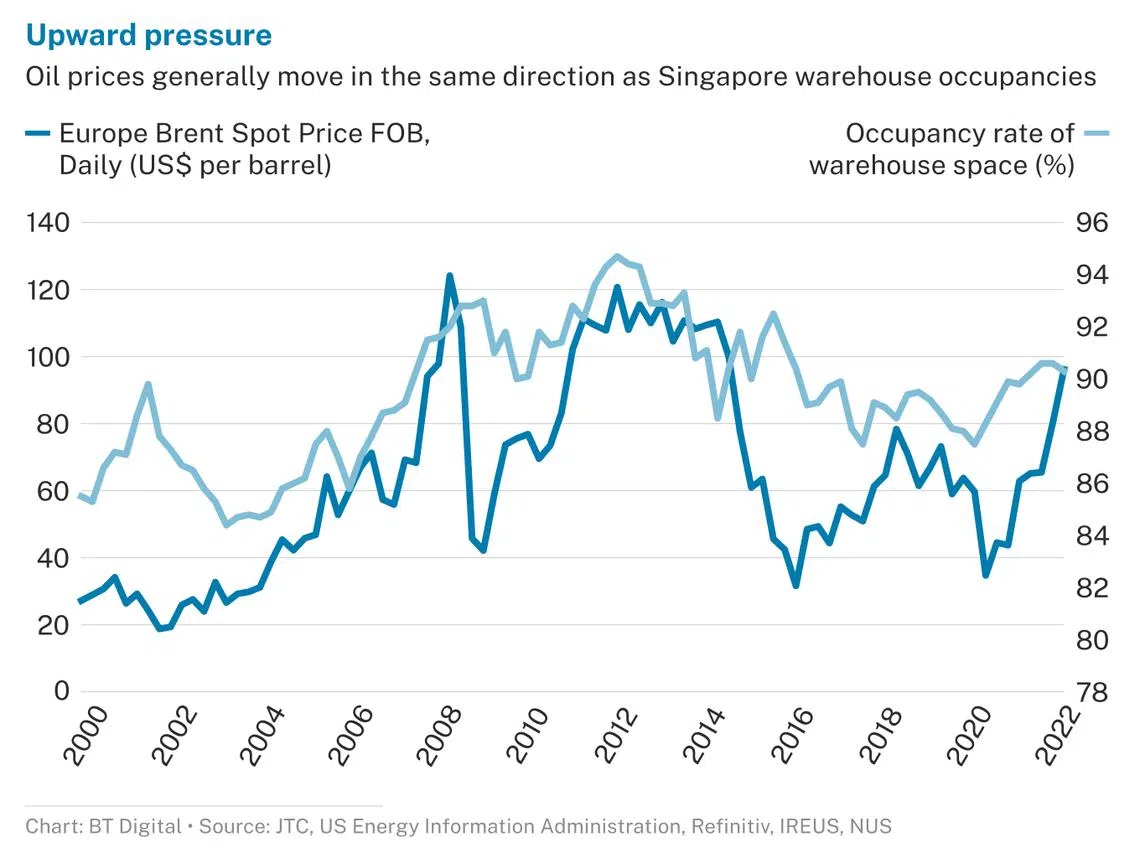
One of the more noticeable run-ups in oil prices began in 2006, partly fuelled by higher global consumption and the Iraq War, IREUS noted. The Europe Brent Spot Price FOB more than doubled to US$124.12 per barrel daily in Q2 2008, from US$60.05 per barrel daily in Q1 2006.
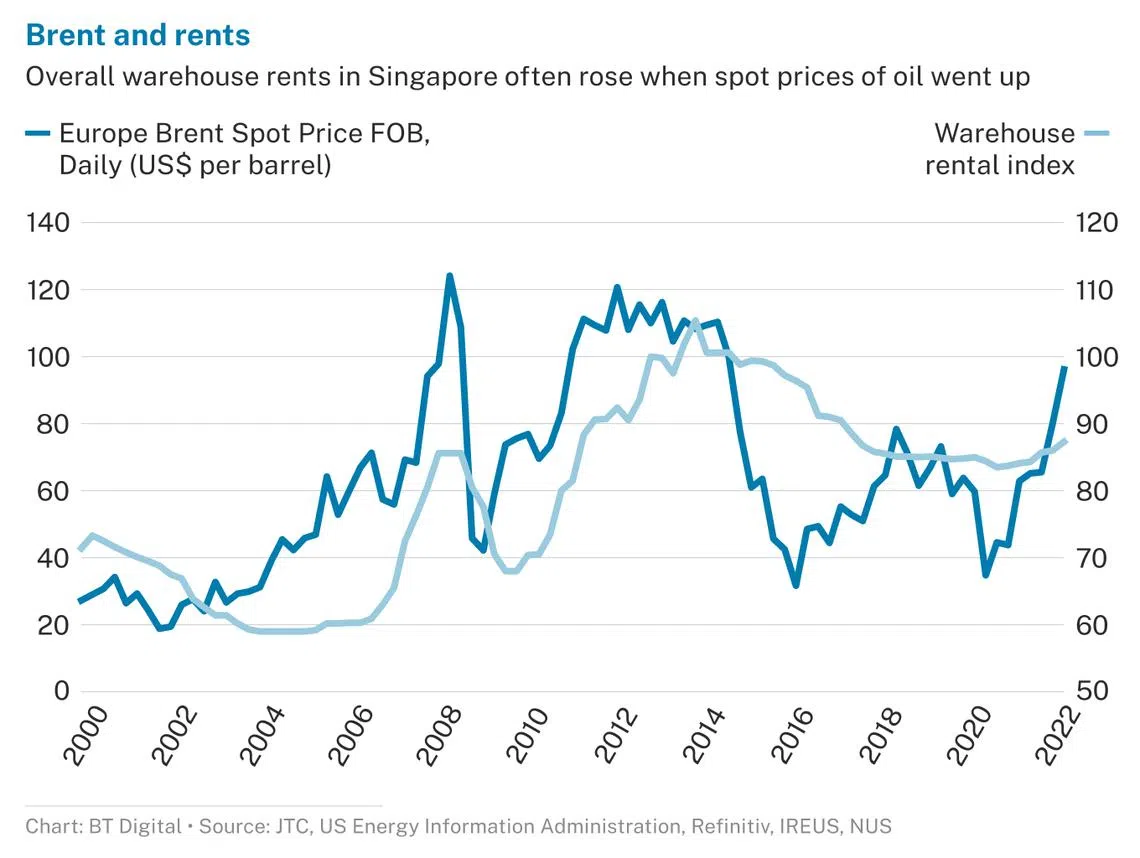
This oil price hike coincided with a sharp rise in warehouses’ occupancy levels, which grew 6.2 percentage points to 92 per cent in Q2 2008, from 85.8 per cent in Q1 2006. Correspondingly, the rental index for warehouses in Singapore jumped nearly 42 per cent over the same period.
Another significant surge was recorded from Q3 2010 to Q1 2012, following a short period of largely stable oil prices in Q3 2009 to Q2 2010. The Europe Brent Spot Price FOB gained some 64.2 per cent between Q3 2010 and Q1 2012, while warehouse occupancy went up by 3.4 percentage points to reach 94.7 per cent. Rents of warehouse space increased 25.7 per cent over the same period.
However, when oil prices decline, the occupancy rate of warehouses tends to be stickier, as it persists at a high level before dropping.
For example, in Q1 2016, Brent spot prices fell to US$31.66 a barrel, from US$110.35 a barrel in Q2 2014. In contrast, Singapore warehouse occupancies rose during that period, from 88.5 per cent to 90.4 per cent. IREUS noted that the effect is lagged; the occupancy rate subsequently eased to 87.5 per cent in Q3 2017.
Meanwhile, warehouse rents corrected when the oil price fell between Q2 2014 and Q1 2016, with the rental index slipping by 4.2 per cent.
Firms appear to seek more inventory space to store their goods and manufacturing inputs – such as raw materials – when oil prices surge, based on the time series in the analysis.
IREUS deputy director Lee Nai Jia said manufacturers are likely to acquire as many inputs as possible, to hedge against future hikes in shipping costs and price increases in secondary inputs.
As for trading or wholesale retail companies, they would want to stock up as much goods as possible to reduce the number of shipments needed, thereby putting a pressure on storage space requirements, he added.
“With e-commerce expected to grow at the same time, we may see rents for warehousing rise fast if new supply is quickly absorbed,” Dr Lee noted.
While introducing more warehouse space in the market seems to be a viable solution to help manufacturers lower their costs, he pointed out that the impact may be felt only at a later stage, given the inelasticity of supply. Building warehouses takes time, which means any increase in demand can only be satisfied after the new completions.
“Additionally, if oil prices were to decline subsequently, we may face an oversupply of storage space,” Dr Lee said.
In late April, JLL Singapore head of research and consultancy Tay Huey Ying wrote that the global supply chain disruptions and geopolitical tensions could lead to increased inventory holding and potential stockpiling of essential items, which could underpin near-term demand for logistics and warehouse space.
Edmund Tie head of research and consulting Lam Chern Woon has also highlighted that increased stockpiling requirements will drive the push towards supply chain diversification to mitigate cost pressures and operating risks as well as to strengthen manufacturing capacity.
In Q1 2022, rents of industrial developments in Singapore increased 1 per cent from the previous quarter and 2.4 per cent year on year, led by gains in the warehouse sector amid robust demand for ramp-up facilities. That was the strongest quarterly growth since Q3 2013.






