Singapore’s prime office rents in Q1 weighed down by global retrenchments, trade tensions
The marginal quarterly increase of 0.5% follows that of Q4, which was 0.4%

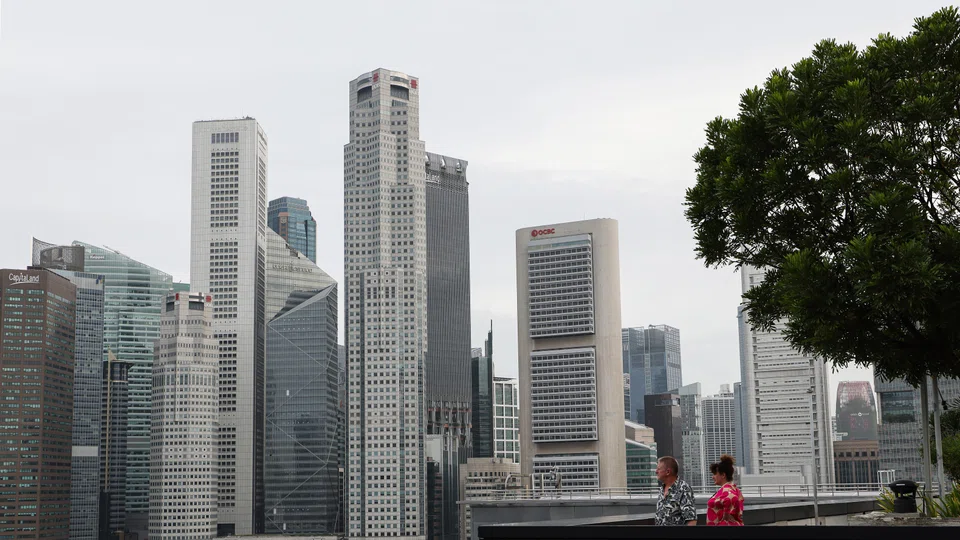
[SINGAPORE] Grade A Central Business District (CBD) rents flatlined for the fourth consecutive quarter as global volatility and trade tensions keep multinational corporations (MNCs) in a holding pattern.
In the first quarter of 2025, rents inched up 0.5 per cent to S$11.60 per square foot per month (psf pm), JLL Research indicated.
The marginal quarterly increase followed that of Q4 2024, which was 0.4 per cent. Rents were flat in Q3 and rose 0.7 per cent in Q2.
“This marks the longest period of such modest variation in rents since we began tracking this data series,” the JLL report noted. It added that Q1’s slight growth can be pinned on “the persistent challenging global economic climate, fuelled by escalating global trade conflicts and ongoing geopolitical tensions”.
Chua Yang Liang, JLL’s head of research and consultancy for South-east Asia, said: “The stability in CBD office rents can be attributed to a unique play of demand and supply factors in the post-Covid-19 market. While demand exists, it remains moderate due to ongoing market volatility.”
Based on Knight Frank’s basket of rents, prime office rents in the Raffles Place and Marina Bay precincts remained unchanged from the previous quarter at S$11.36 psf pm in Q1 2025.
On a yearly basis, rents increased by 1.4 per cent, moderating from the 3.4 per cent year-on-year growth recorded in Q1 2024.
Global firms in “holding pattern”
Calvin Yeo, managing director and head of occupier strategy and solutions at Knight Frank Singapore, noted that “most major global corporations headquartered in Singapore” would have likely remained “in a holding pattern” at the start of 2025.
This is “until more clarity surfaces in the global environment”, allowing these MNCs to make decisions on expansion or relocation, he added.
Presently, landlords continue to prioritise building occupancies, with uncertainty amplified by global trade tariffs.
Occupancy levels in the CBD stood at 93.5 per cent in Q1, a small drop from the 93.7 per cent in Q4, Knight Frank’s report showed.
The slight easing in occupancy could be due to the newly completed Keppel South Central, with a reported 50 per cent of the space committed or under negotiation.
JLL’s Chua said: “New completions like IOI Central Boulevard Towers and Keppel South Central, coupled with space availability resulting from companies right-sizing their office footprints, provided ample space options for occupiers.”
Moreover, following the completion of these two projects, the CBD office landscape is set for a supply pause; there are no substantial additions in the near term except for the Shaw Tower redevelopment in Beach Road, Knight Frank said.
“Although the timing of increased demand is uncertain, office occupiers should consider their options early to avoid getting caught in a potential rental upcycle, as the limited supply pipeline is likely to fuel landlord expectations, barring any unexpected economic downturns.”
Wong Xian Yang, Cushman & Wakefield’s head of research for Singapore and South-east Asia
Limited supply will pose a challenge for occupiers which need large spaces, especially those requiring close to 30,000 square feet (sq ft) with premium-grade facilities, said Yeo of Knight Frank.
Floor plates of such sizes are rare, making relocation for these large-footprint occupiers unlikely in the short to medium term.
Wong Xian Yang, Cushman & Wakefield’s head of research for Singapore and South-east Asia, said: “Over the next three years, CBD Grade A new office supply is expected to average 0.4 million sq ft annually, well below the 10-year historical net demand of 0.9 million sq ft per year.”
Subdued growth ahead
Measured flight-to-quality moves, however, are still expected, with some businesses anticipated to relocate when leases expire.
Knight Frank’s Yeo said: “For instance, a corporate occupier would weigh the three to five-year occupational cost of renewing an existing 20,000 sq ft of space in an ageing building against fitting out and moving to a smaller space in a newer, better-quality office, taking up 15,000 sq ft.”
Knight Frank expects prime rental growth to range between -1 per cent and 2 per cent for the whole of 2025.
According to the Ministry of Trade and Industry, Singapore’s gross domestic product grew 4.4 per cent in 2024.
“The growth will likely be more subdued in 2025, weighed down by risks that include... global uncertainty, which has now been exacerbated by trade tariffs and news of global retrenchment exercises at various MNCs, especially in the financial and technology sectors,” Yeo said.
JLL was cautiously optimistic that office space demand would stay positive in the coming quarters, as some companies look to expand their presence in South-east Asia to meet the growing demand for wealth management, advisory services, fintech and artificial intelligence solutions in the region.
Andrew Tangye, JLL’s head of office leasing and advisory, noted that Barclays recently announced it would establish Singapore as its second booking centre for its Asia-Pacific private banking operations by 2026. Standard Chartered has also declared plans to expand its wealth management services in the Republic.
Wong of Cushman & Wakefield said: “The constrained supply pipeline, combined with emerging demand, will likely continue to push CBD Grade A office rents upward...
“Although the timing of increased demand is uncertain, office occupiers should consider their options early to avoid getting caught in a potential rental upcycle, as the limited supply pipeline is likely to fuel landlord expectations, barring any unexpected economic downturns.”