Some 22 luxury condos linked to S$3 billion money laundering case resold for S$116 million since August 2024
About S$420 million, comprising cash and liquidated proceeds, has been paid into the Consolidated Fund as at end-March

[SINGAPORE] Since Singapore’s largest money laundering case concluded more than a year ago, several luxury condominium units previously owned by persons linked to it have been resold.
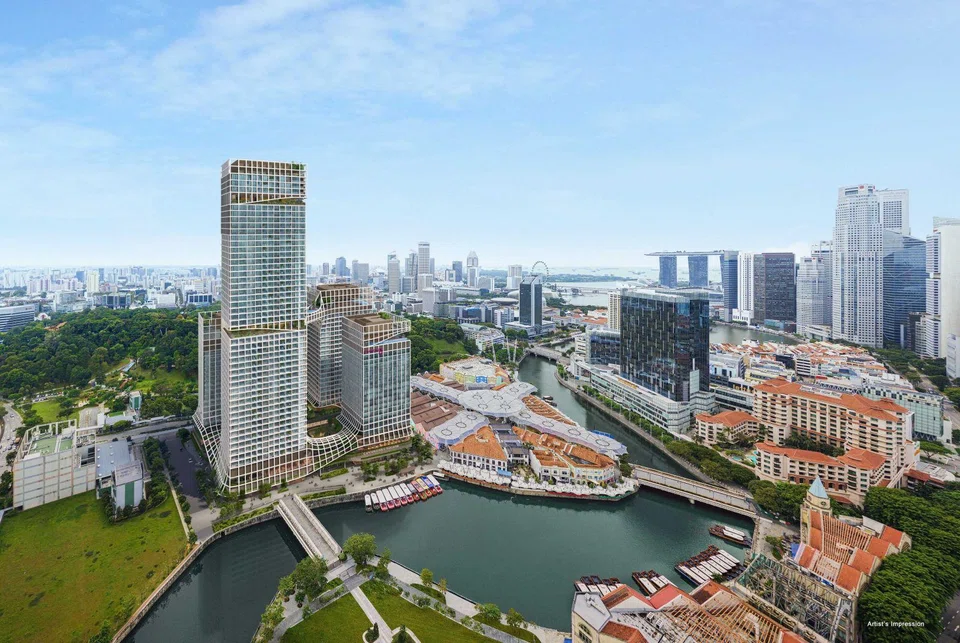
Seventeen units at CanningHill Piers in Clarke Quay owned by Wang Ruiyan and Wu Shuiying have been sold since August 2024 for a total of S$81.8 million, Urban Redevelopment Authority (URA) caveat data showed. Wang is the wife of convicted money launderer Vang Shuiming, while Wu is an associate linked to the case, which involved assets worth more than S$3 billion.
Also since last August, five completed units linked to persons in the case have been resold for S$34.2 million in total, bringing the total value of units resold to at least S$116 million.
In response to queries from The Business Times, the police said that about S$420 million, comprising cash held in bank accounts and other liquidated proceeds, has been paid into the Consolidated Fund as at the close of FY2024, or Mar 31, 2025. The fund is akin to a bank account held by the government, into which public revenues are paid and out of which public spending is made.
The liquidated proceeds come from the sale of assets, which were forfeited to the state by the 10 arrested foreigners and their associates.
According to the latest available figures, approximately S$2.79 billion in assets was surrendered. Of this, S$1.54 billion was in cash or financial assets, and the rest were non-cash assets, which includes properties, vehicles and luxury items.
BT understands that more than 207 properties connected to the case were issued prohibition-of-disposal orders.
Recovering sales proceeds
Market watchers believe that it is unlikely that the entirety of the S$116 million in sales proceeds from the units that BT found were linked to the case will go into the Consolidated Fund.
Around 1 to 2 per cent of the sales proceeds is usually paid to property agents as commission for resale transactions. Outstanding mortgage payments must also be repaid.
A seasoned real estate agent, who declined to be named, said that assuming the associates linked to the case purchased the units at CanningHill Piers at the project’s launch, they likely paid only around 30 per cent of the total purchase price before the August 2023 police crackdown, and prior to the issuance of the sale prohibition orders on the properties involved.
As CanningHill Piers is still under development, these buyers would not have finished making payments in accordance with the progressive payments schedule such projects follow.
In response to queries from BT, a CanningHill Piers spokesperson said: “To the extent permitted by regulatory requirements, any returned units, regardless of their circumstances, are released for sale at prevailing market conditions in the ordinary course of business. We are unable to provide details and conditions imposed by regulatory authorities for specific units.”
The units, which are currently under development, were all sold around S$200,000 to S$300,000 above the original prices they were purchased at. They were transacted under the “new sale” category, which URA defines as units sold directly by the developers.
Ten of the 17 CanningHill Piers units sold were four-bedroom units. The apartments, sized at 1,959 square feet (sq ft) each, were sold for S$5.6 million to S$5.7 million apiece. This price tag is comparable to those of the four-bedders at the recently launched The Robertson Opus in River Valley. At the Robertson Opus, four-bedder units spanning 1,539 sq ft, were sold from S$5.09 million.
On a per-square-foot (psf) basis, however, prices lagged slightly, with the 17 units at CanningHill Piers transacted at an average price of S$2,915 psf. The 999-year leasehold The Robertson Opus, meanwhile, sold 41 per cent of its 348 units at an average price of S$3,360 psf at its launch in July.
While the CanningHill Piers units were sold close to market value, some of the resale units belonging to the convicted launderers and their associates transacted for as low as 30 per cent below guide prices.
The luxury condominium units, located within prime projects in the Orchard area, were marketed by several agencies and auction houses, including Huttons, ETC and Knight Frank.
A four-bedroom unit on the 13th floor of Gramercy Park spanning 2,691 sq ft was sold for S$7.5 million, or S$2,787 psf, in March 2025. It previously belonged to convicted money launderer Su Baolin, who was sentenced to 14 months’ jail and deported to Cambodia last May.
The transaction price was nearly 20 per cent lower than the S$9.3 million guide price which Knight Frank had advertised in July 2024.
Another four-bedroom unit on the 14th floor of Gramercy Park, which spans 2,680 sq ft and belonged to Su Jianhua previously, changed hands for S$7.5 million or S$2,798 psf in June 2025, based on a URA caveat filed.
This was below the S$9.05 million that Su Jianhua, identified by the Ministry of Law as one of 34 individuals who could be linked to the case, paid for it in April 2022.
Two three-bedroom units on the 21st and 22nd floors in the same project were advertised for sale at S$7.4 million each last June.
The 22nd-storey unit transacted for S$5.7 million, or S$2,926 psf, in August 2025 – 23 per cent below its guide price. The 21st-floor unit was sold in an uncaveated transaction for S$5.5 million in April 2025, 25.7 per cent below the guide price.
The 21st-floor unit previously belonged to Su Lihong, another associate involved in Singapore’s largest money laundering case. She bought the 1,959 sq ft property for S$6.37 million in February 2018.
The unit on the 22nd floor was purchased by Su Shuiming in 2018 for S$6.43 million. He was one of 17 individuals who fled the country and agreed to forfeit their assets to the state.
Meanwhile, a New Futura four-bedroom unit on the 24th storey was sold in July 2025 for S$8 million. The former owner is Chen Qingyuan, another convicted money launderer.
This was 30 per cent lower than the S$11.38 million guide price at which it was launched by ETC for sale last October.
Limited impact on pricing
The prices of properties sold at auctions tend to be lower than in the market, as buyers view them as “bargain hunting” opportunities, noted Linda Chern, CBRE Singapore’s head of residential services. This is especially the case if the properties had already been put up for sale in several rounds.
The pool of buyers for these high-end units would be limited due to their high quantum, and potential purchasers may expect significant discounts if the units are perceived as having negative associations, added Tricia Song, CBRE head of research for South-east Asia.
Alan Cheong, executive director of research and consultancy at Savills Singapore, also said that a unit which was previously occupied would have a lower appreciation in price, compared with those which are under construction or newly completed.
The lower-than-market prices of transacted properties will be taken into consideration by valuers and buyers in benchmarking comparables, said Song.
Cheong added that their sale would likely affect sellers of properties of similar size and quality in the resale market.
However, the resold properties are unlikely to have much of an impact on the broader market. In the third quarter, the prices of non-landed properties in the Core Central Region (CCR) rose 2.4 per cent, based on URA flash estimates. This was slower than the 3 per cent pace of growth in the previous quarter.
Song said: “It appears that the luxury and CCR market prices have stabilised. The new launches, such as Upperhouse at Orchard Boulevard, doing well at high prices may have also supported sentiment.”