Taking Singapore’s commercial heart beyond the CBD – a mixed picture
The government’s push for more decentralised commercial spaces has had some favourable results but its overall success is yet to be seen

FROM Tampines in the east to Jurong in the west, several “decentralised” commercial spaces across Singapore have sprung up over the years as part of government efforts to expand the city’s business ecosystem with job nodes across the island.
But the jury is still out on whether the push to move business activity outwards has been successful, said some real estate consultants and human resource management groups that spoke to The Business Times.
In the past five years, much of Singapore’s decentralisation has been done through the Government Land Sales (GLS) programme, various incentive schemes and the government’s office strategy, said Edwin Loo, real estate consultancy Cistri’s associate director with an expertise in urban planning.
As the effective sole provider of development land to the private sector, the Urban Redevelopment Authority (URA) has been releasing more office and office-led mixed-use sites outside the CBD, in locations such as Jurong Lake District and Woodlands, Loo explained. The last office-led GLS site to be sold in the central area was at Central Boulevard in 2016, where IOI Properties’ Central Boulevard Towers now stands.
Schemes such as the CBD Incentive Scheme are specifically designed to encourage the redevelopment of existing, obsolete office buildings in the CBD into residential and hotel-led mixed-use developments, he said. “Reducing the supply of existing office stock within the CBD…should in theory put demand for office towards other locations,” he added.
At the same time, several ministries and statutory boards such as the Ministry of Transport, the Land Transport Authority and the Ministry of Sustainability and Environment are looking at potentially relocating to these decentralised locations, he said. “The theory behind this is that related clusters of firms would follow in turn once a government or government-linked tenant is able to prove that the location works for office use,” he explained.
“From an urban planning perspective, (decentralisation) optimises the use of our transportation infrastructure by redistributing demand at peak times,” Loo added. “It also provides other intangible benefits such as shorter commutes for residents and a wider variety of housing choices in locations such as the CBD by freeing up land previously occupied by office developments for housing.”
Potential cost savings
There are also potential cost savings when renting office space outside core business areas.
Latest data from URA showed that the monthly median rent of Category 1 offices, based on contract date, was S$11.73 per square foot (psf), nearly double the S$6.21 psf for Category 2 offices in Q3. Category 1 offices refer to better-quality buildings in the city area, while Category 2 covers the remaining office space in Singapore.
David Blasco, Randstad Singapore country director, added that a decentralised office location could bring companies closer to specific business networks that could benefit their growth. “For example, Biopolis is host to a wide array of biomedical sciences and research companies that are strategically located close to several universities and hospitals,” he noted.
But a mixed picture has emerged on the ground.
According to Colliers research head Catherine He, the decentralisation push has mainly worked in sectors such as technology, insurance and bank operations.
But certain corporate occupiers in the CBD – such as law firms, banking and finance, and professional services – are still resistant to relocating to the suburbs, she said.
The vacancy rate for Grade A offices was also lower than that of the suburbs in Q3, at around 6 per cent versus the suburbs’ 8.7 per cent, Colliers data showed. In Q2, the difference was even larger, at 2.3 per cent for core CBD Grade A offices versus 9 per cent in the suburbs.
Leonard Tay, research head at Knight Frank, noted that the proportion of offices found outside the CBD remains unchanged in the past 30 years.
In 1993, some 10.2 per cent of offices were found outside the central area and 23.3 per cent in the fringe. Today, about 9.2 per cent of offices are located in the suburbs, and 24.5 per cent in the city fringe.
This is even though the amount of office space located outside the CBD nearly doubled to 29.5 million square feet in Q3, from 15.8 million sq ft in 1993.
The majority of office space at 66.3 per cent continues to be located in the central area, showing that Singapore’s decentralisation movement has not made much of an impact in distributing commercial activity out of the CBD, said Tay.
ManpowerGroup Singapore’s country manager Linda Teo said a CBD address is still valued by companies, thanks to its convenience for visiting clients and the networking opportunities it offers business and industry leaders.
The CBD also has excellent infrastructure, including efficient public transportation, diverse dining options and other essential amenities, said Teo. “Decentralised locations may not yet offer the same range and variety, potentially having a negative impact on employee satisfaction and productivity.”
And with the CBD generally equidistant to most residential areas in Singapore, the average commute time is just over an hour for most people, said Knight Frank’s Tay.
When a major decentralised business node is created at one end of the island, staff commute becomes imbalanced with some having the convenience of proximity and others having their travel times doubled, he said.
Not fully on board
Developers do not seem fully on board either, as evidenced by the September tender results of the 6.5 hectare JLD site. A five-member consortium’s bid for the mega white site that would kickstart development of the new business district was rejected as it was “too low” at S$640 psf per plot ratio.
Tricia Song, CBRE head of research for South-east Asia, said the poor bidding outcome highlights the perceived high risks of insufficient office demand to meet the proposed supply.
“This pessimism could be attributed to the rise of hybrid work trends, which have diluted demand,” she added. “Consequently, developers are adopting a more cautious approach and may lack the confidence to enter the market at present.”
Decentralisation may not make economic sense for developers, pointed out Alan Cheong, executive director of research and consultancy at Savills Singapore.
Since many of these decentralised commercial buildings are built at “tomorrow’s prices”, which is at a high base cost, owners would need to charge higher rents to earn positive returns, he said.
But even if rents were to be half of the CBD’s – which is unlikely due to high construction costs today – they are still “way off their meter” when translated to regional currencies and compared to Grade A CBD offices in those other countries, said Cheong. “Factoring in wages, does one think that it will be viable – especially for shared services that often find a niche in decentralised locations?”
Lower office rents in a decentralised location also means a lower capital value for the completed office development, Loo of Cistri said.
“It is not cheaper to build a tower in Jurong compared to Shenton Way.”
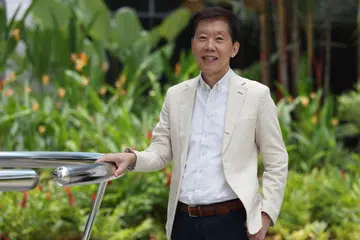
Cistri associate director Edwin Loo
Yet construction costs across Singapore are the same. “It is not cheaper to build a tower in Jurong compared to Shenton Way,” added Loo. This eats into the profitability of decentralised office projects.
Even though the government is committed in its vision, the concept has not yet been proven beyond reasonable doubt among commercial occupiers in the city, said Tay. He noted: “The reticence shown by the private sector can be understandable, especially if the government is calling on private sector developers to shoulder a substantial share of development risk.”
Cheong reckoned that Singapore may be too small a country for offices to be decentralised en masse, given the small local population and its slower growth rate. “You may have small pockets of office space in certain regions, but to have office space up to a million square feet of net lettable area is a bridge too far.”
“The established infrastructure and amenities are still densely located in the CBD, and trying to undo over a century of that imprint is going to expand a tremendous amount of energy – which then leads one to ask whether the benefits are worth it,” Cheong added.
TRENDING NOW
MAS allocates S$1.45 billion to five asset managers in third EQDP batch: Chee Hong Tat
‘My grandfather’s legacy’: Sherman Kwek lays out three-year plan for CDL to drive returns
He built the Vingroup empire. Now South-east Asia’s richest man is handing some key roles to his sons
‘How many will survive?’: Bubble fears arise as China’s humanoid robotics face reality check