Time is running out for Singapore’s oldest HDB flats as prices flatten and demand slows
As demand dwindles for older HDB flats, questions remain over how a voluntary redevelopment scheme will change the market

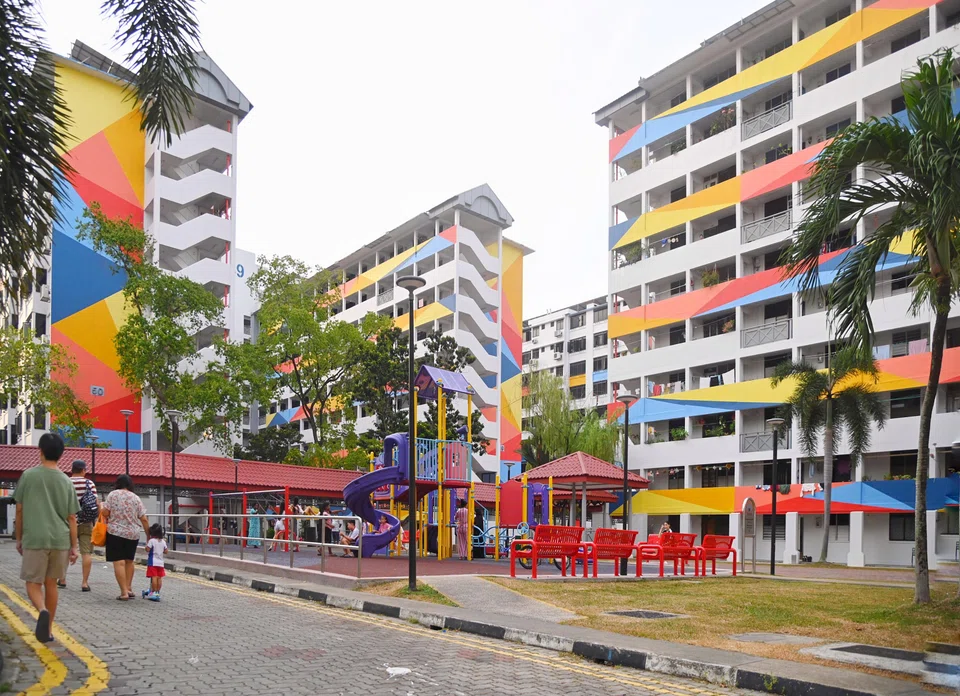
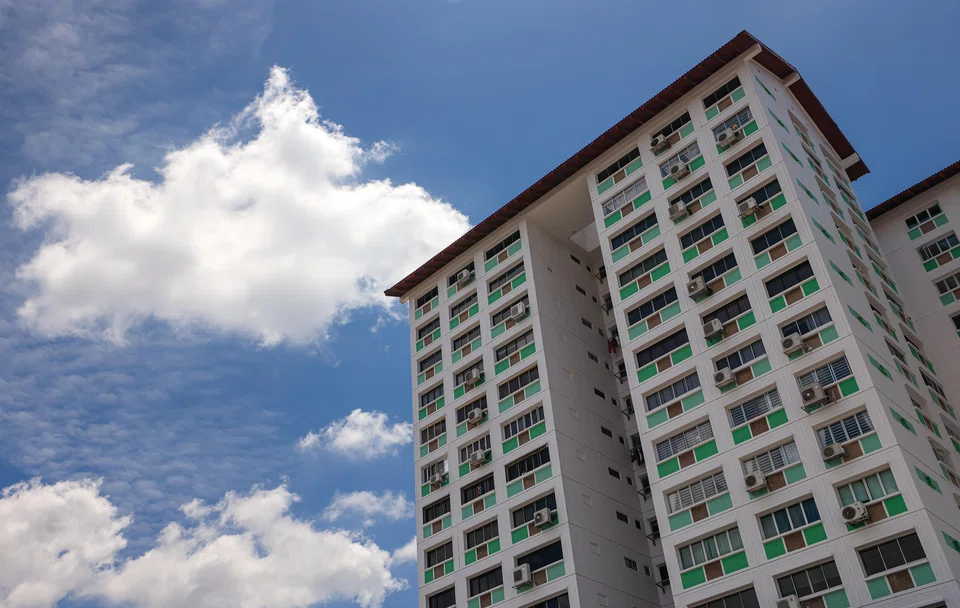
[SINGAPORE] Nearly 300 blocks of Singapore’s oldest Housing & Development Board (HDB) flats are entering the final 30-year stretch of their 99-year leases – and data points to a shrinking resale market and flattening prices for these ageing properties.
Asking prices and resale values for the first HDB flats built in the 1960s have held up as the resale market on the whole continued to rise, especially over the last five years. But set against the broader market and compared to valuations, the picture is less rosy.
Data crunched by property listing platform PropertyGuru for The Business Times indicates that median asking prices of HDB flats built in the 1960s held steady in the past year, up 1.6 per cent to S$375,000.
ERA key executive officer Eugene Lim said many of these old flats in sought-after mature estates witnessed substantial price growth in the last five years despite their age, in tandem with the overall resale market.
In the first seven months of 2025, the median price of three-room flats built in the 1960s ranged from S$335,000 to S$380,000 – up by between 30 per cent and 60 per cent compared to their median in 2020 at between S$220,000 and S$275,000. That of two-room flats likewise rose from S$188,000-S$207,000 in 2020, to S$285,000-S$301,888 in 2025.
Old four-room flats in Queenstown even hit a median price of S$899,000 in 2025, though Lim noted that the transactions were for terraced houses, which are rare and tend to draw high prices.
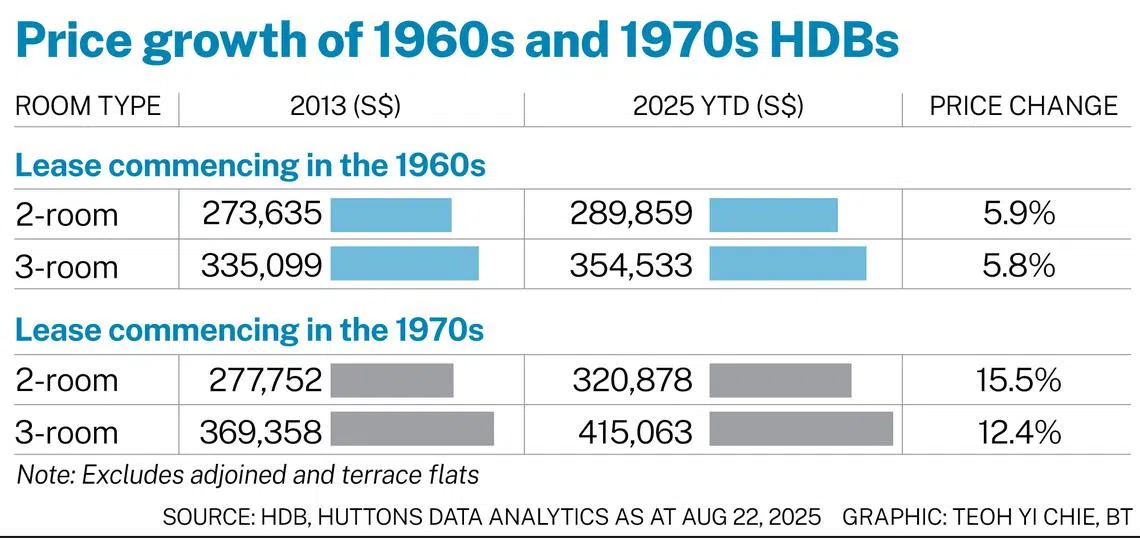
Set against a longer time frame, gains shrink. Huttons Asia senior director of data analytics Lee Sze Teck pointed out that compared to 2013, prices of the oldest two-room and three-room flats are 5.8 to 5.9 per cent higher today.
In comparison, prices of two-room flats built in the 1970s rose by 15.5 per cent between 2013 and 2025, and that of three-room flats by 12.4 per cent.
Dr Lee Nai Jia, head of real estate intelligence at PropertyGuru Group, noted that the 1.6 per cent rise in asking prices for the 60s era flats is modest compared to the 10.3 per cent increase observed in the broader resale market.
Nicholas Mak, chief research officer at property portal Mogul.sg, pointed to a mismatch between sellers’ expectations and valuations of these old HDBs.
Figures from Mogul.sg showed that the median asking price of 1960s HDB flats ranged from S$309,000 to S$1.75 million this year, with the lowest for two-room flats and the highest for terraced houses. The median asking price of three-room flats, which comprised the bulk of listings on the portal, was S$388,888.
Meanwhile, median valuations ranged between S$316,000 and S$847,000 for these flats.
“This suggests that two-room flats may be underpriced on the market, whereas five-room flats and terraced houses appear to be overpriced,” said Mak. Three-room flats, in particular, had a median valuation of S$336,000, which was far below their median asking price of S$388,888.
Lee from PropertyGuru said demand for 60s era flats has been trending downwards.
According to the platform’s data, impressions – or views – on resale listings for the oldest flats fell about 28 per cent year on year, a sharp drop compared to the overall resale market.
As the government ramps up new public housing supply, Lee reckoned that demand for these older flats will only continue to dwindle, potentially placing downward pressure on prices.
ERA’s Lim noted that transaction activity for these older flats has remained fairly stable in the past decade, ranging from 219 to 300 units a year. On average, 263 homes built in the 1960s change hands annually.
In the first seven months of 2025, 170 units were sold – tracking within historical norms.
Fewer transactions does not necessarily reflect weaker demand, and could be due to a limited supply of flats for sale, said Lim.
On the rental front, Lee from PropertyGuru said listing impressions generally tracked the overall HDB rental trend.
“While rental demand saw a decline from 2023 to 2024, it appears to have stabilised in 2025,” said Lee. Listings were typically room rentals, with average asking rent of around S$1,100 per month as at July 2025.
Cashing out
Seniors seeking more immediate ways to monetise their homes can turn to HDB’s lease buyback scheme (LBS).
Under the scheme, eligible seniors can sell part of their flat’s remaining lease to HDB, with proceeds topping up their CPF Retirement Account and purchasing a CPF Life plan, which provides monthly payouts for life. Any excess will be returned to them in cash,
As at Dec 31, 2024, 13,734 households have taken up LBS. Of these, about 52 per cent lived in three-room or smaller flats, around 34 per cent lived in four-room flats, and the remaining 14 per cent in five-room or bigger flats.
The vast majority of households at 90 per cent retain lease lengths of 20 to 30 years, said HDB, allowing seniors to “supplement their retirement income while ageing”. The remaining households were evenly split between 15-year and 35-year leases.
HDB added that after selling part of their remaining leases to HDB, around nine in 10 households received proceeds of between S$100,000 and S$300,000.
This value is before the top-up to their CPF retirement account, and depends on the market value of the flats and duration of the lease retained, it said.
Seniors can also receive a cash bonus when they right-size to a smaller public housing flat with the silver housing bonus. As at Dec 2024, 2,535 households have benefitted from the bonus.
Ageing flats, shrinking value
Figures from ERA indicated that there are 299 HDB blocks built in the 1960s, with 24,428 units in total. Most are concentrated in Queenstown, Toa Payoh, Bukit Merah and Geylang, with smaller clusters in Kallang Whampoa and the Central area.
One of the government’s objectives when it launched the public housing programme in the 1960s was to ease overcrowding in the city centre by providing affordable flats in the city fringe area, Mak said.
Most of these 60s-era flats are three-room and four-room flats, statistics from Mogul.sg showed.
Analysts expect these ageing flats to follow the trajectory observed in older private leasehold homes.
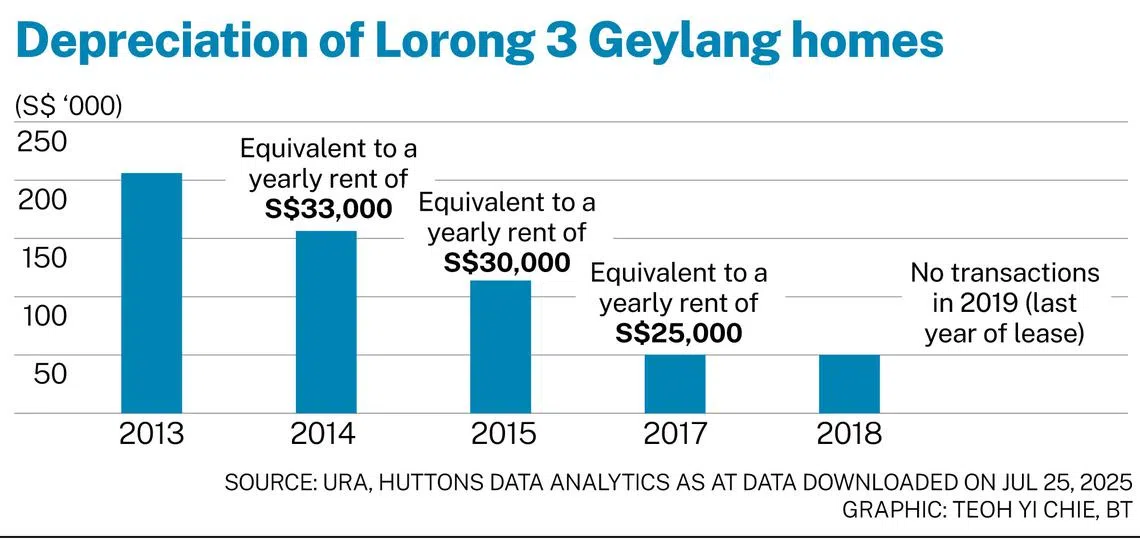
According to Huttons’ Lee, prices of 60-year leasehold terraced houses at Lorong 3 Geylang tapered off sharply as their leases came to an end.
In 2013, units transacted for over S$200,000. This fell to just over S$150,000 in 2014, equivalent to annual rent of S$33,000; declining further to over S$100,000 in 2015, equivalent to annual rent of S$30,000; before dropping to around S$50,000 in 2017 and 2018, equivalent to annual rent of S$25,000.
The land occupied by these houses returned to the state when their leases expired on Dec 31, 2020.
Singapore attempted to address issues related to rebuilding ageing housing estates with the selective en bloc redevelopment scheme (Sers), launched in 1995.
Under the compulsory scheme, old HDB blocks were demolished and rebuilt. Homeowners were compensated based on market value and given the option to buy a replacement flat nearby with a fresh 99-year lease.
In 2022, households in Ang Mo Kio whose flats were picked for Sers received compensation of up to S$450,000. Those flats were completed in 1979 and were about 43 years old then.
On top of that, flat owners received a grant of S$30,000, a removal allowance of S$10,000, and payment of stamp and legal fees for the purchase of a replacement flat equivalent in value to their Sers flat.
Mak said the “attractive terms” led some buyers to pay “top dollar” for flats aged 40 years or more, in hopes of being picked for Sers.
“(It) cultivated the mindset among HDB resale flat buyers that Sers is some sort of safety net for owners of older flats,” he said, “a kind of government bailout for owners of ageing flats”.
This fuelled price growth of these older flats, said Mak. “However, Sers is an expensive exercise for the government, and with the growing number of ageing flats, it is unsustainable in the long run.”
Earlier in August, Minister for National Development Chee Hong Tat said the government does not plan to continue Sers, but instead will focus on a voluntary early redevelopment scheme (Vers), first surfaced in 2018.
Analysts said this could prove tricky. If the scheme mirrors private collective sales, it may be difficult to secure the 80 per cent consent required from owners, with thorny questions over how to handle those who refuse.
Residents who collectively decide not to proceed with it may live in their flats until the leases run out, Chee said. “The government will support them in other ways to keep their flats and their estates liveable and vibrant.”
Compensation is another sticking point.
Valuations are expected to be guided by market benchmarks, but leasehold values fall steeply as leases run down. Lee from Huttons cites the leasehold table informally known as Bala’s Curve in real estate circles.
Based on the table, the value of land with 30 years remaining is 60 per cent of the freehold value, said Lee. This plunges to 30 per cent when only 10 years remain.
Older flat owners may not want to move or sell if it means having to get in line for a new Build-to-Order flat, or pay for a higher-priced resale flat. “The level of interest may be lukewarm, and prices may remain relatively flat during this period of uncertainty,” said Lee.
Vers could still appeal to those seeking a more affordable home with “a potential safety net”, said PropertyGuru’s Lee. “Over time, Vers may help stabilise demand for older flats and offer a monetisation option for households who may need it.”