

Tough 2024 for suburban business parks with rising vacancies; muted growth for industrial rents in 2025
Most industrial submarkets can expect to grow by 2 to 3% next year – but not business parks in the suburbs

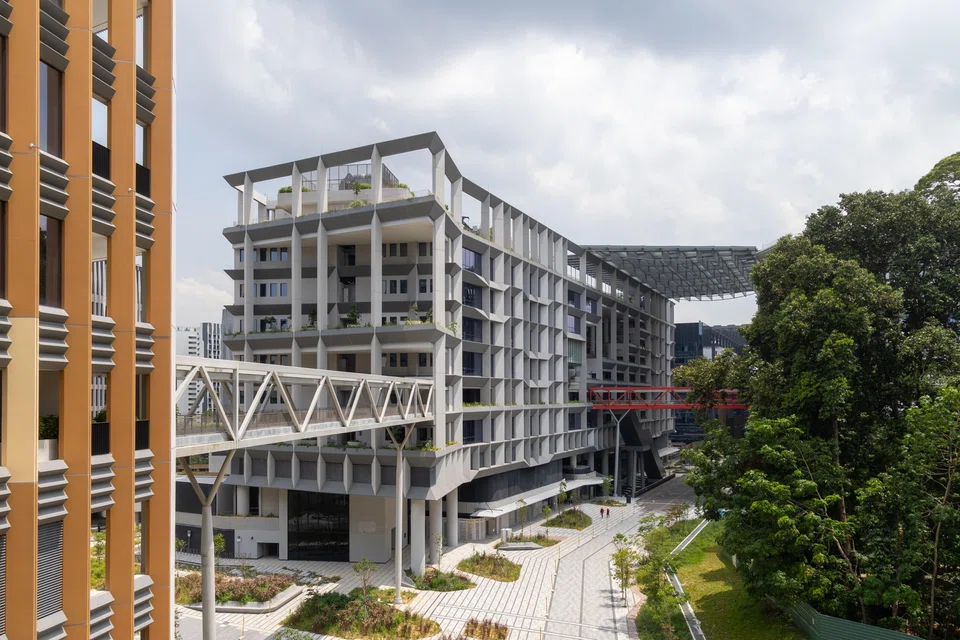
THE business park segment in Singapore has faced challenges in 2024.
It was besieged by concerns about whether new space in the pipeline could be absorbed, and increasing vacancy rates due to consolidation activities among companies looking to cut costs and use the workspace more efficiently.
Islandwide vacancy rates for business parks rose to 21.1 per cent in Q3 2024, from 19.5 per cent in the year-ago period. The amount of vacant space was much higher for suburban business parks, at 32.2 per cent, against the 8.6 per cent vacancy rate in city-fringe business parks.
Business parks on the city fringe remained popular with tenants because of their better connectivity to public transport nodes, their proximity to the Central Business District and access to amenities.
Graeme Bolin, CBRE’s head of occupier and leasing, industrial and logistics services, said that the city-fringe business parks’ relatively newer and modern developments made them more attractive for eligible tenants.
Brenda Ong, head of logistics and industrial for Cushman & Wakefield (C&W), added that they commanded a higher gross effective rent of S$6.21 per square foot per month (psf pm), compared to S$3.46 psf pm for spaces in the suburbs in Q3.
Colliers Singapore’s head of research Catherine He noted that the much stronger performance by city-fringe business parks was driven by a “flight to quality”, which depressed the rents in the outlying and older business parks.
“In a slow market and with increasing competition, some landlords have also adjusted their rental expectations and are throwing in incentives such as fit-out solutions or rent-free periods. With more options, business park tenants are now in much better bargaining positions,” she added.
Tricia Song, CBRE’s head of research for South-east Asia, noted that the new space from Punggol Digital District (PDD) and One Science Park Drive – projected to be completed between Q4 2024 and 2025 – spans about 2.6 million square feet (sq ft) and represents nearly 11.7 per cent of the current inventory islandwide.
She added that economic challenges, high costs and work-from-home measures will further dilute occupiers’ space requirements.
Despite these challenges, she believes that the business parks sector remains attractive to new-economy industries. Song predicts that the high-growth biomedical sector and a potential recovery in the tech industry could drive demand for business park space.
City-fringe business parks rents are forecast to grow by around 2 per cent year on year in 2025, while suburban business parks rents are expected to record “flat growth”, given the expected surge of new business park supply, said C&W’s Ong.
Factory space
In the single and multiple-user factory segments, restructuring led some manufacturers to downsize or shut their Singapore operations in 2024, said Chua Yang Liang, head of research and consultancy for Singapore and South-east Asia at JLL.
The occupancy rate for single-user factories was 87.7 per cent in Q3 2024, lower than the 88.2 per cent in the year-ago period.
Among multiple-user factories, it was 91.6 per cent in Q3 2024, up from 89.7 per cent in Q3 2023.
While JTC’s multiple-user factory rental index rose for the 16th consecutive quarter in Q3 2024 on the back of lower vacancy, this was the slowest quarter-on-quarter (qoq) growth in 11 quarters, reflecting tenants’ cost sensitivity, noted Chua.
Meanwhile, JTC’s single-user factory rental index eased by 0.3 per cent qoq in Q3 2024, after rising for 15 successive quarters. Chua attributed the decline to the rise in the vacancy rate and businesses’ cost sensitivity.
Data from Colliers showed that average factory rent was S$1.68 psf pm in Q3, up 0.6 per cent from the same period last year.
The consultancy firm said that despite a spike in the supply of factories in 2025, many of the upcoming factories are of the single-user type, which have already been pre-committed and will not impact the market significantly.
In 2025, there will be new supply of 479,000 square metres (sq m) and 291,000 sq m of single and multiple-user factories, respectively.
This is higher than the 77,000 sq m for single-user factories and 15,000 sq m for multiple-user factories in 2024, based on official statistics.
The pressure from subdued demand, coupled with an increase in supply, is expected to further temper the growth in rentals in the factory space for the year ahead.
Overall annual industrial rent will grow moderately in 2024, said Colliers, at between 2 and 4 per cent, versus 8.9 per cent in 2023.
Logistics
In the prime logistics segment, rents grew 1.1 per cent in the first six months of 2024, and came to a pause in Q3 2024 at S$1.87 psf pm.
Growth has moderated as occupiers consolidated amid inflationary pressures, noted CBRE’s Song.
Occupancy at prime logistics properties declined to 94.6 per cent in Q3 2024, from 99.8 per cent in the last quarter of 2023.
This was driven by new project completions during the first quarter of the year and consolidation activities, which increased the availability of smaller spaces and units in satellite locations.
She added that landlords have adopted a “more accommodative stance, prioritising occupancy rates”.
Capital values for leasehold prime logistics assets have remained resilient, rising by 0.9 per cent yoy due to strong investor interest. “Yields for these assets have remained almost flat in 2024 as both rents and capital values increased in tandem,” she said.
More than five million sq ft of new supply for prime logistics space will come on stream in 2025.
Although occupancy rates are projected to decline due to these new completions, CBRE estimates that more than 60 per cent of the upcoming space is already pre-committed.
Song expects rental performance in this segment for 2025 to align with 2024’s anticipated full-year growth of 1.1 per cent.
Capital market
JLL’s Chua said that as at November, the industrial investment sales market had achieved S$6.24 billion in industrial property sales, 161 per cent higher than the S$2.39 billion recorded in 2023 – and surpassing the previous peak of S$5.23 billion in 2011.
Rimon Ambarchi, head of industrial and logistics services at CBRE, said these transactions were driven by investors seeking stable, income-generating returns due to the positive carry above the cost of debt, and reflected robust demand for leasehold industrial assets in Singapore.
“Despite higher interest rates and economic uncertainties, investors are attracted by the stability and growth potential of Singapore’s industrial market,” he added.
Outlook
C&W’s Ong expects most of the industrial submarkets, except suburban business parks, to grow around 2 to 3 per cent in 2025, given the resilient economic growth, lower interest rates and positive manufacturing sentiments.
While industrial rental growth is expected to moderate next year, many industrial properties could still see positive rental reversions as their leases come up for renewal, given the robust industrial rental growth in recent years, she said.
CBRE’s Ambarchi projects industrial yields and prices to remain stable next year, and investment interest in industrial properties to remain strong with anticipated interest rate cuts to further support investor sentiment.
TRENDING NOW

Once staunchly pro-China, Malaysian Chinese businesses are now distancing themselves from Beijing

The middle power moment arrives in South-east Asia – but not for Asean

DBS, OCBC, UOB face rate hike reality check

Vietnam’s northern provinces, not Hanoi or Ho Chi Minh City, are powering near 10% GDP growth

