

UK apartment owners getting locked out of money-saving green tech
It risks undermining the UK’s aim of decarbonising the energy system
[LONDON] Millions of apartment owners in England and Wales are being shut out of money-saving technology like heat pumps and solar panels. It’s a financial obstacle for individuals that also risks undermining the UK’s aim of decarbonising the energy system.
Alex Harris hadn’t even completed the purchase of his apartment in the UK city of Cambridge when he first asked for permission to install solar panels.
The 30-year-old, who works for a renewables company, said his motivations were simple: “Save money, reduce carbon and just do the right thing.” But the request was swiftly turned down by Cambridge City Council, which owns the small block where he now lives. His enquiry about fitting a heat pump was also turned down, as was a plea for an electric-car charger.
That means he’s missing out on savings. By one calculation, access to these three technologies, plus home insulation and an electric car, would save the average British household nearly US$26,662 over a decade. But after two years of discussions with the council, which is targeting net-zero carbon emissions by 2030, Harris is no further forward. “There’s been absolutely no change in the situation,” he says.
Harris may be a homeowner, but he’s also a leaseholder. Like millions of others in England and Wales, he has bought the right to live in his apartment for a set number of years – but doesn’t actually own its walls or roof. Those belong to the freeholder, who is also responsible for building maintenance.
In a statement, a spokesperson for Cambridge City Council said that the situation for leaseholders wanting to install green technologies was complicated, because changes had to benefit and be paid for by all leaseholders living in a building. The spokesperson added that the council recognises that this is an area requiring improvement.
Apartment owners tend to be relatively young, with less disposable income than older homeowners. The UK has some of the highest energy costs in the world, with gas prices up 53 per cent in the past five years. Energy security is also a growing concern; interest in solar and electric cars has risen since the war began in Iran earlier this year.
Energy-efficient technology like heat pumps can save homeowners money directly, plus households with electric heating, batteries and solar can increasingly benefit from energy pricing that rewards storing up power at cheaper, off-peak rates to use at expensive times.
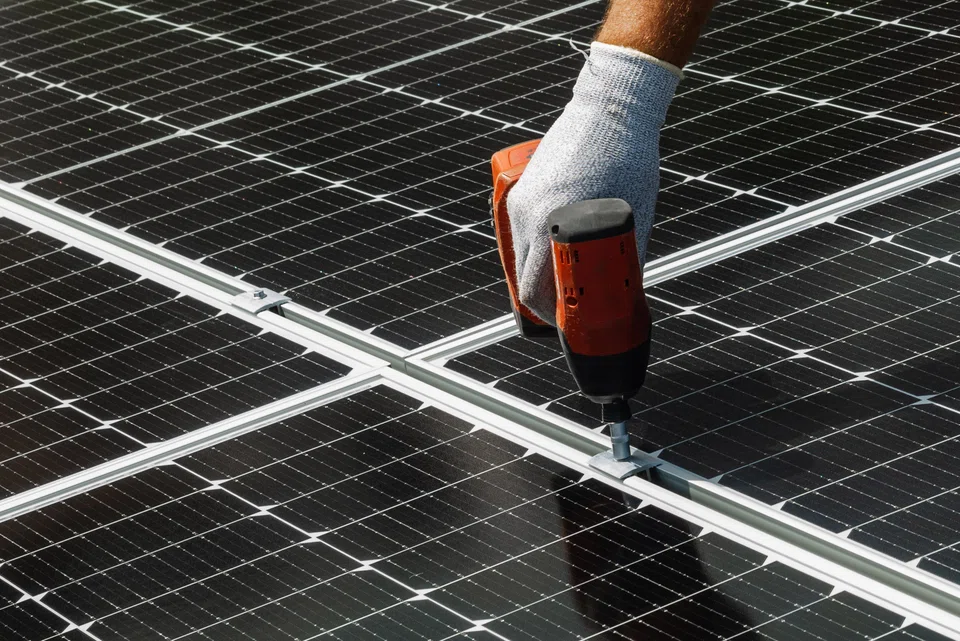
The problem is that many green technologies require building modification. Solar panels need to be affixed to a roof, which isn’t owned by the leaseholder. Heat pumps require drilling through walls, while electric-car chargers would be placed in a communal area that is owned and managed by a freeholder. It’s also difficult to add cooling measures like air conditioning or external shutters, for the same reasons.

Information on how often freeholders reject installation requests is limited. But UK apartments are lagging houses in terms of installation rates. Some 3 per cent of buildings in England containing apartments have rooftop solar panels installed, compared with 7 per cent of houses, according to government figures, while five times as many houses have heat pumps.
“If we all had electric cars and solar panels and a battery, the cost-of-living crisis would already be over,” says Adam Bell, a partner at consultancy Stonehaven who focuses on energy. For a typical household spending around £1,600 (S$2759.47) a year on home energy and £1,200 on a gas car, going electric could save about £1,500, he says.
Younger homeowners are also often more open to clean-energy tech than their older counterparts, according to Nesta, a UK-based nonprofit that researches the energy transition.
If this segment of the population is held back from installations, “it’s going to be very difficult for the government to meet targets, which would help them to meet their legally binding carbon budgets,” says Katy King, a director at Nesta. Many leaseholders don’t realise that their rights are so restricted, she adds.
Freeholders – who may be individuals, corporations, public bodies, investors or pension funds – are required to accept “reasonable” requests from leaseholders for building modifications, but the regulations don’t define the term clearly, King says. Many freeholders are unfamiliar with green technology and some are concerned about what could go wrong, King has found when conducting focus groups. In addition, freeholders generally don’t see the savings or other benefits of an installation.
Freeholders who do approve heat pumps and other tech sometimes charge leaseholders additional fees for this permission, says King. Apartment owners also have to comply with stringent rules on unit size, noise and placement. BLOOMBERG
Decoding Asia newsletter: your guide to navigating Asia in a new global order. Sign up here to get Decoding Asia newsletter. Delivered to your inbox. Free.
Share with us your feedback on BT's products and services
TRENDING NOW

ComfortDelGro appoints two new independent directors

Once staunchly pro-China, Malaysian Chinese businesses are now distancing themselves from Beijing

NoonTalk needs continued financial support from CEO Dasmond Koh, auditors warn

DP Architects sets the benchmark for sustainability disclosure and design

