

Underwater mortgages force China’s banks to get more creative
The local institutions are working to limit the damage of a yearslong property crisis
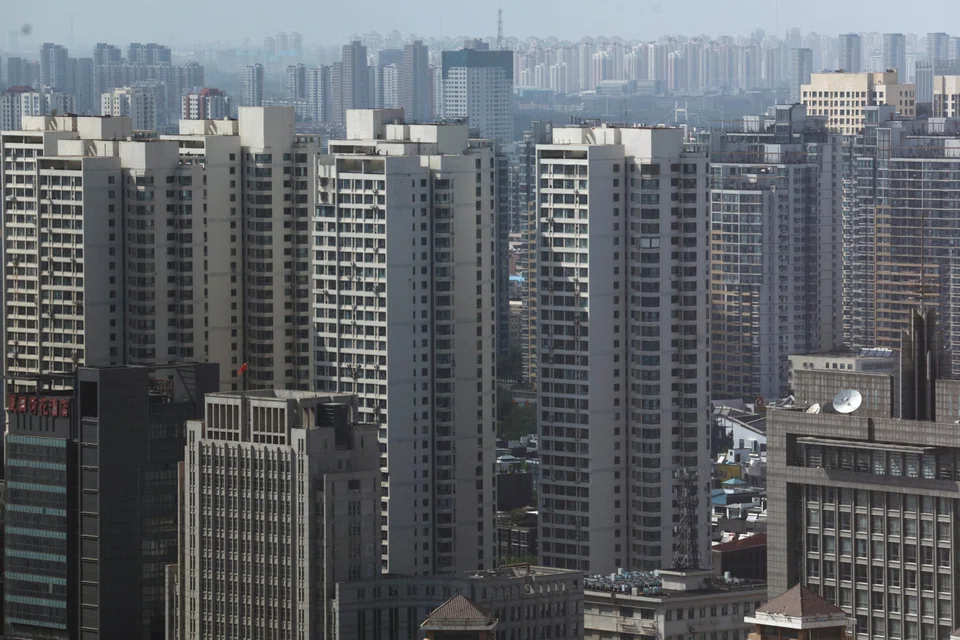
[BEIJING] China’s unrelenting housing downturn is forcing the country’s banks to confront a thorny issue: sinking real estate values are pushing millions of mortgages underwater, increasing the risk of losses for lenders and property owners.
Behind the scenes, Chinese bankers and officials are getting creative to contain the fallout.
Several state-owned banks have approached cash-strapped borrowers and offered them payment holidays on their mortgages for as long as two years, according to people familiar with the matter, who asked not to be identified discussing their firms’ policies.
Some lenders are working with individual customers to find buyers for their homes, instead of calling defaults and foreclosing on the properties.
Local courts across the country have slowed the pace of accepting cases involving defaulted mortgages to limit the volume of forced property sales. Some courts have even suspended or limited the number of litigation cases that banks can file for residential mortgage defaults.
The moves underscore how China’s local institutions are working to limit the damage of a yearslong property crisis that shows no signs of coming to an end. They also raise the question of whether official non-performing mortgage ratios – which have persistently stayed around 1 per cent for big banks despite rising defaults – only hint at the true scale of the problem.
China’s real estate slump, now in its fifth year, followed a debt-fuelled buying spree that has amplified the pain for shell-shocked homebuyers.
Home values in major cities like Beijing and Shanghai have plunged more than a third from their peaks, according to private-sector gauges that show much bigger declines than official data. In poorer areas, the decline has been even worse.
As a result, millions of Chinese citizens now owe more on their mortgages than their properties are worth – a situation known as negative equity.
SEE ALSO



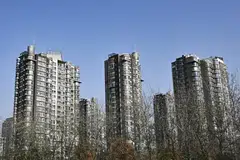
Mortgages worth hundreds of billions of yuan are likely in negative equity, according to Bloomberg Intelligence.
UBS Group estimates that 3.3 million homes could be underwater by 2027, risking losses of as much as 232 billion yuan (US$43.3 billion) from mortgages and business loans collateralised by homes. These figures, though relatively small in relation to the volume of outstanding loans, are unprecedented in China’s history.
Global precedent
Chinese authorities want to avoid a foreclosure crisis like the ones that hobbled the US and other major economies in the past.
The US housing crash that helped trigger the 2008-2009 global financial crisis left many Americans who bought homes near the market’s earlier peak saddled with mortgages that were deeply underwater.
A quarter of US borrowers were in negative equity in 2010, according to Goldman Sachs Research. Some people chose to stop paying their loans and walked away from their properties, leaving financial institutions and mortgage-bond investors with losses.
China’s stock of residential mortgages stood at 37 trillion yuan at the end of 2025, making up around 13.6 per cent of all bank loans, according to official data. A wave of mortgage prepayments prior to late 2024, when banks started reducing the interest rates on existing home loans, brought down the total outstanding sum from an earlier peak.
During the housing boom, millions of Chinese citizens also took out loans for their companies that are collateralised by their homes, which UBS analysts say are now an even bigger negative-equity headache than conventional mortgages.
Such business operating loans tend to be riskier for banks because they have shorter tenors of one to 10 years – meaning they have to be repaid or refinanced sooner.
Cash flow problems, rather than property price declines, would be the key driver of potential defaults, wrote UBS’ head of China and Hong Kong property research John Lam in a November 2025 report.
The risk of borrowers walking away from their mortgages is less than in the US or other markets, in part because the consequences are so dire.
China does not have a national personal bankruptcy system, and if a foreclosed home’s sale price does not cover the full outstanding loan amount, the borrower remains personally responsible for the remaining debt.
That means home buyers would likely have to surrender other assets, such as their savings or future income, to cover the difference. Defaulters would also end up with a damaged credit record that may severely limit their ability to get loans in the future.
These rules discourage individuals from abandoning their mortgages, but they also put banks in a bind. Going after defaulters with unstable incomes would deepen their financial strains, and have a broader impact on the economy and social stability if it occurs on a large scale.
State-owned banks, whose mission statement means they often prioritise the public good over profits, have little incentive to play hard-ball with struggling homeowners.
Loan workouts
Some banks have reached out to borrowers who are facing financial strain to propose solutions. Annie Ji, a 36-year-old who lives in Chengdu, said she was losing sleep last year over her 4,500-yuan monthly mortgage instalment on a two-bedroom apartment, which she bought in 2019 for 1.4 million yuan.
She had run a small eatery, and when it closed she said she could not make her finances work. After mounting problems paying all her bills, she missed a mortgage payment in June 2025.
To her surprise, she received a call from a Bank of China representative a month later. Ji was told she could repay only the interest portion of her loan for as long as two years, cutting her monthly mortgage burden almost in half.
That still was not enough. In September, the same bank representative offered her a six-month reprieve on both principal and interest payments.
“I had prepared for the worst that my home will be foreclosed,” said Ji. “I just went with the flow. A delay is always good – maybe things will turn around someday.”
At another Chinese commercial bank, a monitoring system sends out internal alerts when borrowers miss payments, according to an employee who asked that they and the institution not be named.
A local branch will then send a representative to visit the customer to understand their situation, and try to negotiate a solution. That could involve turning the instalments into interest-only payments for up to two years, extending the loan maturity date, or providing a temporary reprieve from making any payments.
Some of the banks’ mortgage forbearance practices are rooted in policies that were introduced near the start of the Covid-19 outbreak in 2020.
Judy Zhu, a medical aesthetics nurse, lives in Qingdao, a port city in China’s eastern Shandong province. She was offered a long interest-payment holiday from Industrial and Commercial Bank of China (ICBC), another state-owned lender. She had bought an apartment in the city in 2020, paying around 2.3 million yuan.
Zhu said she last made a mortgage payment around a year ago, and ICBC recently told her she could skip interest payments for one year if she repaid her overdue interest of 80,000 yuan. She said the lender also informed her that her mortgage rate would be cut to 3 per cent from 4.35 per cent.
She hasn’t decided whether to take up the offer. “I’m torn about whether to continue paying after a year,” she said. “For now, I can only avoid it and let things slide.”
Banking resilience
The flexible approach by Chinese banks has helped limit the risk of a blowup.
Real estate-related assets, including residential mortgages and developers’ debt, recently made up around 20 per cent of loans in the banking system, down from a peak of 27 per cent in 2019, according to Tianlei Huang, a senior fellow at the Peterson Institute for International Economics in Washington.
The forbearance measures for mortgages and developer loans “mechanically keep nonperforming loan ratios low, delay loss recognition, and mask underlying asset quality risks,” he said.
Huang added that while the banking system appears broadly resilient, it faces growing pressures from the deterioration of real estate assets as well as lenders’ declining profitability.
“The Chinese state remains highly risk-averse with respect to financial stability...and is willing to go to great lengths to prevent a systemic breakdown, as long as fiscal capacity allows,” he said.
Most Chinese banks have been reporting low non-performing loan ratios for years. At the country’s biggest state lenders, NPLs for personal mortgage loans stood around 1 per cent at the end of 2025, according to the banks’ annual results.
The increase has been more pronounced at rural lenders, which have weaker client bases in underdeveloped areas.
Shengjing Bank in northeastern Liaoning province saw its mortgage NPL jump to 4.34 per cent at the end of June, up 0.68 percentage points from end-2024. The lender has since been taken private. Yibin City Commercial Bank in southeastern Sichuan saw the level rise 1.2 percentage points in the last year to 5.06 per cent.
Still, even if 5 per cent of mortgages default, Chinese banks’ loan provisions should be more than sufficient to cover those losses, said Sheng Songcheng, head of the China chief economists Forum.
Foreclosed homes
The prognosis for the real estate market looks less rosy.
Banks have not been able to avoid foreclosures entirely, although the process in China is slow and complicated. Less than a quarter of the foreclosed properties that were put up for auction last year ended up being sold, according to China Index Holdings.
Across the country, the number of foreclosed properties listed for sale on online platforms and auction websites peaked at close to 800,000 in 2023, according to figures compiled by the data provider. They declined in 2024, when courts began slowing down the pace of case acceptance, and slipped to around 719,000 in 2025.
“Even if banks seize the homes, it’s rather difficult to offload them,” said Shujin Chen, chief economist at CSOP Asset Management. “They would rather provide the distressed borrowers some breathing space.”
This supply remains a gnawing problem for a market that seems unable to escape its long slump.
In some areas, the supply of foreclosed apartments up for sale is equivalent to about 20 per cent of the supply of new homes, according to China Real Estate Information Corp. Developers worry that such high volumes could pressure home prices further, according to an executive at a large property company.
There is also rising supply risk from homeowners getting a bit of extra help from their banks.
When Ji, the struggling homeowner in Chengdu, was talking to the representative at Bank of China, she was asked to consider selling her apartment to help repay her mortgage. She took a look at listing prices of similar apartments, and saw they were around 13 per cent below her mortgage’s outstanding principal. She decided the least bad option would be holding on.
“My apartment is becoming toxic,” she said. “It never occurred to me that buying a home would put me into such a mess.” BLOOMBERG
Decoding Asia newsletter: your guide to navigating Asia in a new global order. Sign up here to get Decoding Asia newsletter. Delivered to your inbox. Free.
Share with us your feedback on BT's products and services
TRENDING NOW

DBS, OCBC, UOB rout lops billions off STI as inflation, rate concerns spook investors

Grab CEO’s wife Chloe Tong on life with Anthony Tan and finding her purpose

OCBC sheds S$8 billion in value as shares close nearly 6% down; analysts cautious on banks
Deal between tycoon friends sparks scrutiny of Philippine power sector

