

US housing market remains under pressure in July
Contract signings for existing homes are down 2.3% on the month to the lowest level since January
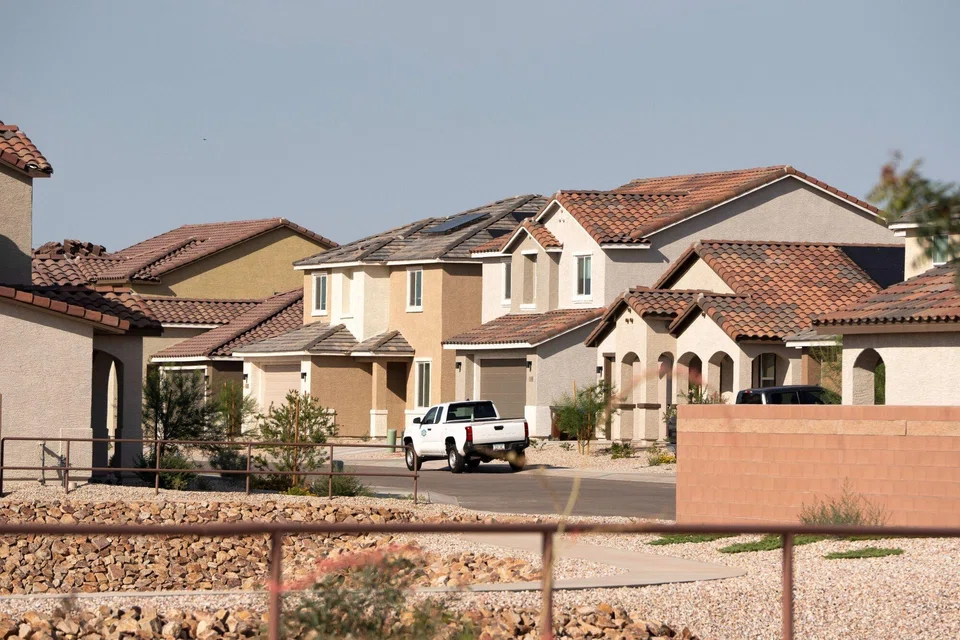
[NEW YORK] US single-family homebuilding fell sharply in July to the lowest in more than three-and-a-half-years and contract signings for purchases of existing homes also slid in the latest signal that the housing market remains under pressure from higher mortgage rates and economic uncertainty from the Iran war.
The manufacturing sector, meanwhile, continues to ride the coattails of the artificial intelligence build out, with a Federal Reserve measure of factory output hitting its highest in more than four years last month, led by production gains for high-tech equipment and industrial and construction supplies.
Single-family housing starts, which account for the bulk of homebuilding, dropped 9.9 per cent last month to a seasonally adjusted annual rate of 808,000 units, the Commerce Department’s Census Bureau said on Tuesday (Aug 18). That was the lowest since November 2022.
Single-family homebuilding slid 15.7 per cent year-on-year in July.
Permits for future construction of single-family homes – an indicator of future new construction activity – rose 2.5 per cent last month to a rate of 894,000 units.
They were up 1.1 per cent year-on-year in July for only the second yearly increase in the past two years, though the issuance rate remains near the slowest in three years.
“Until mortgage rates decline and allow builders to unload currently completed homes or those under construction, we expect home builders to remain hesitant to make significant investments in new projects,” Nationwide Senior Economist Ben Ayers said.
Total new home starts – including multifamily structures such as apartments – fell 12.4 per cent to 1.239 million in July.
Economists polled by Reuters had estimated an annualised rate of 1.35 million.

Overall new issuance of residential construction permits rose 5 per cent to a rate of 1.443 million units. Economists had estimated a permit run of 1.37 million.
Contract signings for existing homes – which become completed sales transactions typically a month or two later – also fell in July, the National Association of Realtors (NAR) reported on Tuesday. They were down 2.3 per cent on the month to the lowest level since January.
The residential real estate market remains in a deep rut, with high mortgage interest rates and limited supply of homes on the market hurting affordability and sales rates.
“The highest mortgage rates of the year hit right in the middle of summer, and that’s pulling back contract signings,” NAR chief economist Lawrence Yun said. “Home prices are at record highs so houses for sale are sitting on the market longer, and fewer buyers are bidding above the asking price than a year ago, though there are large local market variations.”
The contract rate on a 30-year fixed-rate mortgage, the most popular US home loan, ticked lower in the week ended Aug 7 for the first time since mid-June, the Mortgage Bankers Association reported last week. Still, at 6.77 per cent it remains near the highest in more than a year.
On Monday the National Association of Home Builders reported an unexpected uptick in sentiment among construction firms, but their confidence overall remains significantly subdued in the face of economic uncertainty, high mortgage rates and steep building costs aggravated by the US-led war with Iran.
The weak housing market stands in contrast to a robust factory sector, buoyed yet again by hefty AI investment activity that is driving demand for high-tech equipment and the supplies needed to build and run massive data centres.
The Federal Reserve reported its manufacturing output index rose 0.2 per cent in July on the heels of an upwardly revised 0.3 per cent increase in June. The index was at its highest since April 2022.
“The usual suspects, including AI-linked industries, drove industrial production, and particularly durable goods manufacturing, higher,” Bernard Yaros, lead US economist at Oxford Economics, said in a note.
Business equipment production rose 0.8 per cent, led by a 1.5 per cent gain in information-processing equipment and a 1.4 per cent gain in industrial supplies, which offset a decline in transit equipment output. Semiconductor output rose 2.4 per cent and computer and peripheral tech gear production rose 1.8 per cent.
Oxford’s Yaros expects the momentum to broaden out and lift other sectors beyond high tech. “AI is increasingly spilling over into other investment goods beyond information processing equipment,” he noted.
Defence production also rose 1.8 per cent amid continued high spending from the US-led war with Iran.
Motor vehicle assemblies slipped to 10.42 million on a seasonally adjusted annualised rate from 10.68 million in June. Heavy and medium truck production fell to the lowest since March. REUTERS
Decoding Asia newsletter: your guide to navigating Asia in a new global order. Sign up here to get Decoding Asia newsletter. Delivered to your inbox. Free.
Share with us your feedback on BT's products and services
TRENDING NOW

Grab CEO’s wife Chloe Tong on life with Anthony Tan and finding her purpose

Hwa Seng Builder, two China companies win S$1.2 billion Tuas Road Viaduct phase two contracts

Deal between tycoon friends sparks scrutiny of Philippine power sector

Canada is upping oil flows to Asia, but South-east Asia’s refineries aren’t ready to handle them yet

