

A vibrant turnaround for a long-neglected Charleston suburb
Eyeing the neighbourhood's potential, a property developer and his partners spent more than US$70 million to create two architecturally striking office park developments there
Charleston, SC
ON Sunday mornings about a decade ago, shortly after he moved here, Stephen Zoukis used to ride his bike around a ramshackle neighbourhood a couple of miles north of the city's celebrated historic district and wonder why no one had built anything of note there.
The neighbourhood, known in the 1850s as Cool Blow Village and now as the Upper Peninsula, was dotted with small houses, warehouses and metal sheds; had only a few sidewalks; and was infused with an air of neglect. Even with easy access from an interstate ramp, the neighbourhood "lacked an economic pulse", he said.
"I thought, why is there nothing here?" recalled Mr Zoukis, a 62-year-old developer who, as a partner in Jamestown Properties beginning in 1993, made a large imprint on high-end New York real estate. His purchases included the General Motors Building, One Times Square, the Eighth Avenue building that houses Google's New York operations, the headquarters of News Corp and the Chelsea Market.
Surveying the unprepossessing landscape of Charleston's Upper Peninsula, he imagined that it could be so much more.
"We saw a big opportunity for our kind of money," said Mr Zoukis, who, flush with cash from the sales of most of the New York properties, was unencumbered by the need to seek financing from banks. He joined forces with a Charleston partner, Michael Wooddy, who holds 10 per cent of Mr Zoukis's position, and in 2012 began snapping up all the available lots they could find, ultimately more than 20.
"It was really before people realised what was happening, so the pricing was very different than it is now," he said, referring to a recent boom in Charleston's commercial and residential sectors. "You look at a map of the city and clearly people had to move up the peninsula because there was no place else to go." Working under their new shingle, the Raven Cliff Co, the partners initially sought to build a "shrunken" version of the Chelsea Market, the highly successful assemblage of food vendors and retail stores in Manhattan. "But we determined that you can't really just scale these things down that way," Mr Zoukis said, noting the chasm between a place such as New York's Fulton Fish Market, which "cleans a million pounds of fish a day", and "someone who's starting an artisanal pickle company". A fresh option was suggested by Charleston's budding tech sector, which has since grown to about 250 companies in the metro area, according to the Charleston Regional Development Alliance. Many were downtown and had little room to expand there. That inspired the two Raven Cliff partners - eventually joined by two others, Martin Skelly and Christian Sullivan - to step in.
"I knew that we could get the tech companies to fill these places," Mr Zoukis said of his Upper Peninsula properties. He and his partners spent more than US$70 million, including construction costs and the land purchases, to create two architecturally striking office park developments to accommodate not only tech companies but businesses that could provide goods and services to the companies' workers, as well as to the public.
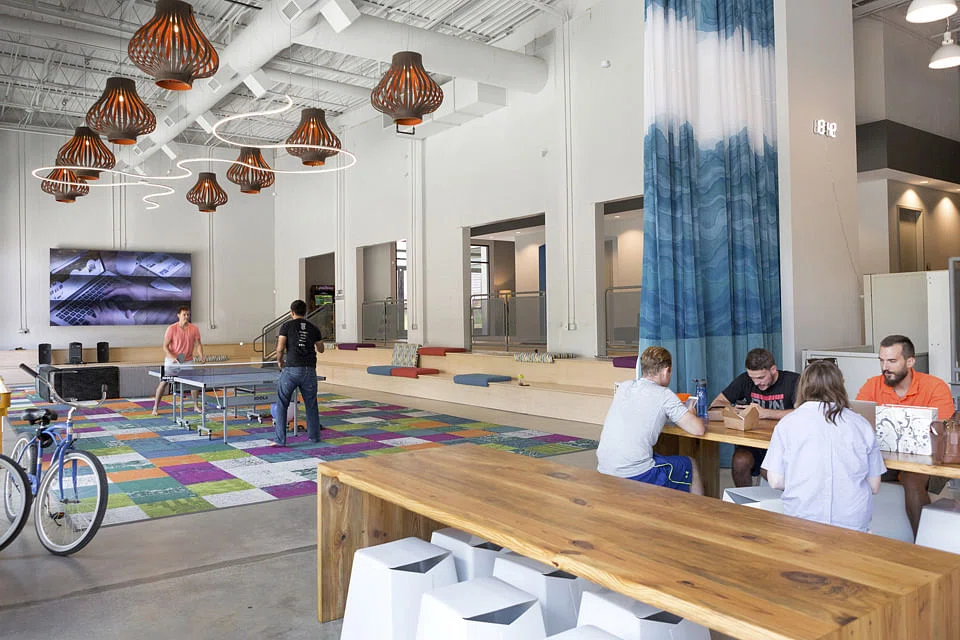
"We saw them as places to not just impress your clients, but to impress your employees," he said while sipping a cortado in a gleaming, white-tiled coffee and pastry shop at one of the two developments, Pacific Box & Crate, which covers 131,000 sq ft in three buildings.
In January, Pacific Box & Crate opened to its first tenant, BoomTown, which employs 250 people and creates software for real estate brokerage firms. "This suited our needs," said Nina Magnesson, whose business card describes her as a "catalyst" for "citizenship and social innovation". The space BoomTown occupies, all 56,854 sq ft of it, was designed in the "industrial chic" style and built for the company from what had been "a disaster of a warehouse", Ms Magnesson said. "We were the first to sign on here. We'd been in a little old grocery store downtown." Other tenants at Pacific Box & Crate - named after previous industrial tenants on the property - include PhishLabs, which helps companies and organisations fight cyberattacks; the crowdfunding company CrowdReach; Twelve South, which makes tech accessories; and the Harbour Entrepreneur Centre. There are also Bad Wolf Coffee; Reverb Yoga; Edmund's Oast Brewing Co set to open September 14; and a 9,970-sq-ft food court, called Workshop, that functions as a "food incubator" for aspirant restaurateurs.
"Who wouldn't love this space?" asked Suzie Rybicki, a vice-president for talent management at PhishLabs, as she surveyed the company's stark, efficiently laid out, two-storey headquarters. "If you think about what's been developed up here, with the restaurants etc, it's a very different scene." A few blocks away, Raven Cliff's other development, Half Mile North - its name an allusion to the site's distance from the Arthur Ravenel Jr Bridge - has been in business since April 2013. Its 12 buildings, which add up to 90,583 sq ft, house several tech companies, including Blue Acorn, which calls itself a "premium e-commerce agency"; the "automated bookkeeping" firm Ceterus; SIB Development and Consulting, an expense management firm; and Integral Solutions Group. There are also three restaurants, a cheese store, an architecture firm and a shop that sells decorative hardware.
"Steve has taken a unique approach," said Kristopher King, the executive director of the Preservation Society of Charleston. "His strategy gets these neighbourhoods functioning, which is a huge positive. It's putting these properties back on the tax rolls, creating jobs and bringing vibrancy to an area that quite honestly, 10 years ago, really needed it." NYTIMES
TRENDING NOW

Nvidia reinstates Jensen Huang as CEO; Trump says move poses no national security risk

Indonesia’s coal tycoon Low Tuck Kwong replaced as Bayan Resources president-director

Nvidia surges 33% after reinstating Jensen Huang, reviving AI trade; stocks soar in US and Europe

Consider lowering homeownership barriers for some non-resident foreigners

