Architects and engineers suggest possible new ideas for future dormitories

Singapore
A NEW set of standards for new Quick Build Dormitories which include no more than 10 beds in a room, at least 6 sqm of space per resident and the use of single rather than double-decker beds was announced at a Covid-19 Multi-Ministry Task Force virtual press conference on Monday.
But architects and engineers feel more can be done when it comes to designing dormitories in the long run, particularly for purpose-built dormitories. Some ideas they suggested include catering to lower density living, more facilities and possibly even integrating with the community to address social stigma. Cost-wise, it is also too early to assume that such suggestions will raise the cost of housing foreign workers for employers.
Theodore Chan, senior director at CIAP Architects, said that he hoped that the number of residents in a room could be lowered to a maximum of eight and with a space of 1.5m to 2m between beds.
According to him, dormitories could be "somewhat integrated with the community to address the social stigma. It will be tough, but if we are serious about social integration and respect, we must walk the talk".
Angelene Chan, chief executive of DP Architects, agreed. "Dormitories can be designed such that they blend better with the surroundings, even if they are situated in remote locations. This can help to lower the sense of segregation that workers might feel from the community they serve," she noted.
"Utilitarian designs can be aesthetically pleasing too," she added. "Currently, most dormitory buildings adopt an introverted or fenced-up pattern which may create a sense of separation or being on the periphery of society. We can consider grouping dormitories by clusters, which breaks up the monotonous massing and also allows for better segregation and containment of disease outbreak."
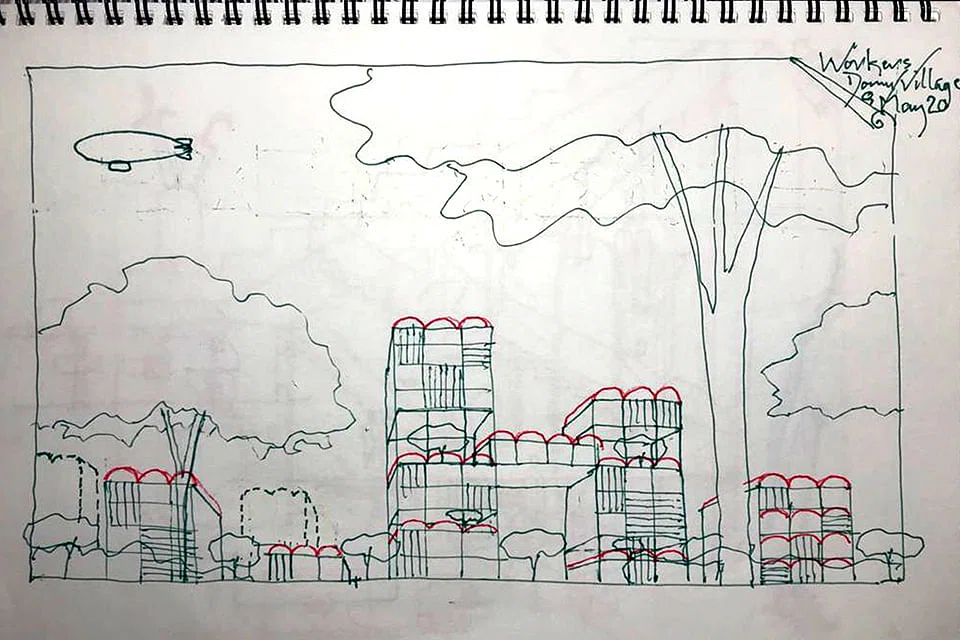
Rene Tan, co-founder of RT+Q Architects, said that a possible option for future workers housing may be found in a mix between low and high-rise housing. "Low and high blocks may perhaps co-exist in a village-like environment with plenty of open spaces with greenery, natural sunlight and natural cross ventilation - indeed the three 'essential joys of architecture'," noted Mr Tan.
To address the need for social distancing, Mr Tan also suggested that beds, for instance, could be tiered in a staggered configuration to ensure better privacy as well as air circulation among inhabitants.
Tan Yok Joo, director at SJ Architecture, Surbana Jurong, said: "An optimal mix of private and communal areas will give workers the personal space that everyone needs and common spaces for social and recreational activities. The quality of these areas is just as important as the sizing. Private and communal spaces should be designed to feel comfortable and welcoming, like how a home feels."
She added that new dormitories "should also build in adaptability and flexibility to allow these spaces to serve multiple functions and accommodate various emergency scenarios".
Good cross ventilation is crucial in places with high density living. Steven Tay, senior principal at global engineering firm WSP, said "where possible, a wind catcher can be introduced into the building. Within the dormitories, window openings should be operable by occupants. Ventilation openings can be oriented such that they are offset from each other and facilitates fresh air mixing, while minimising obstructions to airflow within the room."
On Monday, National Development Minister Lawrence Wong said that the government is still studying different possibilities on the ownership and operations of the new dormitories.
"We will eventually come to a decision on how best to progress with these permanent new dormitories that we are building. The cost indeed will be higher so we have to again, as part of this study, work out what's the way to manage the cost increases. Certainly employers and dormitory operators will have to bear part of the increase in costs," added Mr Wong.
Mr Tan said that "it is difficult to say how construction cost may turn out as we need to explore the variables of materials, structures and enclosures as a new and simpler modular system of construction may be invented and used."
Seah Chee Huang, president of the Singapore Institute of Architects, said that the institute has been working closely with the Urban Redevelopment Authority, the Building and Construction Authority and a number of agencies to review the design specifications and test-bed various prototypes of future purpose-built dormitories, for the mid to long term.
"Our main focus in this collaboration is on prioritising parameters of liveability and resilience in the design of worker dormitories, and hope this endeavour contributes meaningfully to the migrant worker community," he added.