As en-bloc market heats up, agency space gets more crowded
Growing competition threatens to compress commissions, with some newcomers quoting ultra-low fees


Singapore
COMPETITION is stiffening among marketing agencies in Singapore's collective-sale scene, with both incumbents and newcomers eager to grab a piece of the action amid renewed buying and selling interest.
Fresh faces joining the crowded arena have, at times, pushed into the scene by undercutting rivals on the commission rates or terms of appointment. That has also meant them proposing "unrealistically" high reserve prices as they vie for jobs, agents told The Business Times (BT).
Promising fatter margins for sellers is one way agents may try to clinch appointments. But if a reserve price appears to be set too high for a deal to close, experienced players may pull out of the pitch, BT understands. On the other hand, when a project is "priced to move", about five to seven teams may clamour to win the appointment.
An industry veteran said: "It's sometimes a chicken-and-egg situation... you never know what's the real limit and whether this reserve price will actually push the market higher. Some 'gung-ho' agents may say they're confident of their proposed reserve price, but who's to say how realistic it really is?"
The growing competition in the industry has also threatened to compress commissions, with some newcomers quoting ultra-low fees. Broadly, rates in recent months have inched down from levels seen in the 2016-2018 en-bloc boom, and are also a far cry from off-peak periods in the market, consultants told BT.
In the simplest terms, typically, the higher the reserve price or the bigger the redevelopment's allowable size, the lower the commission. But when quoting their fees, agents also consider factors such as how feasible it would be to market and sell the project, the amount of expenses to be incurred, and whether this is the project's first en-bloc attempt.
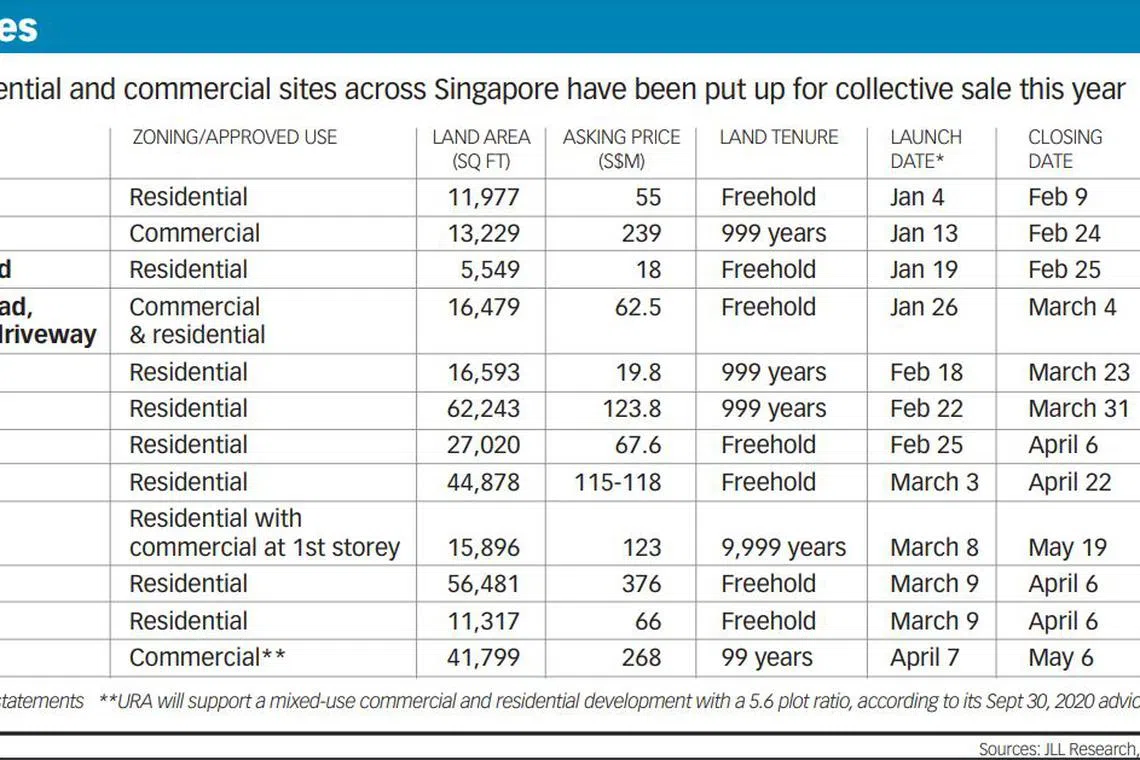
Commissions today can go up to one per cent for small sites. Larger projects priced at S$500 million or more are estimated to garner commissions of 0.3-0.5 per cent, which may be further shaved down if more agents are jostling for the appointment. Quotations have even dipped to as low as sub-0.2 per cent in a few cases - rare as they may be, industry players told BT.
Given the shrinking deal sizes, fees may have come down, some agents said. Bigger sites were once in vogue; now, small and mid-sized ones are more palatable to buyers.
In the last wave which took place from 2016 to mid-2018, the bulk of commissions were observed to be around 0.25 per cent to one per cent. Some reached 2 per cent, for smaller projects priced below S$50 million.
Meanwhile, during off-peak periods in the market, commissions often hit at least one per cent and go up to 3 per cent. This occurs as it is harder to sell when developers are not so keen on collective-sale sites, a broker said.
The Council for Estate Agencies (CEA) does not fix commission rates nor provide commission guidelines. "This allows market forces to drive competitive pricing in the real estate agency industry and incentivise agents to price their services competitively. Consumers can then negotiate the best rates for the services they require," a CEA spokesperson said.
An agent told BT that experienced teams may drop a project if the commission is "unreasonably low" and "not worth our while".
Huttons Asia's head of investment sales Terence Lian said expenses incurred per project can "easily" run into five-figure sums and even exceed S$150,000, depending on the size of the redevelopment.
Such expenses can include advertising, land valuation, baseline enquiry, and engaging an architect for outline planning permission for certain sites. If a collective sale is unsuccessful, no commission is paid and expenses are not reimbursed. Given these factors, agents need to balance the risks and rewards, Mr Lian added.
Tracy Goh, PropNex head of investment and collective sales, said that with the hefty costs, marketing consultants should have "a level of confidence" before they pitch for a project.
In appointing an agency, some collective sale committees may decide to simply go with the lowest quotations. But cheaper is not necessarily better, as it may indicate scant experience and a lack of access to potential buyers, seasoned brokers said.
"The role of a marketing agent goes beyond placing newspaper advertisements... You also need to have reach and access, relationships with developers, and know how to handle the entire process to ensure compliance with legislation, come up with a fair method of apportionment, and so on," a consultant said.
Jeremy Chiu, ERA Realty group division director, investment sales and capital markets, noted that there have been a select few agents pitching for projects even though, in his words, they "only attended an en-bloc training course" and "don't know what to expect in the actual process".
"Some had trouble calculating numbers such as the development charge (DC), differential premium, and development baseline or maximum gross floor area," Mr Chiu said.
DC is levied when planning permission is granted to carry out development projects that increase the land value. In a collective sale, the agent usually provides an estimation of the DC, if any is payable, based on the baseline record obtained from the Urban Redevelopment Authority.
PropNex's Ms Goh said: "The first thing developers will ask the marketing consultant is how much DC is payable, as it needs to be factored into the land cost... If the actual land cost is uncertain, developers will likely lose interest."
CEA "takes a serious view" of those who do not act responsibly and professionally, including agents that provide inaccurate DC calculations for collective sales and fail to exercise due diligence, its spokesperson said.
CEA does not impose mandatory courses for specialised markets - such as collective sales - as it is up to agents and their key executive officers to decide on the courses that will support their learning and work. "Agencies have a responsibility to ensure their agents are adequately trained before the agents embark on estate agency work, including en-bloc sales," the spokesperson noted.
READ MORE: En bloc punts in play, but price gap threatens to spoil the party