Australia’s slumping property market raises risk of a recession
 Add BT as a preferred source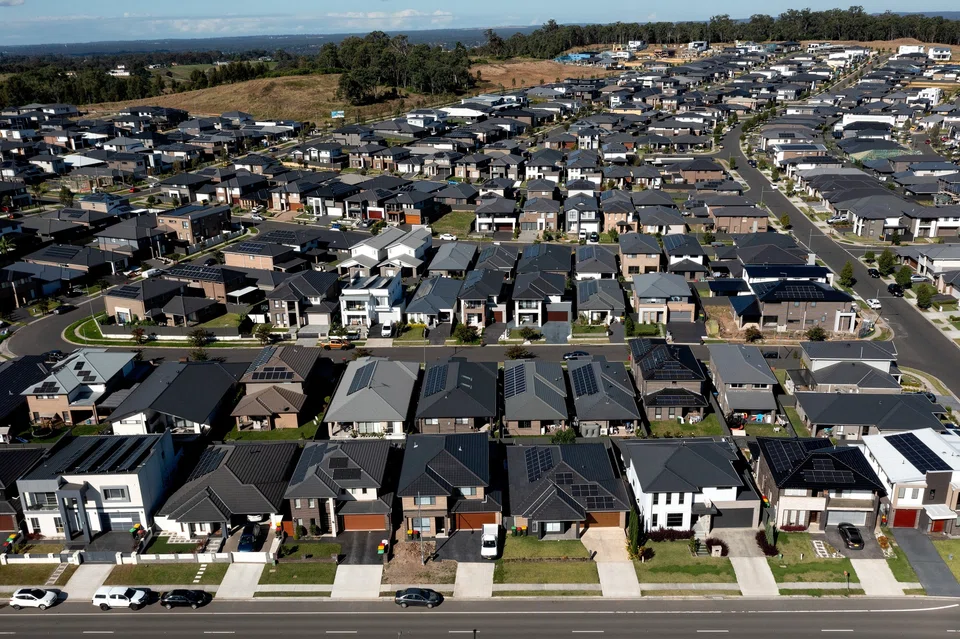
DeeperDive is a beta AI feature. Refer to full articles for the facts.
AUSTRALIA’S rapid-fire interest-rate increases are sending tremors through the nation’s heavily indebted households and threatening a property downturn on a scale unseen since the eve of the 1991 recession.
The market hardest hit is bellwether Sydney, where home values have dropped almost 5 per cent in the past 3 months, compared with 2 per cent in the A$9.9 trillion (S$9.6 trillion) national market. Further falls are inevitable as the Reserve Bank (RBA), which meets again in just under 2 weeks, raises borrowing costs at the fastest pace in a generation.
Home prices are weakening from Stockholm to San Francisco as central banks scramble to contain the hottest inflation in decades. Rate-hike risks are intensified in Australia by a record debt-to-income ratio of 187.2 per cent.
“Australia is quite an exposed market in the world in the sense that household credit and mortgage debt as a share of GDP ranks quite high,” said Louis Kuijs, chief Asia economist for S&P Global Ratings. “There’s a lot of debt out there. The higher the debt-to-GDP, the more the rate channel starts to matter.”
The RBA acknowledges it has only a narrow path to push rates high enough to snuff out excess inflation without driving the economy into recession. The Bank of Korea is grappling with a similar conundrum as it meets on Thursday (Aug 25), while the Federal Reserve has signalled flexibility on future rate moves.
Global policymakers have learned the lessons from 1970s episodes by raising rates in early, large increments to keep inflation expectations in check. The RBA has hiked by a half-percentage point at its past 3 meetings after a surprise quarter-point move in May to take the cash rate to 1.85 per cent.
Navigate Asia in
a new global order
Get the insights delivered to your inbox.
Under a scenario of a 3 percentage-point increase in the RBA’s cash rate, nationwide house prices would fall by almost a quarter. Real estate advertiser REA Group says the national market hasn’t dropped by 10 per cent in a 12-month period since 1990.
While Australian property prices are falling, they remain well above pre-pandemic levels, keeping affordability stretched and suggesting ample scope for additional declines.
Bloomberg Economics reckons the RBA is unlikely to lift rates to the peak priced in by money markets of 3.8 per cent by April - more than double the current level - as it would trigger a recession.

It sees a terminal rate of 2.75 per cent next year, a little over the central bank’s estimate of neutral and opening up the possibility of a soft landing for the economy. Still, it does see a squeeze ahead for households.
Auction clearance rates in Australia have fallen as borrowing costs have risen, sliding to about 60 per cent from more than 80 per cent during last year’s boom. In Sydney, almost a fifth of properties advertised for auction were withdrawn last weekend due to weak demand.
Australians have so far absorbed the income hit from the RBA’s hikes and the accompanying slide in property prices. A case in point is Melbourne-based first home buyer Mithran Vyravipillai, who has seen his repayments jump while adding it’s manageable at this point.
“But if rate increases continue at this pace I’d seriously be reconsidering some of my life choices,” he said.
Vyravipillai bought an inner-city apartment last year, at a time when governor Philip Lowe was signalling rates would likely remain at a record-low 0.1 per cent until 2024. When the RBA pulled an about face in May following a spike in consumer prices, Vyravipillai found he had bought near the top of the market.
“This is an example of the frustrating aspect of the uncertainties in the market. If I had some clarity on the future path of rates I might have made slightly different decisions.”
Vyravipillai fixed a small part of his loan at a “fairly good interest rate”, leaving the bulk floating. His position is likely to become more difficult, with Australia & New Zealand Banking Group predicting mortgage rates will reach just under 6 per cent by year’s end. They currently stand at about 3.7 per cent.
That will sharply increase repayments for borrowers, many of whom also face the prospect of even higher costs when their fixed loans come up for refinancing next year. About 40 per cent of the total loan book is on fixed rates, with 75 per cent of those due to roll off by the end of 2023, according to RBA data.
While Australia’s ultra-profitable 4 major banks have expressed concern about the prospect of slower credit growth, they expect defaults in the A$2 trillion residential mortgage market to be contained by high household savings and many borrowers making advance repayments on their mortgages.
The RBA’s hikes have added about A$690 a month to repayments on an average A$767,000 mortgage, according to Diana Mousina of AMP Capital Markets.
That comes against the backdrop of rising cost of living pressures and still moderate wages growth, which is eroding household income. The darkening outlook for consumption, which accounts for about 60 per cent of GDP, is a major reason why policymakers expect the economy will slow in the year ahead.
One sector where the side effects of rapid rate rises are most visible is the home-building industry, where insolvencies have jumped 70 per cent in the year to June, Goldman Sachs Group says.
Andrew Boak, Goldman chief economist for Australia, sees a 15-20 per cent peak-to-trough decline in house prices as construction insolvencies become “more widespread”.
“The housing cycle is the single greatest domestic downside risk to Australia’s macro outlook,” Boak says. “The outlook is uncertain and pressures on the building cycle and house prices warrant close monitoring.”
The RBA has been surprised in the past by how far property’s tentacles stretch into the economy - ranging from vast construction employment to post-purchase retail and services spending to the wealth effect from rising prices.
Eleanor Creagh, a senior economist at real estate advertiser REA, says if prices fall by 20 per cent or more it will be “like a sigma event. It’s something that has never occurred before”.
Her central case is for a 9-15 per cent drop - enough to hit economic growth sharply and “opening the window for the RBA to reverse course and cut rates”.
The risk is a vicious cycle emerges from households cutting spending and property prices falling together with rates rising and inflation quickening. That could see unemployment rise, spark forced home sales and see the economy contract.
Economists’ estimates of the chances of a recession over the next year have climbed since the tightening cycle began. So far, only Nomura Holdings is calling one outright. Goldman Sachs sees a 25 per cent chance, though adds that could rise if there is a bigger housing correction.
Still, most economists expect the RBA will hike another half-percentage point at its Sep 6 meeting to take the cash rate to 2.35 per cent. Money markets see the benchmark at 3.2 per cent by year’s end.
“A good rule of thumb is that every percentage point increase in the cash rate would reduce house prices by about 8 per cent,” said Peter Tulip, chief economist at the Centre for Independent Studies and a former senior member of the RBA’s economic research department.
“So suppose we get a 3 percentage point increase in the cash rate, that would translate to a 24 per cent reduction,” he said. BLOOMBERG
Decoding Asia newsletter: your guide to navigating Asia in a new global order. Sign up here to get Decoding Asia newsletter. Delivered to your inbox. Free.
Share with us your feedback on BT's products and services