

BTExplains: What Suntec Reit's numbers say about risks in the office segment
Lisa Kriwangko
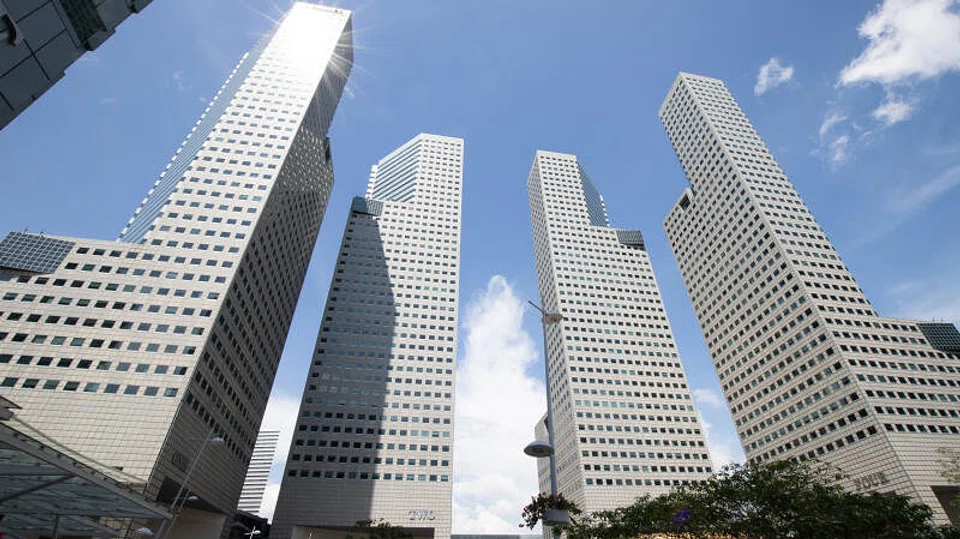
THIS same time last year, most office towers fell into a hush.
Gone were the harried clips of heeled shoes and Oxfords bouncing off the walls of large office lobbies. That silent hum came as safe-distance measures brought on by a global pandemic outbreak forced white-collar office workers to stay home.
Suntec Reit's latest results present one way to understand how workplaces are adapting to new realities again, as more office workers are now allowed back to the office.
While people are still keeping their distance from one another, having more staff streaming into office buildings means a steadier flow of office workers eating and shopping at the retail outlets at the Suntec office towers.
The Reit manager is a major landlord commanding office and retail spaces in Singapore. Properties in its trust portfolio include not just Suntec City, but holdings in One Raffles Quay, towers at the Marina Bay Financial Centres, and the new 9 Penang Road.
That's 3.6 million sq feet (sq ft) of space controlled via its holdings in its Singapore properties - made up mainly of 2.4 million sq ft of office space. (Suntec holds one-third interests in One Raffles Quay, Marina Bay Financial Centre Towers 1 and 2 and the Marina Bay Link Mall, as well as 30 per cent interest in 9 Penang Road.)
In Singapore, overall office rents rose 3.3 per cent quarter-on-quarter after two consecutive quarters of decline. Citi thinks the worst might be over for this sector. But, it pointed out that concerns about vacancy and net absorption could moderate the subsequent magnitude of rental uptick.
Suntec Reit had its Q1 2021 distribution per unit rise 16.2 per cent from the year-ago period to 2.045 Singapore cents.
JPMorgan Research said the gains in the latest quarter were off a low base in Q1 2020, with the year-ago quarter registering a 10 per cent retention of distributable income and capital distributions. This retention, which is absent this quarter, stood at S$5.5 million.
Net property income (NPI) rose 10.2 per cent to S$59.5 million year on year for the quarter, driven by new contributions from 9 Penang Road in Singapore, as well as 21 Harris Street in Sydney and 477 Collins Street in Melbourne.
It was also driven by better performance of the Marina Bay Financial Centre properties. Over at One Raffles Quay, one-off compensation, higher rent, and lower financing costs more than offset lower occupancy.
For its Singapore office and retail portfolios, the trust manager saw an occupancy rate of 96.1 per cent and 91.5 per cent, respectively.
Suntec Reit said rent reversion should remain positive for the year with office occupancy in the mid-90 per cent range. Mall traffic should also recover to about 80 per cent of 2019 levels by year-end.
What can Suntec Reit's numbers say about the future of office space? We dive in:
Large tenants may exit
Despite recording a 0.9 per cent rent reversion drop in Q1 2021, JPMorgan noted that leases which did not manage to close in time for the quarter would have brought Suntec City office's reversions up by 1.5 per cent.
But the brokerage sees a potential for large tenants to exit in late 2021 and predicts that Suntec might have to top-up distributions in H2 2021. This is "of greater concern" as the brokerage predicts lower demand amid work-from-home arrangements.
OCBC Investment Research pointed specifically to financial institutions possibly rationalising their space later; the income impact from this is expected to be less than 4 per cent.
Standard Chartered is reportedly looking to shed some of the 21 floors it leases at Marina Bay Financial Tower 1.
If it is true that it plans to cut a minimum of four floors - the equivalent of about 80,000 square feet - as reported by Bloomberg, this would be "one of the larger downsizing in the office space among the banking institutions", said DBS Group Research in a note on Wednesday.
This decision that will likely impact both Keppel Reit and and Suntec Reit, given their respective 33.3 per cent exposure in the building.
Office space: supply uncertainty
A speedy economic recovery and additional office demolitions would tighten the supply of office space, said JPMorgan. This is coupled with the lack of new offices as the Covid-19 outbreak delayed construction, which could mitigate the softer demand outlook.
But a faster-than-expected clearing of the unfinished projects backlog could also result in a boom of supply instead, resulting in further fall in rents. The supply outlook is unclear.
The weighted average lease expiry (WALE) of the trust's Singapore office portfolio is at 2.96 years.
OCBC added that there are also uncertainties over the longer-term impact of work-from-home trends.
Retail suffers
As work-from-home arrangements cut the amount of office workers in nearby buildings even as tourism numbers fell, Suntec City Mall suffered a 26.2 per cent fall in headline retail rent reversion. The brokerage predicted that the slow recovery at Suntec City Mall, given the lack of tourists and the impact from work-from-home, will add pressure on occupancy. This could result in aggressive rental cuts to attract new tenants.
OCBC pointed to the rent contraction being due to the renewal of retail tenants in growth categories at lower base rent and higher gross turnover (GTO) rent.
The short-term restructuring of rent, which comprises a lower fixed rent with a higher GTO component, was granted to the Singapore retail tenants that take up a third of its net lettable area. Most of these short-term restructuring will end by Q2 this year, the brokerage said.
Maybank-Kim Eng Research said performance at its Suntec City mall softened in Q1 2021 from the seasonally stronger Q4 2020, with footfall and tenant sales down from a year ago. Management expects occupancy to improve, but for retail rent reversion to stay negative in FY21.
Portfolio diversification
Suntec Reit managed to keep its quarter-on-quarter and year-on-year revenue and NPI change from turning red because of its diversified portfolio. Maybank-Kim Eng said rising overseas contributions in Australia and the UK - mainly office spaces - remain a silver lining.
OCBC said for Suntec Reit's properties in Australia and UK, rental rebates will continue to be granted to retail tenants that are adversely impacted from the pandemic. But overall revenue is expected to remain resilient, given the high occupancy and long WALE of its office portfolio in those markets.
Caution continues
JPMorgan has lowered its target price for Suntec Reit to S$1.35 from its previous S$1.55, while rating the Reit as "underweight".
The brokerage anticipates a lack of incremental interest in the stock; it predicted that many investors will remain cautious on Suntec Reit due to its sector-high gearing of about 44 per cent.
Given the current market sentiment, the trust has said that it will continue to explore divestments or bring in partners for upcoming redevelopments to address such gearing issues.
Maybank-Kim Eng added that acquisition growth will likely be constrained by its weak balance sheet; it also sees an overhang from a potential dilutive equity raising. It maintained a "sell" rating on the stock, with a target price of S$1.25.
OCBC kept its "hold" rating on the stock, but trimmed its fair-value estimate to S$1.56 from S$1.59, to account for higher borrowing costs ahead.
Units of Suntec Reit were trading at S$1.54 as at 3.15pm on Wednesday.
READ MORE: High-floor strata office at Suntec Tower 2 up for sale
TRENDING NOW

Once staunchly pro-China, Malaysian Chinese businesses are now distancing themselves from Beijing

Cliff Tan has 7 million followers and a 4-month waitlist. Why won’t he expand his business?

Grab CEO’s wife Chloe Tong on life with Anthony Tan and finding her purpose
Singapore F1 to proceed despite haze; no changes planned to outdoor entertainment

