Construction industry making progress on digital road
Use of drones and digital fabrication catching on, but industry fragmentation, squeezed margins and lack of skilled labour remain hurdles
Singapore
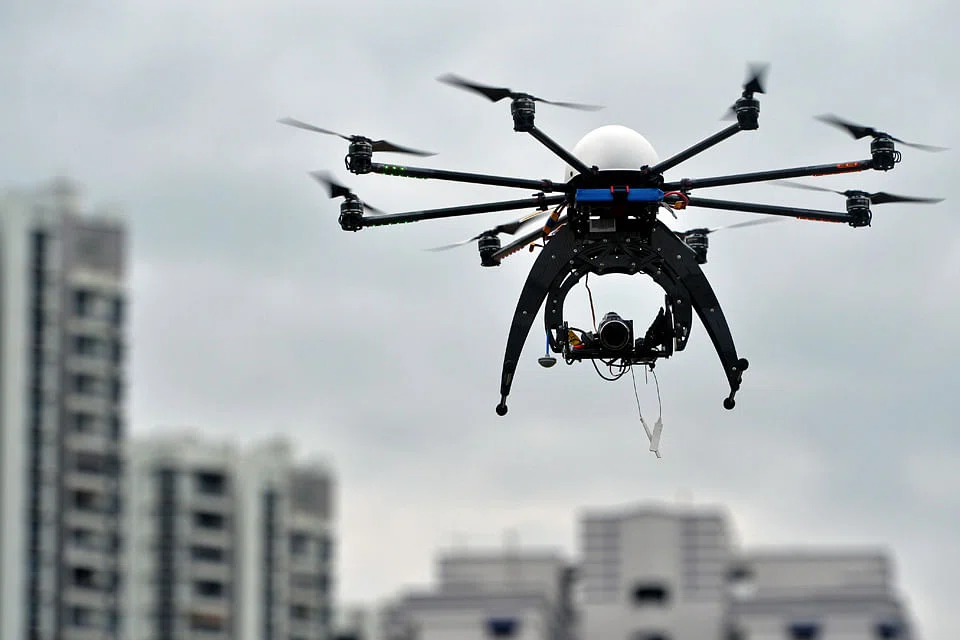
MAINBOARD-LISTED Lum Chang Holdings began using drones for aerial construction site surveillance in 2018 - a decision that has since proven invaluable.
When the Covid-19 pandemic hit, and the company had to split its workforce, Lum Chang was still able to submit updated photos of project sites in its weekly reports - thanks to remote surveillance by the drones.
Tan Wey Pin, managing director for Lum Chang Building Contractors (LCBC), said using drones has helped not just with the weekly documentation of external site progress, but also with safety risk management and general site inspection.
Lum Chang is among the many construction companies that are increasingly having to adopt new technologies in their workflow processes.
The coronavirus outbreak has made some construction work more difficult while reducing the available labour pool for construction companies, which have traditionally imported most of their workforce. As input costs - from land prices to building materials to worker salaries - rise, there is also pressure to keep costs down. But not all the industry's players have been able to adapt.
Lum Chang is among the more forward-thinking of the local construction companies. It has adopted laser scanning for existing buildings that require additional and alteration works.
Mr Tan said that in one of the company's projects, a 3D model was developed with laser scanning technology to verify the details of an existing building as the available 2D drawings had been done more than 30 years ago. The 3D model was subsequently used to integrate the existing building with the new works.
"Laser scanning has ensured 100 per cent accurate information from the resultant point cloud. And with the adoption of (virtual reality) mock-ups, we have been successful in reducing mock-up wastage cost by almost 70 per cent," he added.
Lum Chang also used a digital fabrication process in the construction of an entrance canopy at Northpoint City shopping mall and for some structural steel elements at PSA's headquarters in Pasir Panjang. It has adopted prefabrication and modularisation in the mechanical, electrical and plumbing systems for all its current projects.
Industry experts polled by The Business Times said Singapore's construction industry is generally ahead of its regional peers in terms of digitalisation, and nudges from the government have spurred companies to adopt new technologies. But industry fragmentation, compressed margins and the lack of skilled labour continue to stand in the way of digitalisation efforts.
Amos Cheong, who is head of project and programme management as well as business advisory for building consultancy Arcadis in Singapore, said the "current apparent laggards" are the subcontractors, smaller-sized consultant firms or suppliers that are further down the value chain.
He attributed this to "fragmentation, contracts, project structure (and) payment mechanisms" of the industry, among other factors. Most technologies, he said, are "tailored to meet specific needs and swayed towards perceivable gains in the shorter term".
For some of the smaller companies, therefore, the technologies may not make sense. Smaller companies without scale cannot apply a technology to multiple, different projects. And they may take on many similar projects at the same time.
Collaborative contracting could help, Mr Cheong said, by incentivising parties along the value chain to "harness the benefits and potential of digital transformation, or at the simplest form, to reduce adversarial interactions that may even impede digital adoption".
Shahzad Nasim, group executive chairman of engineering consultancy Meinhardt Group, seconded the need for collaborative efforts. The development of common platforms for digital delivery across the industry would help accelerate digital adoption, he said.
Other pain points he highlighted were the affordability of technology and the need to upgrade tech skills.
On the types of technologies that are likely to see faster adoption, experts pointed to the use of drones, cloud-based technologies and artificial intelligence (AI) - possibly because they have the greatest potential for immediate impact.
At China Construction (South Pacific) Development Co, a regional subsidiary of Shanghai-listed China State Construction Engineering Corporation, a cloud-based common data environment has been used to digitalise construction processes such as "technical documentation systems, digital safety and quality, and progress management".
According to Rob Sanchez, senior manager for building information modelling (BIM), this has helped the company achieve a 70-80 per cent increase in productivity.
With the pandemic hampering the usual workflows, Chris Smeaton, digital practice leader for Singapore and Vietnam at consultancy Aurecon, said the use of drones will now be a priority for many construction companies and land developers this year.
"This is off the back of 2020, where we already saw an acceleration of sites in Singapore and Asia adopting drones for surveying, site supervision and asset condition assessment," he added.
Drones can also be used alongside photogrammetry - which converts photographs or videos of a physical space into a virtual 3D model - and mesh model creation. Such models can, in turn, feed into BIM systems, which are digital models used in design and construction.
If paired with AI functionality, drones can also help manage health and safety restrictions onsite, noted Mr Smeaton.
Looking ahead, various forms of offsite fabrication are likely to be adopted. "It will become possible to print materials important for prefabrication and have them ready to use immediately, reducing labour and materials and leading to a more sustainable development," said Meinhardt's Dr Nasim.
But Lili Tao, Aurecon's South-east Asia managing director for infrastructure, said many companies are "only scratching the surface when it comes to the potential benefits to be gained from harnessing digital engineering".
She cited the use of automated tunnel boring machines in other markets. These are used to excavate tunnels and can be operated remotely, reducing the need for manpower working underground. The deployment of digital tools in the design process is another area where Ms Tao sees "a strong opportunity for avoiding costly delays or complications on building sites".
Khoo Sze Boon, managing director for Singapore at real estate consultancy Turner & Townsend, said digital initiatives should also "cascade to post-construction completion and into asset management and operation stages".
Current digital technologies focus more on the design and construction stage of a project. But they could be integrated with, for instance, facility management software to improve the management and operation of a building.
"The great outcomes achieved by adopting digital technologies should not come to an end with the completion of the construction works," said Mr Khoo. "And the value of digital must be looked at on a whole-life basis".
READ MORE: