Cooling measures cited as key risk by Singapore real-estate market, poll finds
Lisa Kriwangko
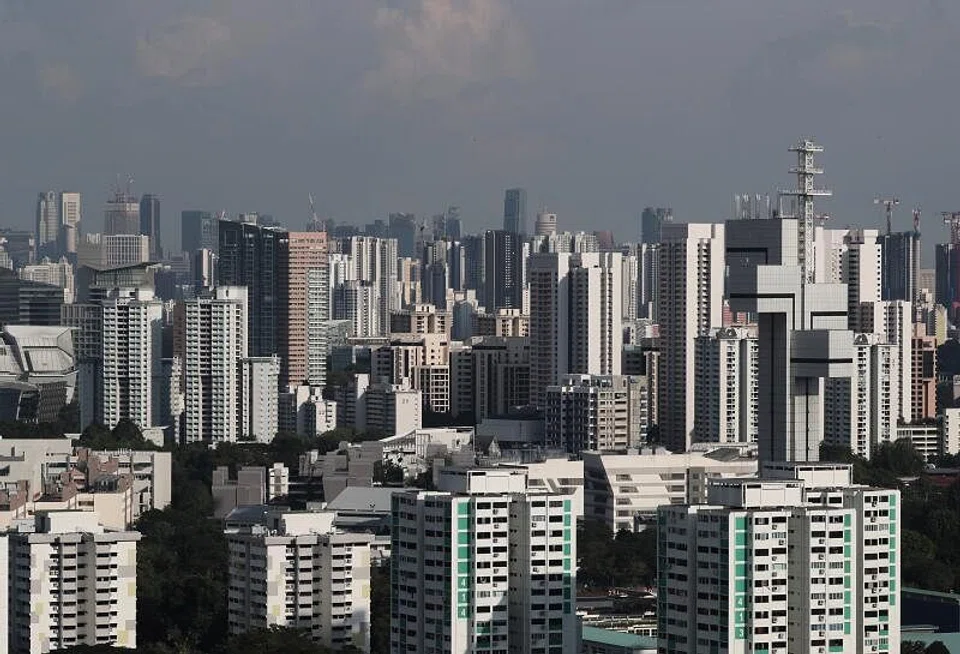
COOLING measures have been named as the biggest risk faced by Singapore's real-estate market, a poll among senior executives of real-estate firms has found.
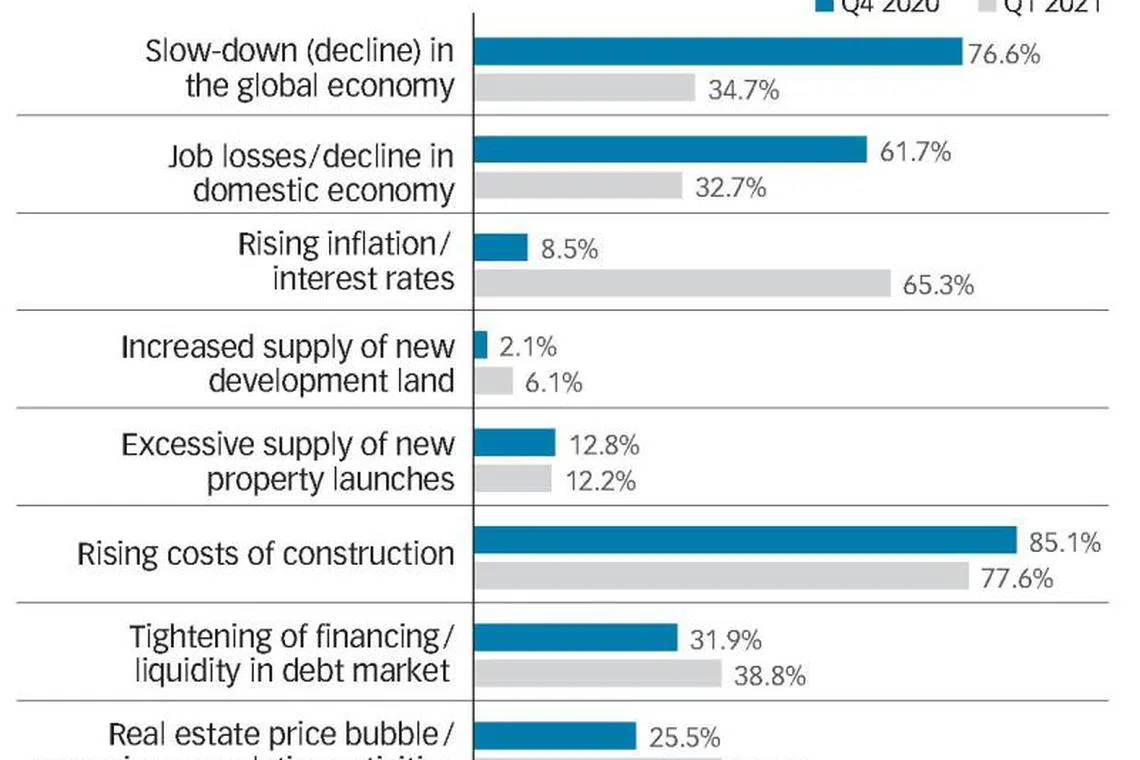
Of the approximately 50 such executives surveyed in March, 87.8 per cent indicated the possibility of cooling measures as a potential risk which may hit market sentiment in the next six months. This is almost double the previous quarter's 44.7 per cent.
This finding came from the latest Real Estate Sentiment Index published by the National University of Singapore Real Estate (NUS+RE), which represents the Department of Real Estate and the Institute of Real Estate and Urban Studies at the university.
The study's composite sentiment index, a derived indicator for overall real-estate market sentiment, rose for the fourth consecutive quarter since the lifting of the "circuit breaker" in Q3 2020.
On a 10-point scale, the index came in at 6.8 in the three months from its previous 6.5. Respondents commented that the market condition had improved in Q1 2021 and will continue to improve in the coming six months.
After cooling measures, the second biggest risk cited by the survey participants, who follow the pulse of the real-estate market, was rising construction costs - a factor named by three-quarters (77.6 per cent) of the respondents in the Q1 2021 poll. This proportion is slightly down from 85.1 per cent in Q4 2020.
The third biggest risk factor was rising inflation or interest rates. The proportion of respondents who indicated these in their answers jumped to 65.3 per cent from just 8.5 per cent last December. This category saw the biggest change in the two quarters.
In contrast, those who indicated job losses/a decline in domestic economy as a potential risk factor fell to 32.7 per cent from 61.7 per cent; those who were worried about the slowdown in the global economy halved to 34.7 per cent from 76.6 per cent.
Developers who were asked what their biggest concern relating to development costs cited rising labour cost. One developer said: "The construction industry is facing challenges in employing workers and the limited supply of migrant workers pushes up labour costs."
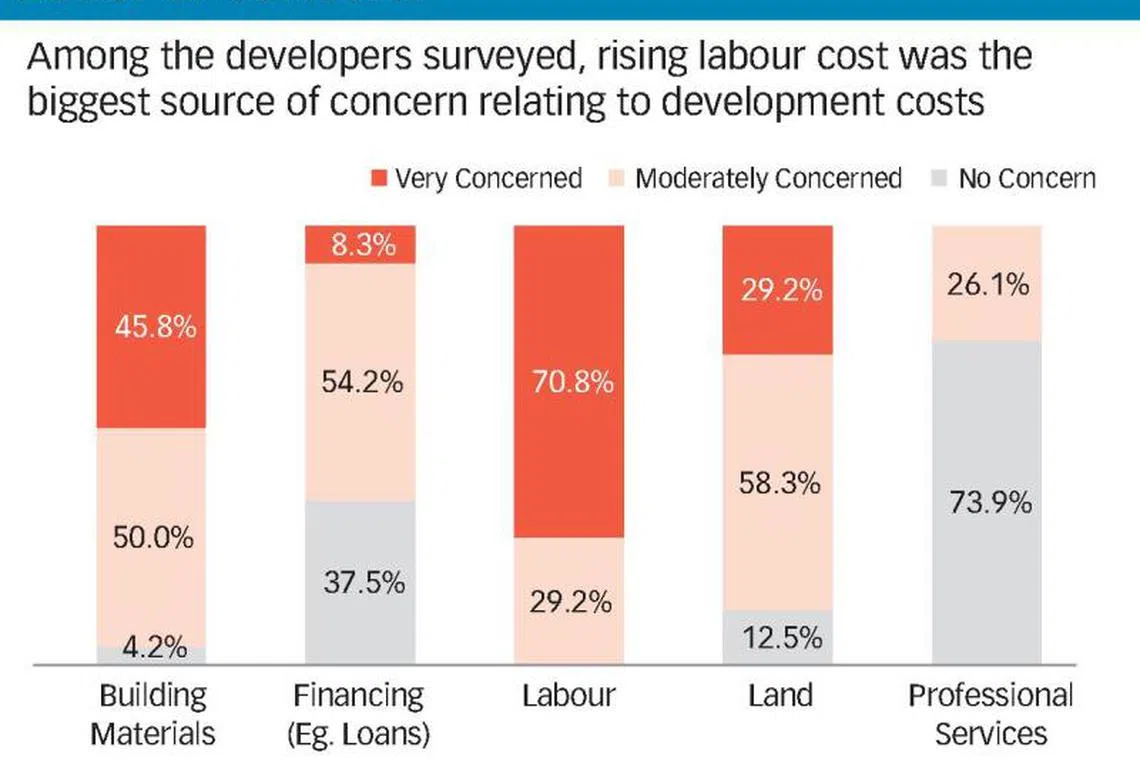
Seven in 10 (70.8 per cent) said they were "very concerned" about this; the remaining 29.2 per cent described it as a indicated "moderate" concern.
The cost of building materials was also named a major source of concern. Some 45.8 per cent said they were "very concerned"; 50 per cent were "moderately concerned".
In terms of future launches and sales, about 70 per cent expected the number of units launched to be moderately or substantially more in the next six months; 12.5 per cent predicted moderately fewer launches.
One survey participant said: "Developers would continue to push out more launches over the next six to 18 months for land parcels that were bought between 2016 to 2018, due to the additional buyers' stamp duty five-year completion requirements."
About half the developers surveyed expected moderately or substantially higher prices; 41.7 per cent predicted that prices of the new launches in the next six months will be at the same level as prices in Q1 2021.
"The improved market sentiment and the strong demand, coupled with the depleting pool of unsold units, will enable developers to settle at higher prices," said another respondent.
READ MORE: