GuocoLand's Midtown Modern to draw more families, retirees into city area

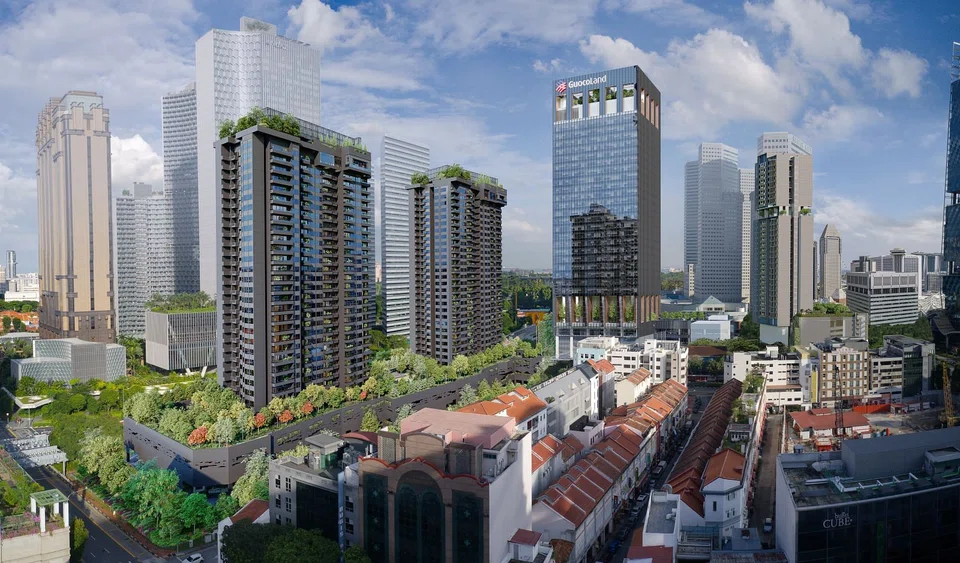
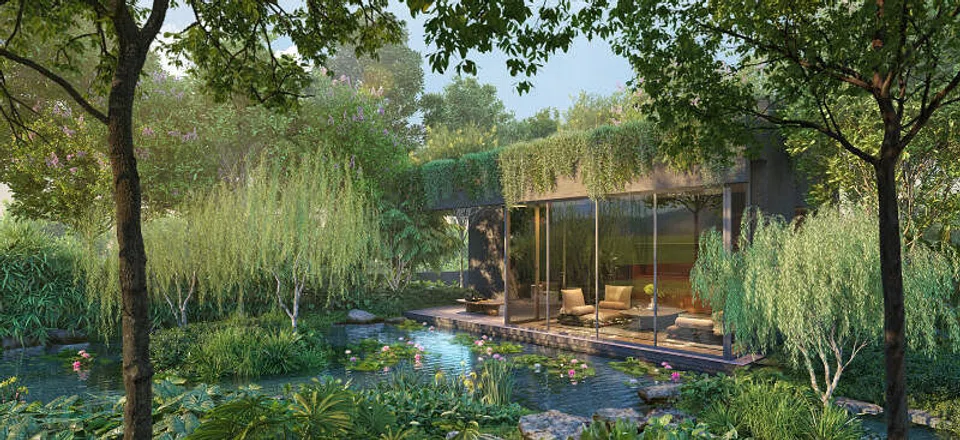
BIGGER apartments at GuocoLand's upcoming Midtown Modern condominium will target owner-occupiers from a buyer pool wider than typically seen in Singapore's central area.
This goes towards the property developer's long-term aspiration of creating a "very vibrant community" within its mega Guoco Midtown integrated development, said GuocoLand Singapore group managing director Cheng Hsing Yao.
Besides one- and two-bedroom units, the 99-year leasehold Midtown Modern will have a "significant" number of three- and four-bedroom units and two penthouses, he said in an interview with The Business Times (BT).
These could appeal particularly to families with children, and other owner-occupiers such as retirees and affluent individuals or households.
Such a wide product range is "a bit of a departure from most CBD (central business district) residential projects", which tend to garner strong investment demand and are thus mostly made up of one- to two-bedders that can be rented out to CBD workers, Mr Cheng noted.
The Singapore government has been looking at increasing the live-in population within the central area, and to achieve that, "you really have to attract the families", he added.
Another target buyer group would be retirees who are downsizing from landed homes and want to live in the city centre with easy access to food, shopping and amenities. Healthcare and medical services are a stone's throw away, too: Raffles Hospital is within walking distance of Midtown Modern.
Meanwhile, the smaller units will continue to appeal to investors, singles and young couples, Mr Cheng told BT.
"Our orientation is towards very strong owner-occupation," he said. GuocoLand is also aiming to attract long-term property investors, rather than buyers looking to maximise value in the short term.
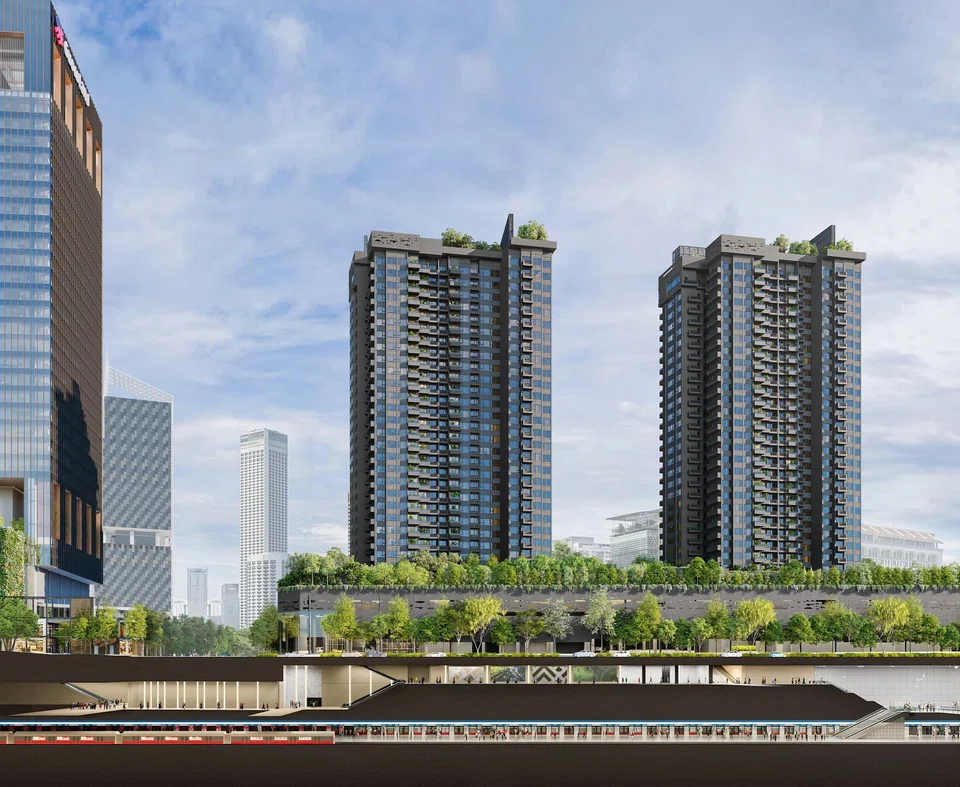
Midtown Modern will comprise two 30-storey towers with 558 units and a retail podium; almost half or 249 of the residential units are three or four-bedroom apartments.
The one-bedders are about 409-474 square feet (sq ft) each; the two-bedroom units are 592-721 sq ft; the three-bedders are 904-1,066 sq ft; the four-bedroom units are 1,432-1,464 sq ft; while the four-bedroom "premium" apartments are 1,733-1,808 sq ft each. Larger households may opt to buy two four-bedroom "premium" units and combine them into a duplex multi-generational family home.
The four-bedroom penthouse spans 3,272 sq ft and the five-bedroom penthouse, 3,520 sq ft.
Prices start from S$1.1 million or about S$2,400 per square foot (psf) for a one-bedroom apartment, and go up to nearly S$15 million or over S$4,200 psf for the bigger penthouse.
The luxury residential project will launch on March 20, 2021 and is expected to be completed in 2024.
Beyond the unit sizes, its one hectare (ha) of green spaces, full condo facilities - a 50-metre pool, tennis court, hot spring and large clubhouse - and direct access to the Bugis MRT interchange are other features that may appeal to a wider variety of buyers. Such amenities are not commonly seen in the CBD because sites there tend to be smaller.
A major selling point is the fact that the condominium is part of a multi-billion-dollar mixed-use project.
Guoco Midtown is the company's second flagship development, spanning 3.2 ha of prime land on Beach Road and Tan Quee Lan Street. To be completed in phases between 2022 and 2024, it comprises a 30-storey office tower with 770,000 sq ft of Grade A office space, a five-storey Network Hub, three retail clusters, public spaces, a collection of 30 thematic gardens, and two condominiums - Midtown Modern and the earlier launched Midtown Bay.
The 33-storey, 219-unit Midtown Bay, launched in October 2019, was designed as "business homes" or home offices and thus aimed at entrepreneurs and employees working from home. Over 70 apartments or one-third of the units there have been sold to date, at an average transaction price of close to S$3,000 psf, GuocoLand told BT. The highest psf price attained at Midtown Bay was S$3,882.
Meanwhile, the office tower, slated for completion in H2 2022, will feature a flexible leasing scheme and aim for a diverse tenant base, including large corporates and "some of the most dynamic companies in Singapore", Mr Cheng said.
"So there will be creatives and talented people in the offices, be it from the tech sector, trading firms or multinational corporations (MNCs); an entrepreneur-type ecosystem in Midtown Bay; and families and singles in Midtown Modern, all intermingling," he noted.
"Imagine a family with kids in secondary school or junior college, rubbing shoulders with 'techpreneurs' or MNC staff, for example... That will form a very exciting mix."
As to why the family aspect is important, he pointed out that GuocoLand will be holding Guoco Midtown's offices and retail components as long-term investment assets, thus the company has an interest in ensuring its product positioning for the residential portion "attracts the kind of community that will add to the right mix" for the overall integrated development. This is unlike a typical residential-only site, whereby developers exit after selling the units.
"When we build developments, we're very interested in the people occupying them," Mr Cheng told BT.
In creating the swathes of greenery in the mega project, GuocoLand thus went above and beyond the requirements in the tender guidelines, in part to improve the work environment and well-being of commercial tenants, residents and the public.
The 3.8 ha of thematic gardens and landscaped spaces spread across Guoco Midtown will be home to over 350 species of trees and flora. "When we planned the green spaces, we didn't see them as ornamental. We paid a lot of attention to biodiversity and also included a storytelling, heritage element in selecting the plant species," Mr Cheng said.
A third of the gardens in Guoco Midtown will be publicly accessible. There will also be three key public spaces; one of them is Midtown Common, located below Midtown Modern featuring more than 20,000 sq ft of retail area.
Although such public spaces require more investment, they may benefit GuocoLand's commercial tenants by bringing in more foot traffic, Mr Cheng said, citing the popular landscaped Urban Park at Guoco Tower as an example.
"It's not necessarily a zero-sum game. When the private sector takes a broader perspective and contributes more to the bigger picture, it can be good for business as well... Everybody will be better off."