

Industrial S-Reits' return on assets most resilient: IREUS
Most S-Reits' ROAAs declined in FY2020, with hospitality, retail, healthcare players slipping into negative territory

Singapore
AMONG Singapore-listed real estate investment trusts (S-Reits), the industrial sector took the smallest hit to their return on average assets (ROAA) from the Covid-19 crisis.
Industrial S-Reits averaged a dip of just 0.5 percentage points in fiscal 2020, from the previous year, showed data from S&P Capital IQ Pro.
ROAA is an indicator of how profitable a company is, relative to its average assets.
In its analysis of the data, the Institute of Real Estate and Urban Studies (IREUS) noted that most S-Reits' ROAAs declined in FY2020, with retail, hospitality and healthcare players slipping into negative territory.
Lee Nai Jia, deputy director of IREUS at the National University of Singapore, said that during FY2021, the vaccine rollout and progressive economic reopening boosted ROAAs of some S-Reits in the first two fiscal quarters. However, ROAAs for others were dragged by acquisitions or incomes that were yet to be realised.
Diversified S-Reits' average ROAA fell 3 percentage points to 3.4 per cent in FY2020. On a quarterly basis, their numbers stayed "very consistent", within a narrow band of 2.3 per cent to 3.1 per cent from Q2 FY2020 to Q2 FY2021, Dr Lee said.
"While diversified S-Reits were affected by the pandemic, many were also repositioning their portfolios, and these strategic acquisitions and divestments helped returns stay consistent," he added.
As for industrial S-Reits, three have financial years ending on March 31, which contributed to the sector's resilience, as the pandemic's impact had become less severe by then.
Still, even after factoring in FY2021 numbers for the trio, industrial names' average remained robust, easing by a mild 1.3 percentage points to 2.1 per cent, from FY2019. "All industrial Reits, except Sabana Reit, recorded positive ROAAs," Dr Lee said.
Within the sector, data centre-focused Keppel DC Reit enjoyed the biggest upside, amid rising demand for cloud computing. Its ROAA went up to 5.5 per cent in FY2020, exceeding the sector average of 2.9 per cent.
Industrial players focusing on logistics properties had higher ROAAs than those that held a mix of logistics, business parks, high-spec factories and data centres.
By quarter, the sector average rose to 4.7 per cent in Q3 FY2020, from 3 per cent in Q2.
However, it fell to 2.8 per cent in Q2 FY2021 due to asset acquisitions, Dr Lee said. This decline may, again, also be partly attributed to the financial reporting periods.
"For example, Aims Apac Reit's Q2 FY2021 ended on Sept 30, 2020. Its ROAA became negative that quarter, but rebounded to 2.4 per cent in Q3 FY2021 and 3.9 per cent in Q1 FY2022," Dr Lee noted.
"Industrial S-Reits will likely conduct more strategic repositionings of their portfolios. Their quarterly ROAAs may hence see greater fluctuations," he added.
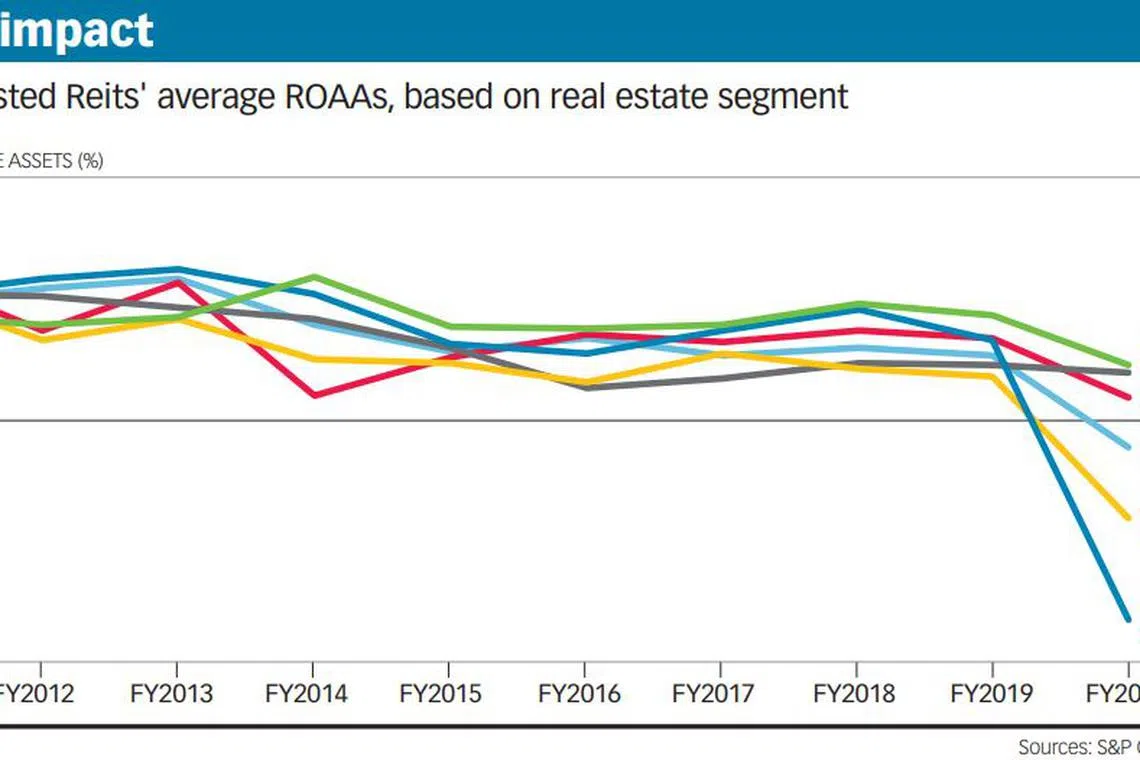
Office S-Reits' ROAAs were steady, ranging from 2.4 per cent to 2.8 per cent in the first two quarters of fiscal 2021. This was an improvement from their 1.3 per cent average in FY2020.
Hospitality players' returns shrank the most among S-Reits due to stringent border controls; all of them recorded negative numbers in the last financial year. On average, hospitality S-Reits recorded negative 6.1 per cent ROAA in FY2020, versus a positive 2.7 per cent in FY2019.
ARA US Hospitality Trust, whose entire portfolio is in the United States, endured the steepest downside with a negative 12.6 per cent ROAA in FY2020.
Based on S-Reits' annual reports, hotels in Singapore seemed more resilient than those in countries with more Covid-19 cases and lockdowns.
"In Singapore, support from government contracts to lease hotels as isolation facilities and from companies to accommodate Malaysian workers helped cushion the decline in revenues," Dr Lee noted. Singapore hotels also saw healthy staycation demand, although room rates stayed soft due to the lack of tourists, he added.
In Q1 and Q2 of fiscal 2021, the quarterly ROAA of hospitality S-Reits returned to positive territory, boosted by domestic demand and government contracts, but remained subdued when compared to the quarterly levels in FY2018 and FY2019.
Dr Lee expects those holding Singapore hotels to see returns improve further next year, given the Republic's new Vaccinated Travel Lane.
"But any increase in ROAAs could be limited, considering the fluidity of the Covid-19 situation and uncertainty in tourism flows," he added.
The retail sector's average ROAA for FY2020 was negative 1.7 per cent. Although the quarterly returns bounced back to positive levels in Q1 and Q2 FY2021, they remained weak.
Retail S-Reits holding Singapore assets hovered between 2.2 per cent and 2.9 per cent in the first two quarters of FY2021, while their Chinafocused counterparts had ROAA ranging from 2.3 per cent to 4.4 per cent. In contrast, Lippo Malls Indonesia Retail Trust stayed in negative territory.
Dr Lee foresees ROAAs to remain positive for the China and Singapore retail S-Reits.
As for the healthcare sector, which has only two S-Reits, the sharp ROAA decline from First Reit brought down the overall average last year. First Reit and Parkway Life Reit went on to post strong quarterly ROAA this year, averaging 4.8 per cent in Q1 FY2021, up from 2.9 per cent a year ago.
Due to the pandemic, Indonesiafocused First Reit had halted operations at some assets that were integrated with either hotels or malls. Its healthcare assets were also hit by a slump in patient volumes last year when some visits and procedures were deferred.
"As governments grapple with episodes of Covid-19 resurgence, there may be periods of shutdowns, which will in turn depress returns for S-Reits," Dr Lee said.
READ MORE:
TRENDING NOW

LTA proposes combining car COE categories, adding rebate-surcharge system

StarHub to acquire MyRepublic’s mobile business amid ongoing telco consolidation

DBS, OCBC, UOB rout lops billions off STI as inflation, rate concerns spook investors

Grab CEO’s wife Chloe Tong on life with Anthony Tan and finding her purpose

