

Industrial sector to continue doing well: IREUS
Lisa Kriwangko
THE industrial sector is expected to “continue doing well” on the back of manufacturing growth, a report from National University of Singapore’s Institute of Real Estate and Urban Studies (IREUS) said.
According to the Ministry of Trade and Industry, the manufacturing sector grew 7.9 per cent in Q1 2022, and is expected to expand by 8 per cent year-on-year in the second quarter this year.
“However, recent interest rate hikes by the US Fed to keep inflation in check may slow down demand and expansion. According to the head of the IMF (International Monetary Fund), the outlook for the global economy has darkened significantly in recent months, and the world faces an increasing risk of recession in the next 12 months,” said IREUS.
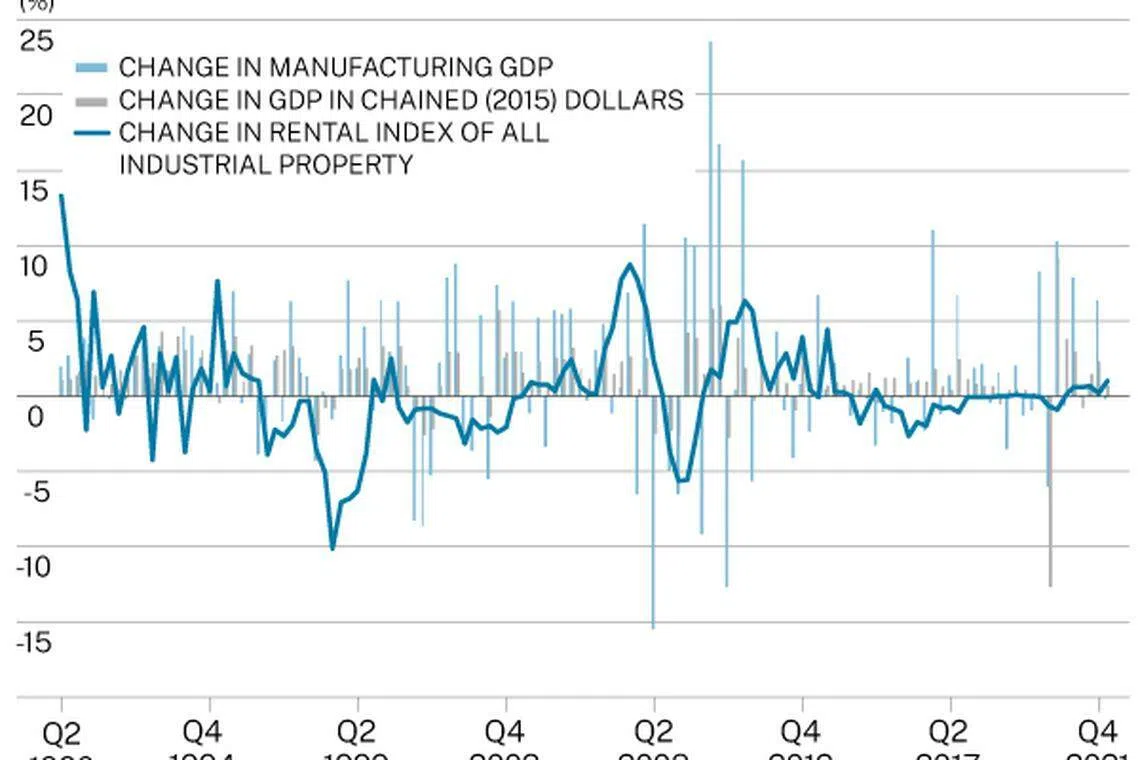
The institute regarded the industrial sector as a “green shoot” during the pandemic, boosted by e-commerce growth, stockpiling of food and strong demand for semiconductors. After declining in the first 3 quarters of 2020, industrial rents grew for 6 straight quarters from Q4 2020 to Q1 2022.
Disruption in construction further limited supply and bolstered rents. The average net supply of industrial space in 2020 and 2021 was about 500,000 sq m per year, much lower than that of 2010 to 2019 at 1.3 million sq m per year.
That said, industrial rents have declined in tandem with the last 3 recessions and lagged behind the economy during recovery, the report added.
The biggest drop was seen during the Asian Financial Crisis, exacerbated by a surge in supply. After industrial rents reached a historic high in Q2 1996, supply was ramped up to moderate rents and meet demand, reaching close to 2 million square metres (sq m) for the whole year 1996. Rents started to slide correspondingly in Q3 that year, amplified by the external shock of recession.
The subsequent recessions caused greater impact in Singapore’s manufacturing sector, but industrial rent drops were more modest then. This was because rents started from a lower base during the Dotcom Crash and the Global Financial Crisis compared to that in 1998.
IREUS added that rents tend to be stable when the economy is doing well as the government uses supply-side policies to manage volatility. However, IREUS deputy director Lee Nai Jia noted that it is difficult to accurately time and calibrate supply due to the unpredictable nature of economic shocks.
“While there is much scope for the manufacturing sector to expand further, the downside risks are significant as well. Hence, it may be time to review some of the restrictions, such as subletting restrictions, to allow firms to navigate this uncertain period,” he said.
TRENDING NOW

LTA proposes combining car COE categories, adding rebate-surcharge system

StarHub to acquire MyRepublic’s mobile business amid ongoing telco consolidation

DBS, OCBC, UOB rout lops billions off STI as inflation, rate concerns spook investors

Grab CEO’s wife Chloe Tong on life with Anthony Tan and finding her purpose

