New retailers sprouting in Singapore, but more shop spaces stand empty
This has been attributed to budding retailers setting up and operating from home during the pandemic

Singapore
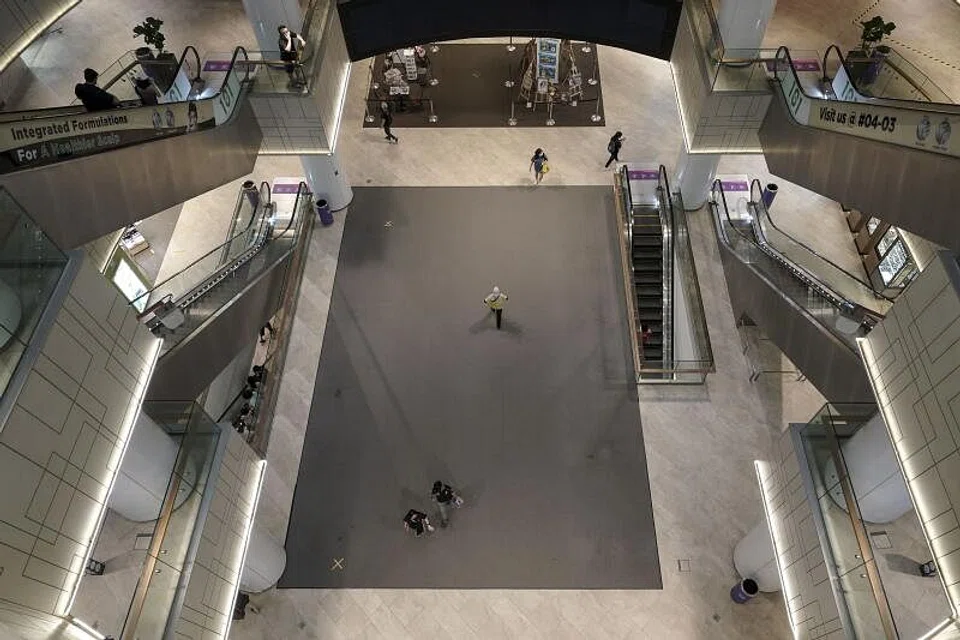
MANY brick-and-mortar shops are likely to remain unoccupied even if the overall number of businesses in the sector continues to grow, with more retailers working from home and starting their ventures online.
Going by data compiled by the Institute of Real Estate and Urban Studies (IREUS) at the National University of Singapore, the take-up of retail units across Singapore has been slow despite a net increase in retail entities from pre-pandemic levels.
IREUS deputy director Lee Nai Jia foresees more budding retailers focusing on building their online platforms and operating from home, as e-commerce gains popularity and consumers avoid crowded malls during this coronavirus outbreak.
This is especially so after the country's recent uptick in Covid-19 cases and the restrictions during its Phase Two (Heightened Alert) period, which started on May 16 and runs through June 13.
When the number of new cases falls and more people get vaccinated, some online retailers may decide to shift to or add a brick-and-mortar presence to widen their reach to customers. However, a cautious approach can be expected, with some of these entrepreneurs possibly starting with pop-up stores to test the market, Dr Lee said. Pop-up stores are short-term, smaller venues usually operating days or weeks. They often require less space than typical retail outlets, and offer a relatively low-cost way to generate brand awareness or to put new products and services through a dry run.
"As a result, the number of new entity formations in the retail sector may diverge from the take-up rate of physical space," Dr Lee said.
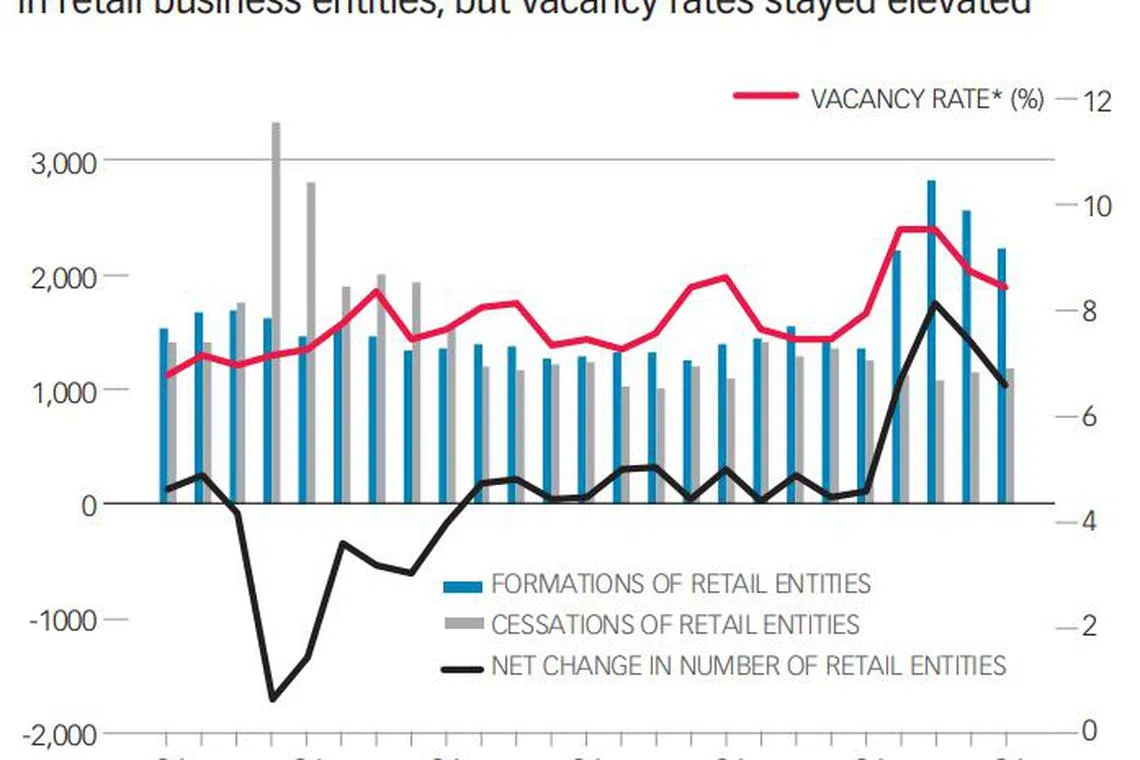
Vacancy rates of retail space island-wide have stayed elevated since last year. They eased to 8.5 per cent in Q1 2021 from 9.6 per cent in Q3 2020, as net absorption registered its second straight quarter of increase, at 301,389 square feet, CBRE Research said in a recent commentary.
Still, the latest vacancy rate exceeded the quarterly average of about 7.9 per cent in 2019 before the coronavirus outbreak reached Singapore shores, Dr Lee noted.
That appeared to be at odds with the bigger net increase in retailers of late, compared with prior years.
In Q1 2021, formations of business entities in the retail trade sector exceeded cessations by 1,043, based on data from the Accounting and Corporate Regulatory Authority (Acra).
In 2020, even as the Covid-19 crisis raged on, the full-year net increase in retail entities totalled 4,345, several times higher than the 651 net increase in 2019.
A possible reason for vacancy rates not falling significantly is that home-based and online retailers probably contributed to the surge in new entities, Dr Lee suggested. Some individuals who lost their jobs in the pandemic turned to home-based businesses to generate income, he added.
The Business Times earlier reported that industry observers expect the number of home-based businesses to keep growing, although moving offline would be a tough sell because of the high brick-and-mortar overheads. Singapore retail rents are projected to decline 7 per cent this year, and rise 1.8 per cent next year and then jump by 4.8 per cent in 2023, said the Urban Land Institute.
Some 2,820 new business entities mushroomed in the retail trade sector in Q3 2020, climbing 82 per cent from the year-ago period. It was also the highest figure since Q4 2014, when 3,722 were set up.
Although the number of retail entities formed eased to 2,236 in Q1 2021, it remained "way above" the average of about 1,450 formations per quarter in 2019, Dr Lee said.
Meanwhile, the number of retail business entities that ceased operations stayed below 1,200 each quarter from Q2 2020 to Q1 2021, fewer than 2019's average quarterly figure of around 1,290.
Part of this came as the retail sector's recovery in recent quarters was helped by the economy's progressive reopening and Singapore's vaccination drive, he noted. Retailers' digital transformation, made possible by support measures and grants from the government and also sped up by consumers' shift to online shopping, likely staved off cessations for some businesses as well, he added.
Moreover, Acra has extended the time for parties to respond to notices for the striking-off applications by companies and limited liability partnerships due to the pandemic and Singapore's "circuit breaker" last year. That had a consequential effect on the published cessation statistics for August-October 2020, Acra said.
READ MORE: