

Retail rents could see short-term pressure before recovering in 2022

RETAIL property rents could face further pressure in the near term, following the extension of safe-management measures, but analysts say that a recovery could be on the cards in 2022 as restrictions ease and Singapore introduces more vaccinated travel lanes (VTLs).
The Urban Redevelopment Authority’s (URA) retail rental index, released on Friday (Oct 22), showed that rents in the central region continued to retreat in the third quarter, falling by a sharper 2.7 per cent after chalking up a 0.5 per cent dip in Q2.
This is the seventh consecutive quarter of decline, with dining limited to groups of two vaccinated individuals and many employees continuing to work from home (WFH).
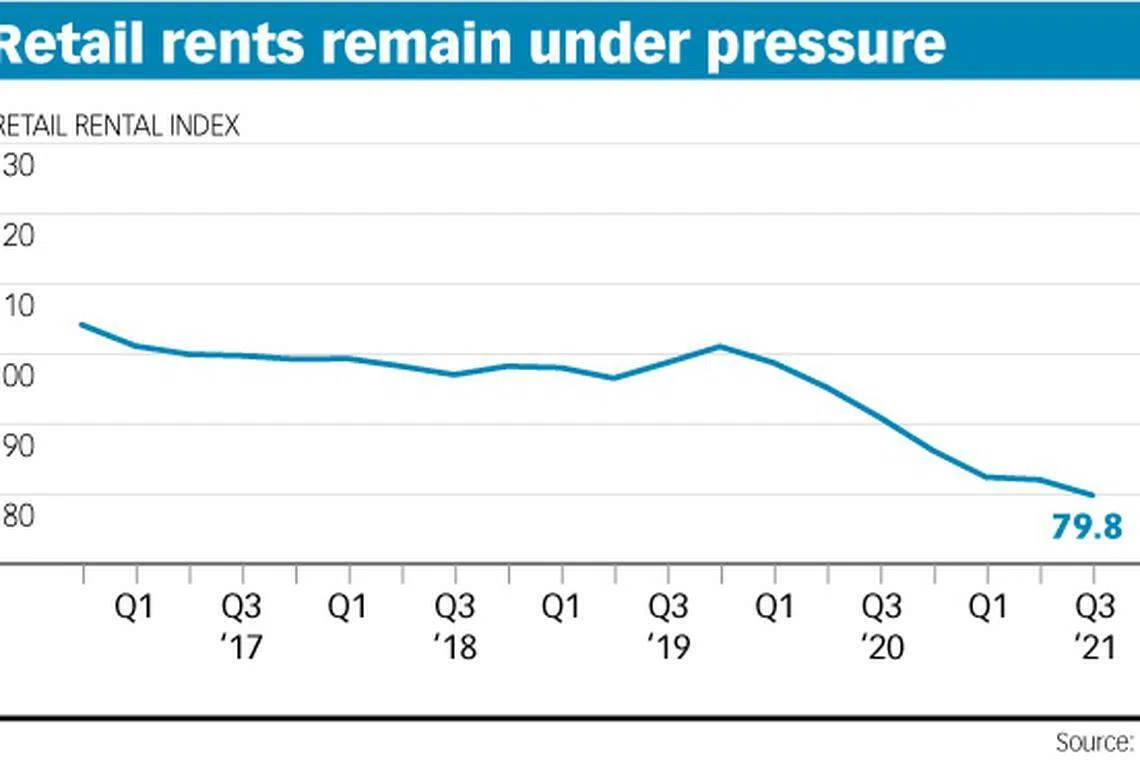
However, in the fringe areas, where certain malls continue to be thronged by the WFH crowd, the rent correction moderated, easing 1.2 per cent quarter on quarter in Q3 after a 1.4 per cent drop in Q2, noted JLL consulting director for research and consultancy Angelia Phua.
Meanwhile, the prices of retail spaces in the central region remained flat in Q3, following a decline of 2.8 per cent in Q2.
According to Knight Frank, retail rents have slumped by 7.4 per cent in the first 3 quarters of this year as Singapore repeatedly tightened and loosened restrictions to combat the resurgence in Covid-19 cases. Retail prices have eased 6 per cent in the first 9 months of this year.
Lam Chern Woon, head of research and consulting at Edmund Tie, noted that location ultimately matters when it comes to the impact on retail rents. He said: “Landlords of assets in the prime shopping belts and city areas remain more flexible on rental negotiations, given the lacklustre tourism market and the continued thinning of office crowds. On the other hand, the suburban retail market is holding up better, benefiting from the immediate residential catchments.”
On an island-wide basis, as at the end of Q3 2021, there was a total supply of 428,000 square metres (sq m) gross floor area of retail space from projects in the pipeline, up 2.1 per cent from 419,000 sq m as at the end of Q2 2021.
The amount of occupied retail space expanded by 33,000 sq m net lettable area (NLA) in Q3 2021, up from an increase of 14,000 sq m NLA in the previous quarter. The stock of retail space increased by 7,000 sq m NLA in Q3 2021, following a larger 18,000 sq m increase in the previous quarter.
Leonard Tay, head of research for Knight Frank, pointed out that with leisure travel limited to the vaccinated travel lane (VTL) scheme, consumers have been seeking new activities or places to explore in the city-state. This in turn has given rise to greater entrepreneurship as well as the expansion of existing businesses. Going by Acra business registry data extracted by Knight Frank, 3,175 new businesses in the retail trade and food-and-beverage (F&B) services sectors were established in the third quarter of this year.
Tay said: “Even though the stock of retail space increased by 75,347 square feet (sq ft) in the third quarter, the amount of occupied retail space grew by about 355,209 sq ft, compared to the growth of 150,695 sq ft in Q2. Certain retailers such as Don Don Donki and Decathlon also continued to expand in spite of the pandemic.”
There were also new entrants to the market, such as the restaurant Eggslut at Scotts Square and E-sports Experience Centre, which launched a 12,000 sq ft store at Kallang Wave Mall, Phua noted.
Meanwhile, the island-wide vacancy rate of retail space fell from 8.5 per cent as at end-Q2 2021 to 8.1 per cent as at end-Q3 2021.
Despite the headwinds, some retailers seem open to setting up shop, especially if they can lock in favourable rents. Lam said: “Encouragingly, the vacancy rate fell across all the various submarkets, signalling that retailers with strong branding and innovative concepts remain on the lookout for opportunities to leverage the soft retail rental climate and expand their physical footprint.”
CBRE’s head of research (South-east Asia), Tricia Song highlighted that the vacancy rate in the downtown core eased from 11.9 per cent in Q2 to 11.2 per cent in Q3. Similarly, the retail vacancy rate in Outside Central Region declined for the fifth straight quarter from 5 per cent in Q2 to 4.8 per cent in Q3, she added.
Vacancy rates in the Orchard area improved to 11.6 per cent in Q3 from 11.8 per cent in Q2 as a fall in net supply outpaced a drop in net demand, said Cushman & Wakefield’s head of research Wong Xian Yang. He said: “Coveted brands are expected to continue selecting prime retail areas in Orchard, securing current appealing rents as they forge ahead in the gradual reopening of the economy.”
Typically the destination of choice for international brands, Singapore’s primier shopping belt has pulled in some local brands, which have taken up space in prime malls this year, Wong pointed out. As the gradual re-opening of borders brings tourists back to Singapore’s shores, the Orchard retail market should see further upside, he added.
Looking ahead, JLL’s Phua expects that retailer confidence may be dented by the latest extension in safe-management measures, with rents likely “succumbing to further pressure in the short-term.” But Singapore’s transition to endemic living, along with the VTLs and re-opening of Singapore’s economy, should “push vacancy rates lower and support a rent recovery in 2022,” she went on to say.
Knight Frank’s Tay added: “If restrictions are eased by November, coupled with more VTLs, the pace of rental declines may slow down by the end of the year, with the sector poised to make a gradual recovery in 2022.”
TRENDING NOW

Despite the de-dollarisation debate, demand for dollar liquidity in Asia is growing
URA to review guidelines on floor space to give developers more design flexibility: Chee Hong Tat

He built the Vingroup empire. Now South-east Asia’s richest man is handing some key roles to his sons
Can a first-time homebuyer couple earning S$18,000 a month afford a new EC unit?

