

Retail rents seen falling up to 15% this year as pandemic bites
Prime suburban malls most resilient, while most desirable tenants could get several months rent free
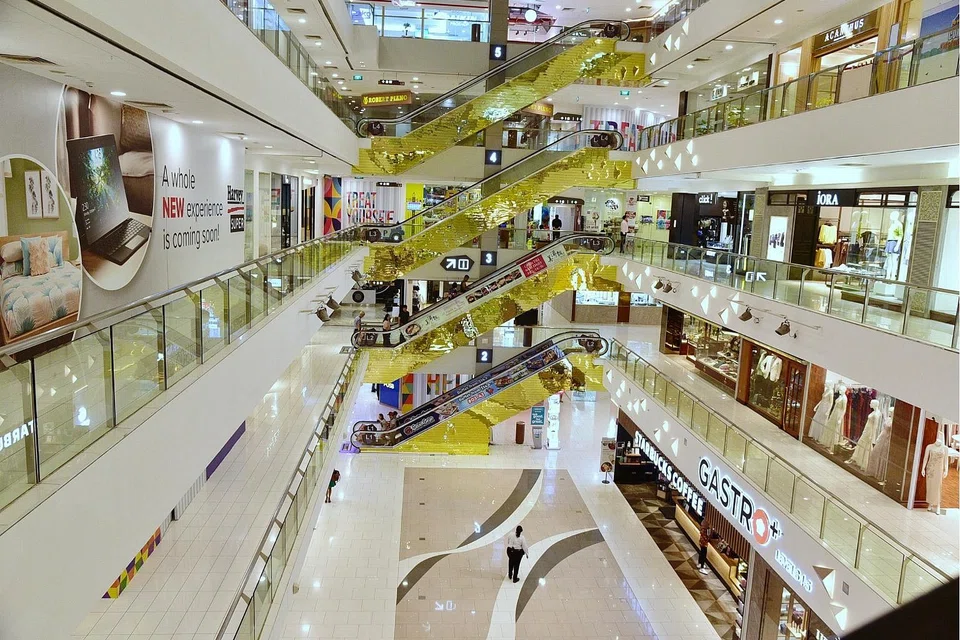
SHOPPING malls in Singapore have been quite beaten down by Covid-19 this year, but as in all things, some have held up better than others.
Retail rents in prime suburban malls on transport nodes are projected to fall about 5 per cent in 2020 while the rest are expected to decline as much as 15 per cent.
Tenants with staying power now have the upper hand, and the most desirable ones may be able to demand six months of free rent when it is time to renew leases or sign new ones.
Adding to their woes, landlords are staring at an upcoming supply of 3.9 million square feet (sq ft) over the next four years, according to a Knight Frank Q2 2020 retail report. The current stock of retail space in Q2 2020 is 66.9 million sq ft.
Impacted by the circuit breaker measures that impeded business operations of many retailers, island-wide prime retail rents fell by 5.4 per cent year-on-year (y-o-y) to an average of S$28.90 per square-foot per month in the second quarter of this year, said Knight Frank.
Average prime retail rents in all locations declined in the second quarter, as many retailers were unable to cope with the effects of the pandemic and exited the market, despite rental waivers granted by the respective landlords, it said.
The islandwide vacancy rate for retail space rose to 9.6 per cent as at the end of the second quarter of this year, from 8 per cent as at the end of the previous quarter.
The retail sector will likely continue to face challenging times in the remaining half of 2020, adjusting to the economic impact and after-effects wrought by the circuit breaker measures between April 7 and June 1, said Leonard Tay, Knight Frank Singapore head of research.
"For the whole of 2020, retail rents could fall by about 15 per cent," he said.
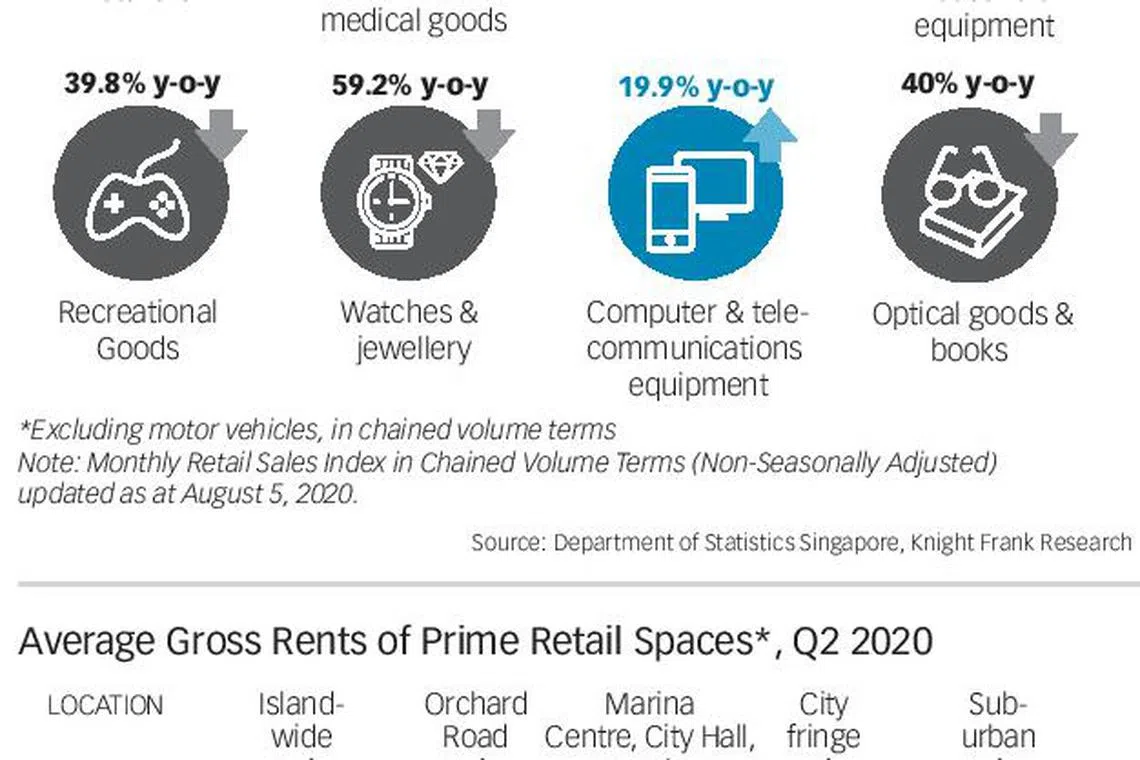
The retail sales index in June fell 25.2 per cent y-o-y, the 17th consecutive month-on-month decrease since February 2019.
Supermarkets and hypermarkets continued to record the largest increase in sales, surging 41.7 per cent y-o-y.
Computer and telco equipment sales also rose strongly, up 19.9 y-o-y. Sales from minimart and convenience stores rose 5.4 per cent y-o-y.
Everything else fell, the sharpest were in sales of discretionary and luxury goods such as clothes and shoes (-61.9 per cent) and watches and jewellery (-59.2 per cent). Department store sales plunged 68.4 per cent.
"For the whole of 2020, we expect prime rents in Orchard and other city area to fall by about 10 per cent each and suburban prime rents to fall by 5 per cent," said Christine Li, Cushman & Wakefield, head of research, Singapore and South-east Asia.
The worst hit retail malls are those in the Marina Centre areas as these depend on tourism and office trades, said Desmond Sim, CBRE's head of research, South-east Asia.
Rents in these areas, which include Suntec, Marina Bay Sands and Marina Square, could fall by 10 to 12 per cent, he said.
Rents in the Orchard Road area is expected to drop about 10 per cent because while it relies on tourists, malls there have locals shopping too, he said.
The prime suburban malls with transport nodes and supermarkets are more resilient and projected rent decline is a smaller 5 per cent, said Mr Sim.
Drilling further, rents holding up best are shops located in the first floor and basement one, he said.
"Prior to Covid-19, we were already seeing a two-tier retail market. Covid-19 is a wedge that drove this more," said Mr Sim.
As for when retail rents will stabilise, Mr Sim said that's the million dollar question which depends on an effective vaccine being found.
"At the end of the day, for the retail market to spring back, the solution to the pandemic is a vaccine which will bring back business confidence to spur the spending mood," he said.
Knight Frank's Mr Tay said: "Next year, should there be no recurring waves of the Covid-19 outbreak in the community in Singapore, no further circuit breaker measures and a viable vaccine becomes available, the retail sector could take between six and 12 months to stabilise with rents generally plateauing for some time before recovery gains momentum and rents turn a corner."
Retails rents could possibly rise moderately in the second half of next year, he added.
Tenants will have the upper hand during this period, especially those signing new leases or renewals. Retail leases are typically three years.
Many landlords are working to increase footfall, marketing and help with cash flow, said CBRE's Mr Sim, adding that rental correction is not the only thing to do.
"Cash rebate, such as rent free periods, incentives or other handouts can be parked under operational or marketing expenditure for landlords. These do not erode their rent as much so when the market stabilises, then it would not be so difficult to claw back," said Mr Sim.
He expects landlords will give longer rent free periods such as three months.
"For new leases, it could stretch to six months for a 'desired' tenant, but it's not common yet," he said.
Giving six months' free rent happened in previous economic crises, such as the 2003 Severe Acute Respiratory Syndrome (Sars), and the 2009 Global Financial Crisis.
Cushman's Ms Li said landlords continue to provide rent free fit-out of four weeks depending on space size.
For renewals, some landlords have given extra rent holidays and she has seen cases given maximum two months of rent holiday for three-year leases.
Ethan Hsu, Knight Frank Singapore's head of retail, said landlords are responding creatively by packaging their commercial lease terms with longer rent-free fitting-out periods, switching to a higher turnover rent component instead of a high base rent and incorporating rent holidays during the lease term, to cushion the impact of the pandemic crisis.
"Landlords are also more forthcoming in lending support for new tenants, with many open to a staggered structure to assist tenants in the earlier years of the lease term which is when they need the most help," he said.
"For retailers with unique concepts that are deemed desirable by the landlord, more flexibility can be expected in order to incentivise the operator to set up shop and bring in shoppers, which would in turn drive more footfall traffic to the mall."






