

S-Reits more leveraged but still cautious in taking up new debt obligations: IREUS
Some trusts have already lowered their leverage by Q2 this year; hospitality names chalk up some of the largest jumps in FY2020 debt ratios


Singapore
THE average debt ratios of Singapore-listed real estate investment trusts (S-Reits) went up amid the Covid-19 pandemic, with those in the hospitality sectors clocking some of the biggest increases.
Nonetheless, S-Reits remained disciplined in taking up new debt obligations, and some had already lowered their leverage by Q2 this year, according to the Institute of Real Estate and Urban Studies' (IREUS) analysis of data from S&P Capital IQ Pro.
"Despite having greater leeway to raise debt, most S-Reits kept their leverage ratios below 45 per cent in FY2020," said Lee Nai Jia, deputy director of IREUS at the National University of Singapore.
Last April, the Monetary Authority of Singapore raised the leverage limit for S-Reits to 50 per cent, from 45 per cent, to offer them more flexibility to manage their capital structures amid the challenging environment resulting from the Covid-19 outbreak.
"Only two S-Reits - healthcare-focused First Reit and hotels-focused ARA US Hospitality Trust - exceeded 45 per cent in FY2020. The rest hovered between 28 per cent and 44 per cent," Dr Lee added.
The institute's analysis excluded three Reits that listed in late 2019 and 2020 as their time series were deemed too short for comparison: Lendlease Global Commercial Reit, Elite Commercial Reit and United Hampshire US Reit. Eagle Hospitality Trust was also excluded, as trading in its units was suspended last March.
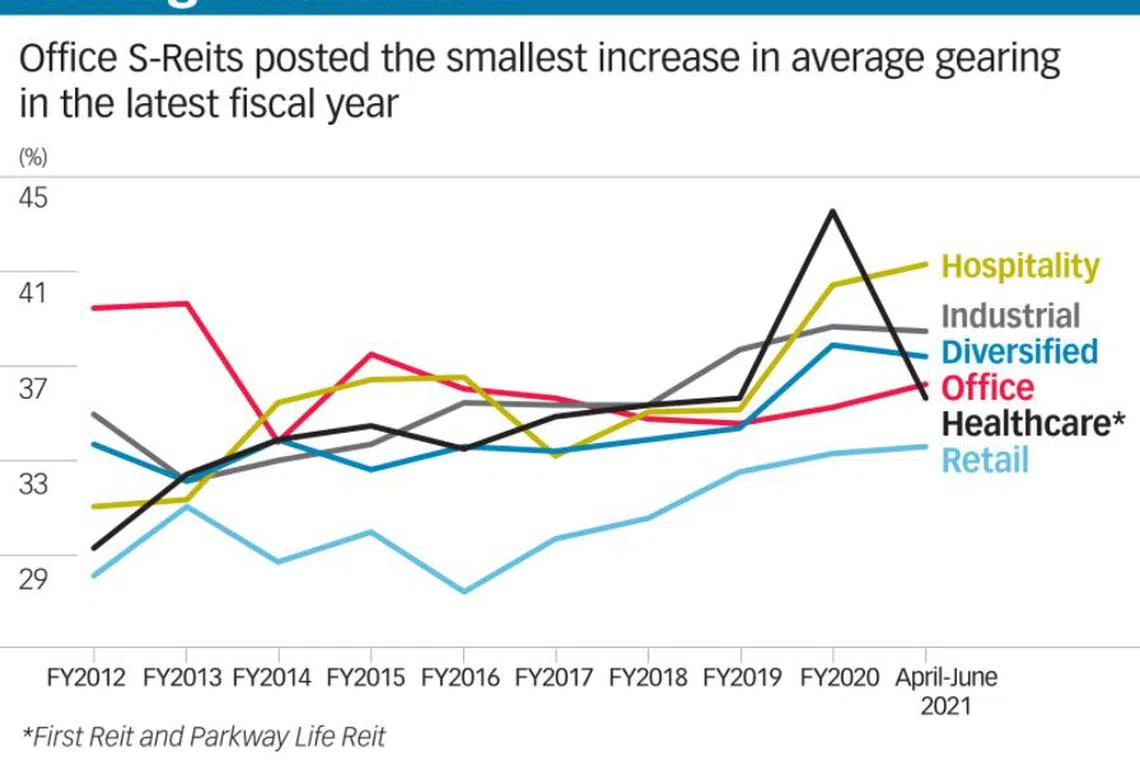
By sector, and excluding the two healthcare S-Reits, hospitality names on average chalked up the largest jump in debt ratios, while office S-Reits posted the smallest increase.
The average gearing of hospitality S-Reits rose to 40.4 per cent in FY2020, up 5.3 percentage points from 35.1 per cent in FY2019.
"This increase was not surprising, considering that the sector was badly hit by international border controls that crippled tourism," Dr Lee said.
The marked uptick in debt ratios came as hospitality S-Reits, in general, borrowed more while portfolio valuations weakened.
In FY2020, the year-on-year increase in debt averaged 11 per cent for the sector, alongside a 4 per cent drop in their asset values, according to IREUS' analysis.
"However, there are early signs that the hospitality Reits are trying to keep their debt obligations in check, even while they wait for portfolio valuations to stabilise," Dr Lee said.
For instance, Ascott Residence Trust (ART) has lowered its gearing slightly in Q2 2021. ART reported that its gearing stood at 35.9 per cent as at June 30, 2021, down from 36.3 per cent as at Dec 31, 2020.
In the retail sector, average debt ratios inched up by just 0.8 percentage points in FY2020, far milder than hospitality S-Reits' increase, even though both sectors bore the brunt of the pandemic's impact.
Dr Lee noted that the rise in gearing for retail names was moderated by those with exposure to the Chinese market - Sasseur Reit and BHG Retail Reit - which maintained their debt ratios in the past year. CGS-CIMB analysts wrote last month that Sasseur Reit's Q2 2021 sales at its outlet malls grew 6.4 per cent, and they expected the long-term uptrend for outlet malls to remain intact in China.
Said Dr Lee: "These China-centric retail S-Reits have also continued to keep their leverage at roughly the same levels by Q2 2021."
Office S-Reits' average debt ratios crept up by less than one percentage point, to 35.2 per cent in FY2020 compared with 34.5 per cent in FY2019.
"While office S-Reits' debts have increased, the value of their assets likewise appreciated. The office sector has enjoyed rising rents and prices, especially with Chinese tech giants like Alibaba, Tencent and ByteDance expanding or setting up operations here," Dr Lee said.
On the industrial front, average gearing expanded by one percentage point in FY2020. Five industrial S-Reits raised their leverage, but four reduced their ratios.
Keppel DC Reit had the biggest surge in total debt for FY2020 among industrial names, but it also posted the largest percentage growth in total assets, S&P Capital IQ data showed. DBS Group Research this week said Keppel DC Reit's low gearing will enable it to embark on fully debt-funded, highly accretive acquisitions.
Among diversified S-Reits with exposure to multiple property sectors, the average debt ratio rose 3.5 percentage points to 37.8 per cent in FY2020.
"The Covid-19 situation remains fluid, and Reits need to keep credit risks low in the event they need to borrow for future exigencies," Dr Lee noted. "Also, interest rates may be low now, but the reliance on short-term debt will increase refinancing risks especially when rates normalise or if there is a credit crunch."
In the healthcare sector, there are only two S-Reits: First Reit and Parkway Life Reit.
Moreover, one has double the amount of debts of the other, and they have also deleveraged to substantially different extents, thus making it hard to discern any meaningful trend in gearing within the sector, Dr Lee added.
READ MORE:
TRENDING NOW

Prima to move out of historic Keppel Road flour mill building in 2028

Grab CEO’s wife Chloe Tong on life with Anthony Tan and finding her purpose

OCBC sheds S$8 billion in value as shares close nearly 6% down; analysts cautious on banks

As Asia’s food delivery giants rejig the pie, who will win the market?

