

Salary review for engineers at Surbana Jurong, CAG
Committee aims to close the gap between what they are paid and what bankers and lawyers earn
Singapore
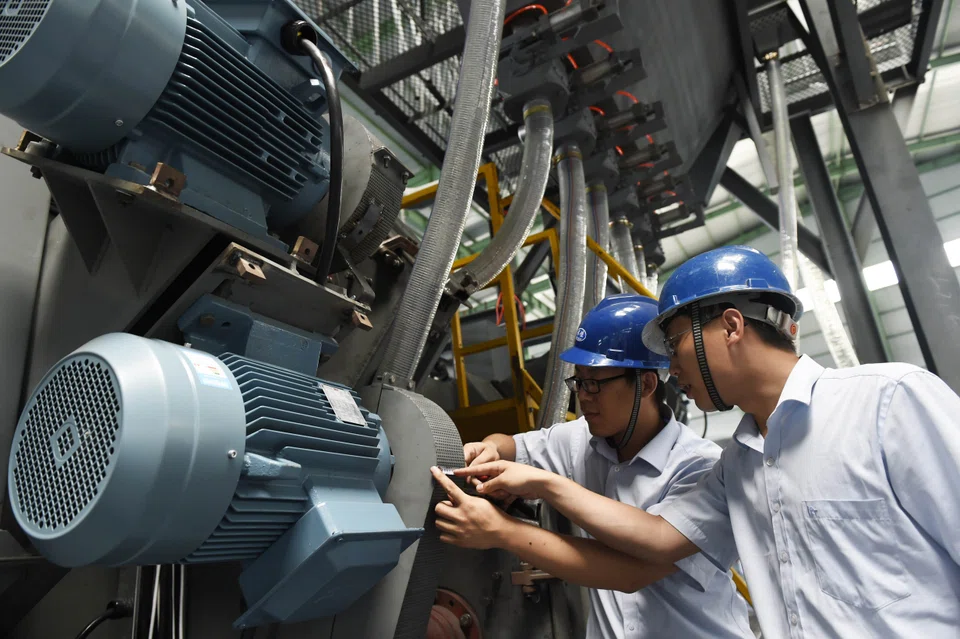
THE salaries of engineers at Surbana Jurong and Changi Airport Group (CAG) are being reviewed in order to close the gap between what they are paid and what bankers and lawyers earn.
A committee named the Engineering Profession Improvement Committee, or Epic, has been set up for this purpose, said Liew Mun Leong, chairman of both Surbana Jurong and CAG.
This is among efforts aimed at attracting more engineering talent and stemming a shortage of engineers in Singapore, Mr Liew told The Business Times.
The shortage of engineers here is a serious issue that has caught the attention of even the government, he said, adding that this has become a universal problem in the US, Europe and even China.
"I think we have to address our local context. The short answer is society has taken engineers for granted. These are the unglamorous, unsung heroes," Mr Liew said.
"If you think about it, who had to supervise the construction of one million homes housing more than 82 per cent of our country's population? We are all happy staying in HDB but we forgot that someone must do the piling, the construction, the design.
"If you go to the airport terminal building, you think it's very nice but who built it, who designed it and who has to supervise the construction? Same for the MRT; no one thought about who built it until the trains got delayed."
Singapore saw its worst train breakdown since 2011 on July 7, with both the North-South and East-West MRT lines crippled at one go.
Some market watchers argue that Singapore lost key engineering competencies after it hived off the government's Public Works Department (PWD), now in the hands of a Chinese company, and the building and development arm of the Housing Board that became Surbana.
With major industries in Singapore such as manufacturing, transport, oil and gas, construction, real estate and infocomm all requiring engineers and accounting for an estimated 42 per cent of the economy, the nation cannot afford to have "third-class engineers", Mr Liew said.
To be clear, he added that he is looking at it from "a business standpoint". Drawing better talent into the engineering profession increases value-add and productivity - this is evident in successful companies such as Apple, which clocked in a whopping US$58 billion in fiscal second-quarter revenue.
Surbana Jurong has been growing its pool of engineers by 15-20 per cent every year, taking in both fresh graduates and people in mid-careers.
"We start our engineers at S$3,200-S$3,500. Lawyers start at S$6,000-S$7,000. Investment bankers are taking home S$10,000. Is the value proposition valid?" Mr Liew asked.
But he also recognises that salary is a hygiene factor. "It is what the mathematician calls the necessary but insufficient condition. We need to not just review the salary but what career progression we offer to them and leadership development we are giving to them."
This year, Surbana Jurong will increase the number of scholarships that it jointly offers to local university students with the Building & Construction Authority and extend its scholarships to polytechnic students.
It also collaborates with overseas universities on career fairs and talks. Through its inaugural Surbana-Myanmar Scholarship programme launched last year, Surbana Jurong is also looking to grow the local talent pool in markets where it operates.
For mid to senior career engineers, Surbana Jurong allows them to specialise in different areas. For example, civil and structural engineers have opportunities to design building structures or be involved in underground engineering, urban infrastructure projects and coastal engineering where their generic engineering skills are applicable.
They may choose to specialise in a particular field thereafter.
"To attract engineers, we need very interesting iconic projects for them to be involved in and then they will come," he said. With Surbana Jurong's projects spanning across China, Myanmar, Africa, the Middle East, Malaysia and Vietnam, its engineers are exposed to multiple career and personal development opportunities.
To promote engineering as a profession, Mr Liew proposed that students be enthused through field trips to understand what it is like to build an airport terminal, an oil rig, or a HDB flat. "It's a question of how we can highlight to the younger people what is engineering. If I bring you to the rock cavern, 150 metres down, you see, wow, that's what you can do."
For Mr Liew who started his career as an engineer, the profession is one that requires the brains, the hands and the heart to create things.
"I was working on the Changi Airport 40 years ago. Today, the airport is still there for me to show my grandchildren."
READ MORE: Surbana Jurong open to strategic alliances
TRENDING NOW
Can a first-time homebuyer couple earning S$18,000 a month afford a new EC unit?

He built the Vingroup empire. Now South-east Asia’s richest man is handing some key roles to his sons

Asia needs new energy security architecture

Chagee, Mixue and Luckin won the market. Sustaining their edge is the harder part

