

Singapore boutique hotels tap on buoyant market to offload
A few properties have been put on the market in the last six months, with owners vying for attention from funds
Singapore
BOUTIQUE hotel owners are perking up at active property buying in Singapore, as the Covid-19 pandemic crushed the tourism sector but not the will of the well-heeled in scooping up assets.
A few such boutique properties have been put on the market in the last six months, with owners vying for attention from funds and family offices circling for deals to ride their projected tourism recovery in two years or so.
The latest to go to market is the Aqueen Heritage Hotel at 51 Joo Chiat Road with an indicative price of S$55 million, marketing agent Cushman & Wakefield announced on Wednesday. This translates to about S$2,400 per square foot (psf) on the gross floor area (GFA), or about S$786,000 per key.
Located in the Joo Chiat conservation area, the boutique hotel is zoned "commercial" with a gross plot ratio of 3.0, according to the Urban Redevelopment Authority's Master Plan 2019. It sits on a corner plot with a land area of 7,629 square feet (sq ft) and has a GFA of 22,925 sq ft. There are 70 rooms with sizes ranging from 140 to 276 sq ft, and a shop space of 1,744 sq ft. The property, which is currently operated under the Aqueen Hotels & Resorts, is within a short walk to Paya Lebar and Eunos MRT stations. It is also located near the Geylang Serai and Joo Chiat neighbourhood, which is known for its heritage and local cuisines.
Shaun Poh, executive director of capital markets at Cushman & Wakefield, noted that the hotel which opened in 2016, is designed with Peranakan elements. "Buyers can capitalise on the opportunity to benefit from the ongoing rejuvenation of the Paya Lebar precinct," added Mr Poh.
The expression of interest (EOI) exercise for Aqueen Heritage Hotel will close at 3pm on Feb 24.
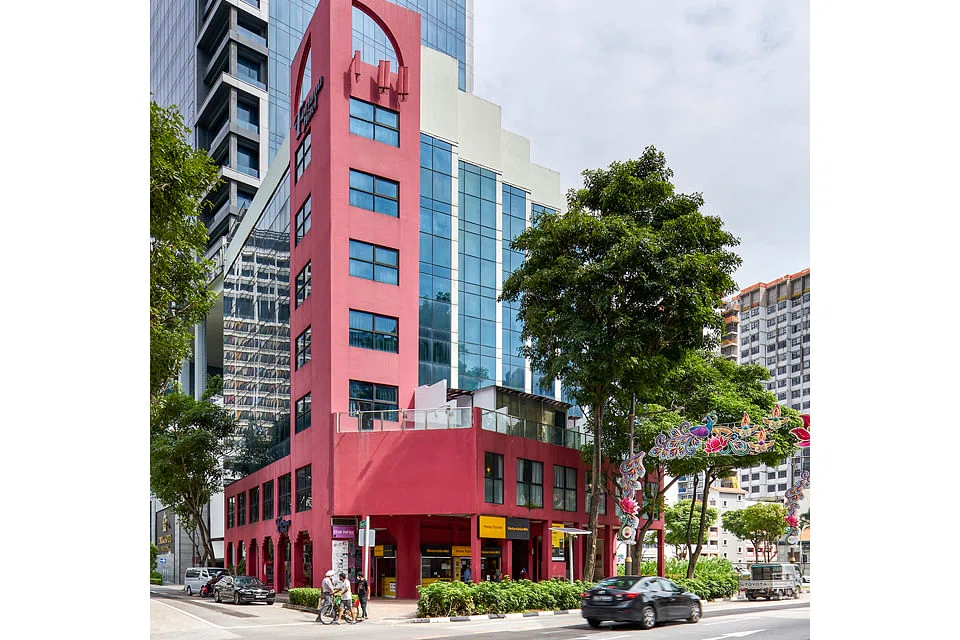
It comes as Fortuna Hotel at 2 Owen Road, just across the road from Mustafa Centre, was launched for sale by tender with a guide price of S$98.8 million in October last year. The guide price works out to about S$932,000 per key, or S$2,060 psf on the GFA.
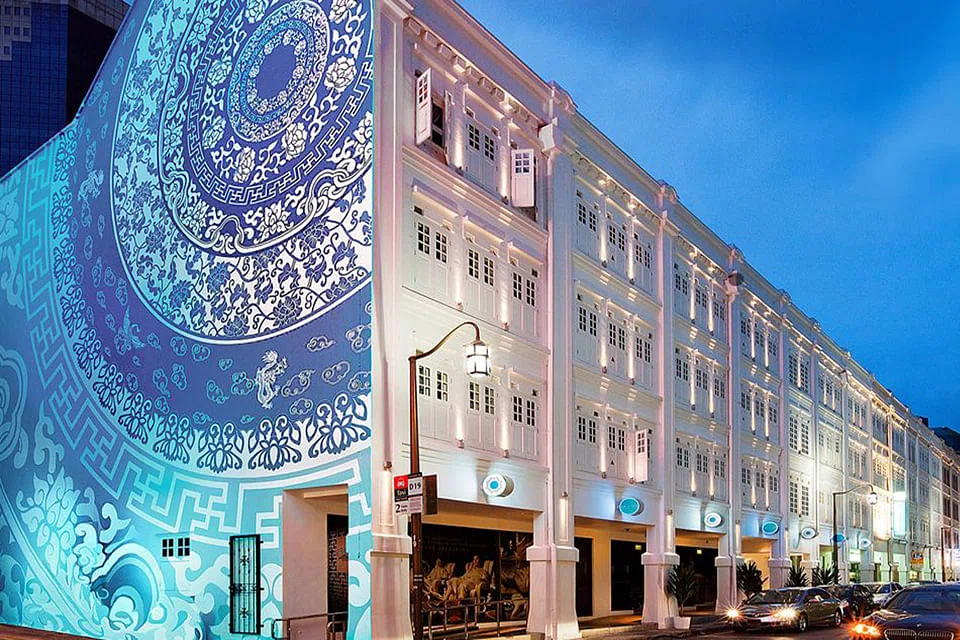
Meanwhile, The Porcelain Hotel at 48, 49 and 50 Mosque Street was relaunched for sale last November with an indicative price of S$68.8 million. This works out to about S$820,000 per key, or S$2,986 psf based on the GFA.
The five land lots at 46 to 50 Mosque Street were previously up for sale with a guide price of S$115 million back in February 2020, translating to about S$830,000 per key or S$2,950 psf based on GFA.
But the owner, JL Asia Resources, has decided to keep the remaining two land lots at 46 and 47 Mosque Street for "long-term investment", Clemence Lee, senior director of capital markets at CBRE Singapore, told The Business Times on Wednesday. JL Asia Resources is run by Jason Lee, known for, among other things, selling his Good Class Bungalow to the UK's James Dyson.
While the firm received "multiple offers" during the earlier EOI exercise that closed in March, said Mr Clemence Lee in a press statement then, the owner then withdrew the property from the market as the spread of Covid-19 worsened.
By the time of the relaunch in November, the Covid-19 situation had stabilised. The ongoing "strong interest" in the limited number of shophouse assets, particularly those located in the central business district, as well as low rates, made it an "opportune time" to relaunch The Porcelain Hotel at 48-50 Mosque Street, CBRE's Mr Lee had said in November.
The tender for Fortuna Hotel closed on Dec 10, while the latest EOI for The Porcelain Hotel closed on Dec 16. CBRE told BT on Wednesday that a "handful of bids" were received for the two properties, with the owners currently evaluating the offers.
CBRE's Mr Lee added that interest for boutique hotels with investment quantum below S$100 million has been strong. "We see interest from boutique real estate funds, family offices, high net worth individuals and owner-occupiers who believe in the long-term prospects of owning hotels in Singapore.
"Given that it will likely take up one to two years to define the development's new positioning and to conduct asset enhancement works for these two hotels, the properties' completion then should coincide with the recovery of tourism in Singapore, as the economy gradually moves back to normalcy."
Likewise, Wong Xian Yang, associate director of research for Singapore and South-east Asia at Cushman & Wakefield, told BT that some hotel owners have placed their properties on the market amid a low-interest rate environment, coupled with optimism about future economic conditions as the Covid-19 situation in Singapore seems to be under control.
"Owners could be looking to cash out and recycle their funds into other segments," Mr Wong said, adding that with the current global economic uncertainty, Singapore properties are on the radar of those who are looking for "diversification, stable growth and wealth preservation".
Ian Loh, head of capital markets for land and building, collective and strata sales at Knight Frank Singapore, noted that with the pandemic, the cash-flow of boutique hotels are likely to take a hit, at least for these two years. As such, a lot of owners are undertaking a "strategic rethink" on whether they should continue operating or divest their assets.
TRENDING NOW

Cracks emerge in AI borrowing boom as CoreWeave, Oracle and SoftBank debt worries grow

Could stablecoins be the future of money?

‘How many will survive?’: Bubble fears arise as China’s humanoid robotics face reality check

Philippine power giant First Gen rebuffs foreign offers, plans up to US$2.6 billion in expansion

