

Singapore retail rents and inflation moving in tandem may put retailers in a bind

Fiona Lam
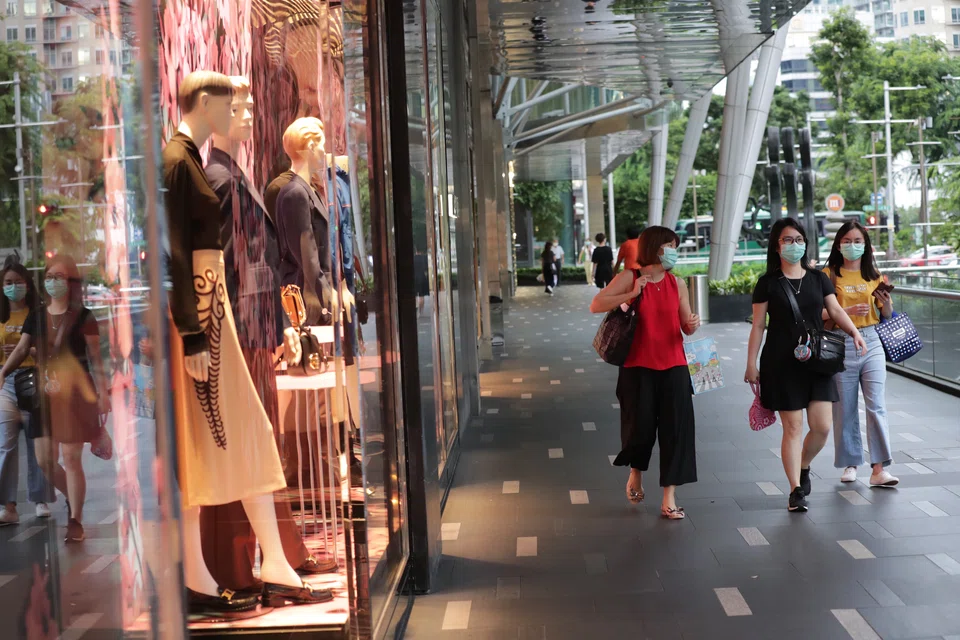
SOME retail businesses, including those selling recreational goods and furniture, are likely to be hit harder by rising rents coupled with inflationary pressures in Singapore, an analysis by the Institute of Real Estate and Urban Studies (IREUS) suggests.
On the other hand, retailers of items such as food, toiletries and computers may be better able to weather higher rents.
Historical data shows that core inflation, which excludes accommodation and private transport costs, tends to move in tandem with overall rents of private-sector shop spaces in Singapore’s Central Region on a quarterly basis.
For example, the rental index grew 7.1 per cent quarter on quarter in the second quarter of 2007, and then increased by 8.1 per cent in the third quarter of 2007. In the same year, core inflation was high at 1.6 per cent in both the third and fourth quarters, on a quarter-on-quarter basis. *(see amendment note below)
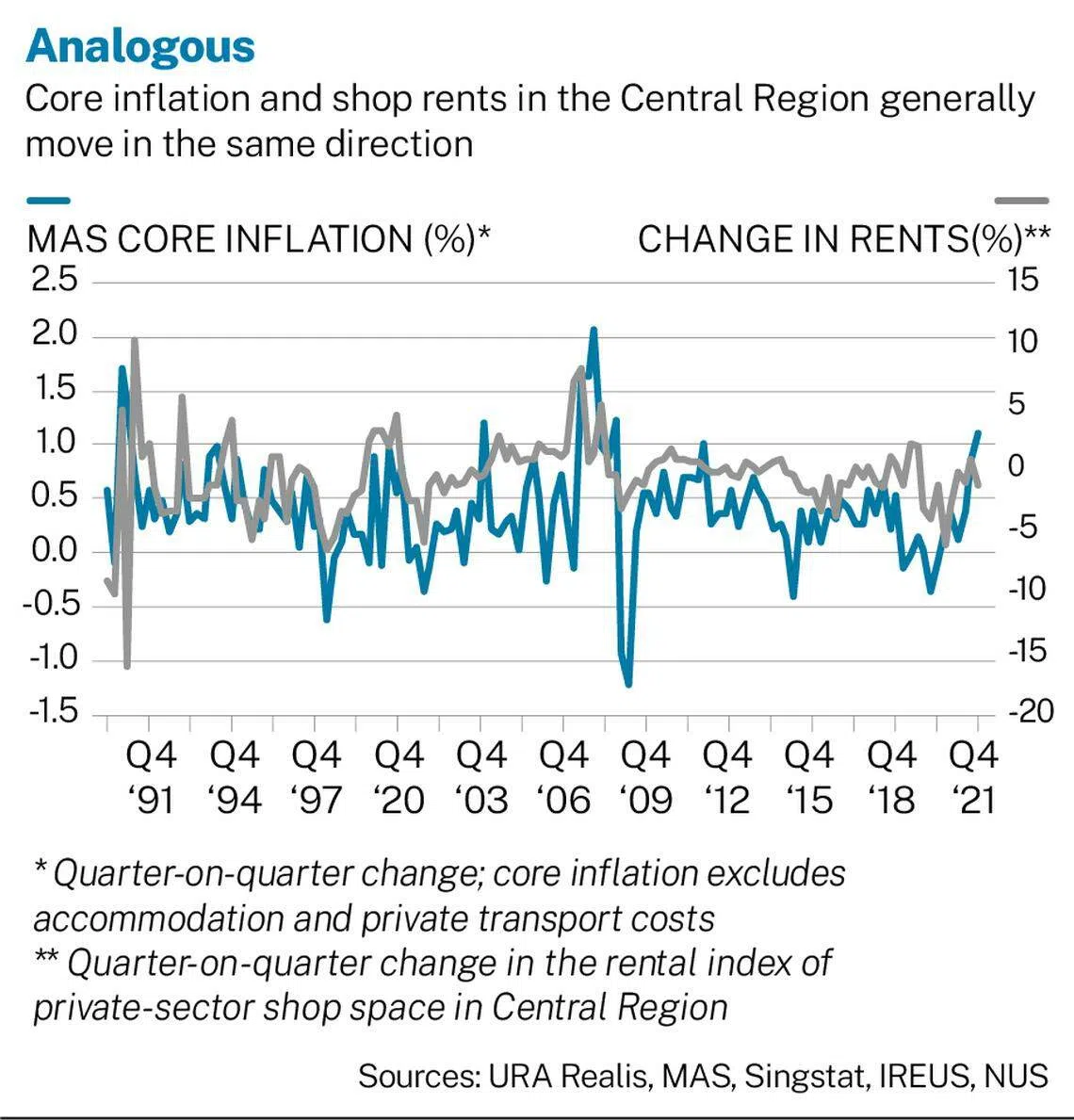
IREUS highlighted what appears to be a lead-lag relationship between the 2 time series, which possibly explains why the positive correlation between core inflation and the retail index is “relatively weak” at 0.28 over the period spanning Q2 1990 to the first quarter of 2022.
Lee Nai Jia, deputy director of the research institute at the National University of Singapore, said that when inflation is high, landlords usually expect interest rates to go up, so they may raise rents to increase their yields. Rents, however, are contractually locked over a period, except for new tenancies. “Hence, we expect the movements to be lagged,” he added.
Some landlords will also adjust rents in view of stronger consumption demand and lower unemployment, though this may not translate immediately to higher prices of goods and services due to the time lag, Dr Lee noted. “That said, there are other exogenous drivers that impact retail rents, such as new supply of retail spaces,” he told The Business Times.
As landlords could seek to raise rents to buffer their yields against inflation, the correlation statistics suggest that retailers in some segments may face narrower margins.
Using the retail sales index by industry, IREUS derived the correlation between the quarter-on-quarter change in sales for each segment and Singapore’s core inflation for the period from Q2 1993 to Q1 2022. For retail sales at department stores as well as supermarkets and hypermarkets, the period for deriving the correlation spanned from Q2 2008 to Q1 2022.
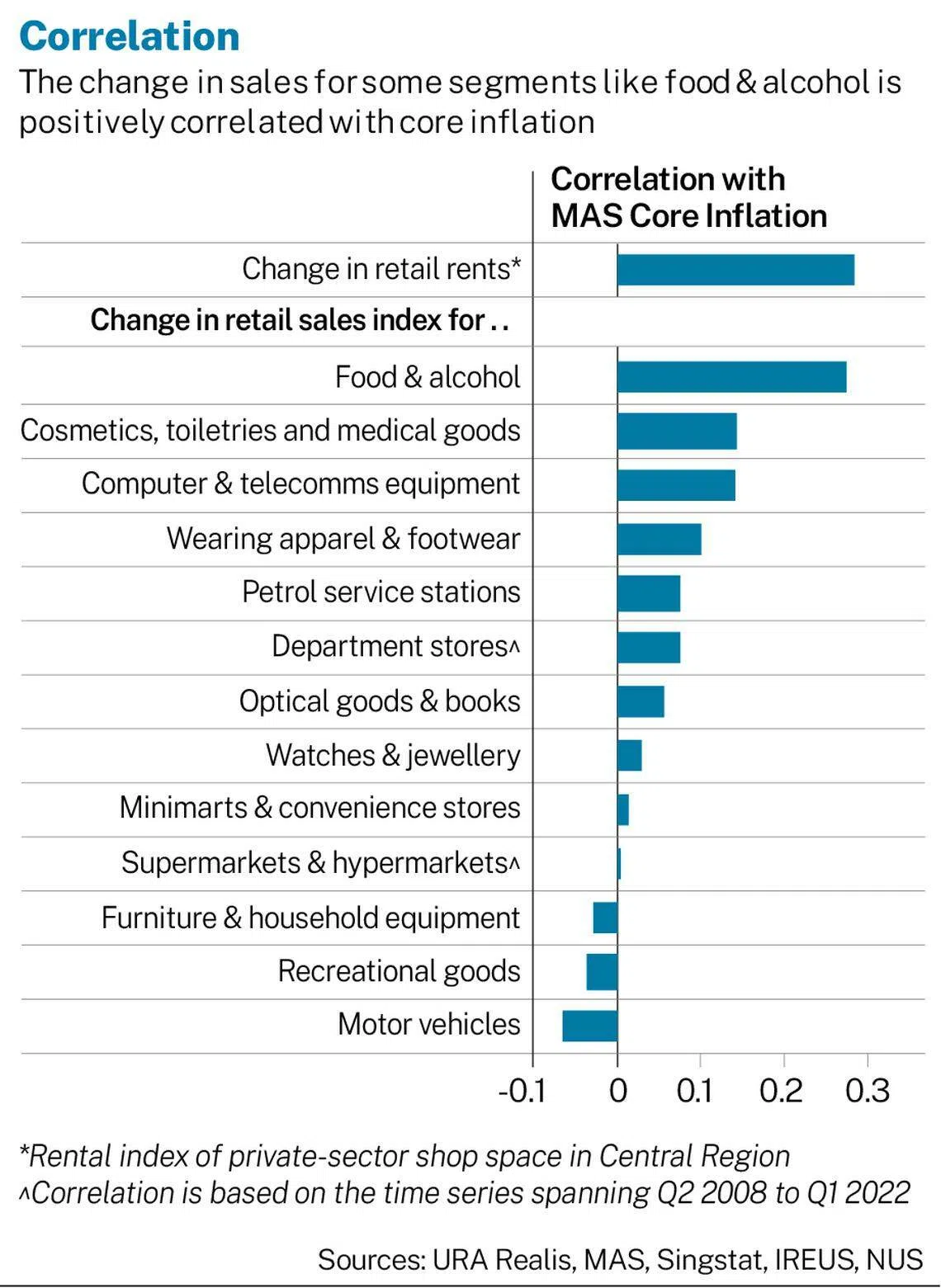
A positive correlation indicates that retail sales in the segment are less affected by rental increases arising from inflation, especially if the correlation exceeds that for rents and inflation.
For segments such as food and alcohol, cosmetics, toiletries and medical goods, and computer and telecommunications equipment, the change in sales exhibited a positive correlation with inflation. These shops are thus expected to be able to withstand higher rents.
In contrast, for retailers of recreational goods as well as furniture and household equipment, the change in sales is negatively correlated with inflation. This implies that these businesses are likely to suffer a drop in sales volumes while having to cough up higher rents in an inflationary environment.
Dr Lee said: “While correlation is a blunt measure to reflect the relationship between the retail sector and core inflation, it offers some interesting observations.” For instance, essentials or goods that provide hedging against inflation are likely to see greater demand, whereas non-essential durable goods such as furniture exhibited negative correlation.
“Additionally, rising inflation may trigger consumers to buy more now than later for some goods, which explains the positive correlation,” he added.
To be sure, even if sales volumes surge for some retailers, that may not compensate for rising shipping costs and pricier commodities. And if landlords are unwilling to share the burden, retailers will probably need to bear the brunt of higher costs and diminishing profits as consumers become more price-sensitive, Dr Lee pointed out.
“While landlords may be able to support their real returns by demanding higher rents, it is a stop-gap solution. Higher rents could inadvertently push (brick-and-mortar) retailers to e-commerce platforms and hence weaken demand for physical shop space in the future,” he said.
This April, core consumer prices in Singapore continued to climb amid increases in the cost of food and other goods as well as electricity and gas. Core inflation reached 3.3 per cent in the month.
Meanwhile, property analysts have said retail rents are expected to rise, although they may return to pre-pandemic levels only in 2023. JLL Singapore’s director of research and consultancy, Angelia Phua, noted that rents of prime retail floor space could grow about 1.5 to 3.5 per cent in 2022.
*Amendment note: A previous version of this article wrongly stated the core inflation figures for Q3 2007 and Q4 2007, and included a chart with inaccurate data on the MAS Core Inflation series.






