

45 businesses, fake review provider taken to task over fabricated online reviews: CCS
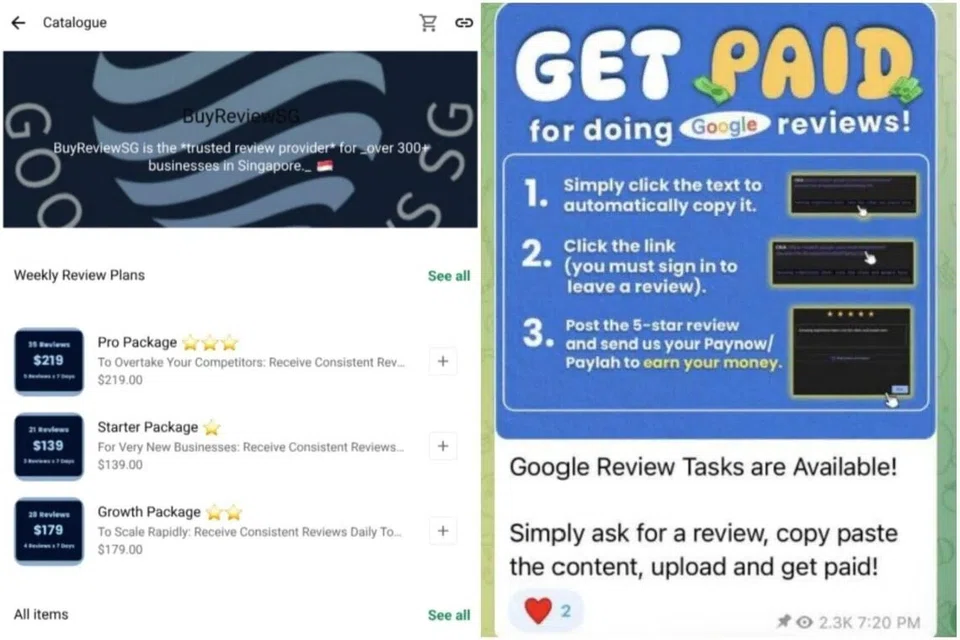
SINGAPORE – A fake review provider and 45 businesses that had procured the service have been taken to task by the Republic’s competition watchdog for fabricating online reviews.
In a statement on Sept 30, the Competition and Consumer Commission of Singapore (CCS) said two websites – BuyReviewSG and GetReviewSG – were found to have provided fake review services to about 100 businesses.
The websites were owned by Julian Tung Yan Kai, who is the sole director of Reputifly – a company that operated the websites.
This marks the commission’s largest fake review investigation to date in terms of the number of businesses involved, prompting a two-phase probe.
The first phase covers the fake review provider and 47 businesses that had procured its services.
Of these, 45 businesses admitted they had purchased fake reviews from the provider.
They have agreed to cease their unfair practices, remove the fake reviews and publish a public apology for six months on their websites, social media accounts and at their physical premises.
The fake review service provider admitted to aiding and abetting these unfair practices by generating fake review content, recruiting and paying reviewers, and taking steps to make the reviews appear authentic.
It has also committed to putting a stop to providing such services and publishing a public apology on Reputifly’s website for six months. In addition, it voluntarily committed to donating proceeds obtained from its fake review services to a charity.
Two of the businesses, however, declined to provide undertakings on the commission’s required terms. CCS said it will continue its investigations into these two firms and take firmer enforcement action if necessary.
Meanwhile, the second phase of the investigation, which extends beyond the remaining businesses to other businesses that may have procured fake review services, is ongoing.
Alvin Koh, the chief executive of CCS, said: “In the digital age, consumers increasingly rely on online reviews to decide what to buy and which businesses to trust. They should be able to expect that these reviews reflect genuine experiences, not manufactured ones.
“Fake reviews deceive consumers, distort competition and disadvantage businesses that compete honestly.”
He warned that CCS will “pursue not only those who buy (the fake reviews), but also those who profit from supplying them”.
In its statement, the commission urged other fake review providers, as well as businesses that bought fake reviews, to come forward voluntarily.
It added that those who do so before CCS commences investigations will have their cooperation viewed favourably.
How the fake review operation worked
CCS investigations found that Tung started providing the fake review services in or before 2023, eventually expanding his services to about 100 businesses.
The fake reviews would be posted on online review platforms including Google, Facebook, Tripadvisor, Carousell, Yelp and Trustpilot.
Companies could purchase packages of fake reviews to be posted periodically. They could even use a rating calculator to determine how many five-star reviews were needed to reach their desired Google rating.
To make the reviews resemble genuine customer experiences, the provider used generative artificial intelligence.
The technology was used to vary writing styles and sentence structures, incorporate details specific to the Singapore context, and introduce natural imperfections. Clients were also able to edit the generated reviews before publication.
As the operation grew more sophisticated, an online dashboard was introduced to generate, manage, and track the fake reviews.
The dashboard could draw from a business’ existing four- and five-star Google reviews to generate new ones containing relevant details.
Some fake reviews deliberately described initial reservations before recounting a positive experience, creating an illusion of authenticity.
To recruit individuals to post the reviews, Telegram channels were used, with payment offered in exchange for posting the prepared content and ratings. These reviewers were instructed to avoid duplicating reviews to reduce the risk of detection.
The provider also offered to replace reviews that were removed by online platforms.
Customers could have been misled into believing the businesses or their products and services were more popular or positively received than they actually were, CCS said.
The 45 businesses found to have procured fake reviews are:
Apax Medical Kovan
Apax Medical
Aqua Luxe
Atop Aesthetic
Bavarian Capital
BrandLoom Digital
Certified Translation Services
Chrysalis Spa
Data Savers
Dots ‘n’ Tots Interior
FAS Auto Services
First Security & Private Investigation
For the Love of Laundry
Forest Darts Bishan
Groupasia Hospitality
Harmony Essentials
Harmony Funeral Care
Haven Enterprises
Haven Tech
Hiremop
Integral Facilities Management (IFM)
J & S Management
Kuisine Koncepts
L E Autoshop
Label-Line Corporation
Le Wave Art of Hair
Le Wave Hair
Le Wave Hair Studio
Martin Luxury
MB Karaoke Solution
Meso Ceramics
Nails In Dulge
Nanyang Brew Coffee
Picasso Hair Boutique
Play! Ball
Play! Tennis Now
Print Scream
Sanook Group
SBLab Beauty
The Hamper Story
TM Designers
Torio Japanese Restaurant
TT8 Logistics
UniWise Admissions Consulting
Yeo & Associates
Under Singapore’s Consumer Protection (Fair Trading) Act, posting or buying false reviews is an unfair practice because it deceives or misleads consumers.
Consumers Association of Singapore (CASE) president Melvin Yong welcomes the enforcement action.
“Such fake reviews are not harmless. They mislead consumers into believing that a business or its products and services are more positively received than they actually are,” he said in a Facebook post on Sept 30.
He added: “CASE is also concerned about businesses incentivising consumers to only leave good reviews, often by dangling discounts or free gifts if consumers leave a five-star rating.”
He shared some signs consumers can look out for when assessing online reviews such as multiple reviews with similar wording and an unusually high number of five-star ratings within a short period.
He also encouraged them to compare reviews across different platforms before making a purchase.
Consumers who encounter misleading or unfair practices may approach CASE for assistance at 6277 5100 and on its website: www.case.org.sg.
The Straits Times has contacted CCS for more information. THE STRAITS TIMES
Decoding Asia newsletter: your guide to navigating Asia in a new global order. Sign up here to get Decoding Asia newsletter. Delivered to your inbox. Free.
Share with us your feedback on BT's products and services






