AI demand to keep Singapore’s export growth robust despite Middle East uncertainty: economists
May’s 38.4% NODX growth, the strongest in over 2 decades, prompts Maybank to lift its 2026 forecast to 15%

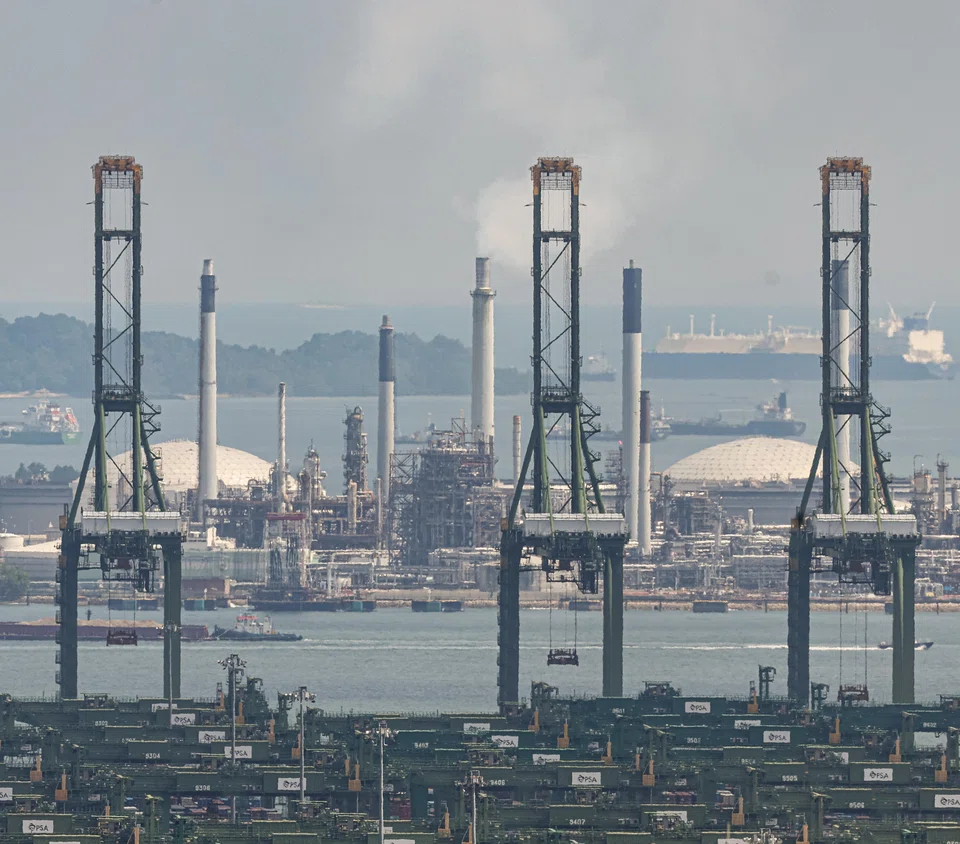
[SINGAPORE] Artificial intelligence-related demand is expected to continue supporting Singapore’s key export growth in the coming months, with a potential US-Iran peace deal offering further upside, said private sector economists on Wednesday (Jun 17).
This comes after the city-state’s non-oil domestic exports (NODX) surged 38.4 per cent year on year in May, the fastest expansion in more than two decades.
May’s figure also outperformed economists’ median forecast of 30.5 per cent year-on-year growth, a Bloomberg poll showed.
The better-than-expected performance was largely driven by electronics shipments, which jumped 94.8 per cent on strong chip and computer demand, versus the 66.7 per cent increase in April.
Non-electronics NODX also grew at a faster clip, expanding 17.7 per cent compared with the 10.9 per cent increase in the previous month.
May’s stronger-than-expected data prompted Maybank to upgrade its full-year 2026 NODX growth forecast to 15 per cent, from 4.5 per cent previously, on a sustained global AI expenditure boom.
This is significantly higher than Enterprise Singapore’s official forecast range of 3 to 5 per cent growth for the year.
Economists Chua Hak Bin and Brian Lee noted that NODX has risen 18.1 per cent in the first five months of 2026, a higher-than-expected pace even after accounting for the impact of the Gulf War.
In real terms, export shipments are up 17.3 per cent over the same period, suggesting the outperformance is being driven by genuine demand rather than higher prices alone, they noted.
While favourable base effects partly contributed to May’s outsized 38.4 per cent jump – given the 3.9 per cent contraction recorded the year prior – Lee expects exports and manufacturing to remain robust in the second half of the year, supported mainly by a sustained global AI capital expenditure boom.
“America’s six-largest hyperscaler tech firms are planning to increase capex by about 76 per cent in H2 2026,” said the analysts. “Leading AI firms, such as Anthropic and OpenAI, are racing to raise funds to expand their footprint and infrastructure.”
“The ramp-up in AI infrastructure investments implies that Singapore’s electronics growth – particularly that of memory chips, servers and server-related products – will likely remain strong.”
Petrochemicals production could also recover in the second half as supply disruptions ease with the reopening of the Strait of Hormuz, said Dr Chua and Lee.
Robust growth
UOB associate economist Jester Koh expects AI-related tailwinds to be sustained at least through the third quarter of 2026, as the rise in the electronics orders-to-inventories ratio suggests production is still struggling to keep pace with demand.
In contrast, he foresees that elevated prices stemming from the Middle East conflict could continue to weigh on non-electronics exports, even as energy prices have softened somewhat on expectations of an imminent peace deal.
Oxford Economics senior economist Sheana Yue said in a research note that NODX volumes remained well above Q1 levels, pointing to a strong external demand contribution to second-quarter GDP growth, though weaker re-export activity suggested trade momentum had become less broad-based.
“While the US-Iran agreement reduces severe disruption risks, the Strait of Hormuz remains volatile,” Yue said, adding that lower oil prices could ease inflation and support global activity, even as they weigh on the value of Singapore’s oil exports.
Not all economists, however, expect the momentum to be sustained. OCBC chief economist Selena Ling expects some moderation in the second half of the year, citing higher base effects, even as the global AI story remains resilient for now.
This is even while she kept to her full-year forecast of 6 per cent growth, which is above the official forecast range.
Nevertheless, Ling noted that shipments to the US, the EU and China remained robust, suggesting diminished growth concerns stemming from the Middle East conflict.
NODX to all of Singapore’s top 10 markets grew in May, except for Indonesia, for which shipments contracted.
NODX to Taiwan more than doubled, up sharply from the 33.5 per cent expansion in April, lifted by integrated circuits, disk media products and specialised machinery.
Meanwhile, NODX to the US rose 80.9 per cent, up from 59.6 per cent in the previous month, driven by pharmaceuticals, disk media products and PCs.
NODX to China grew 31 per cent, slightly slower than April’s 37.8 per cent, supported by specialised machinery, non-monetary gold and integrated circuits.
In contrast, NODX to Indonesia contracted 26.9 per cent, but was still an improvement from the 60.8 per cent slump in the month before.
Total merchandise trade grew 39.7 per cent in May, extending the 33 per cent rise in April, with both exports and imports increasing.
The rise in total exports was driven by growth in both non-oil exports (up 34.9 per cent) and oil exports (up 43.1 per cent). Total imports climbed 43.6 per cent.