AI should not lead to a winner-takes-all scenario: MAS’ Chia Der Jiun
With wider AI adoption in the financial industry, it is not just big firms in the sector that will benefit, he notes

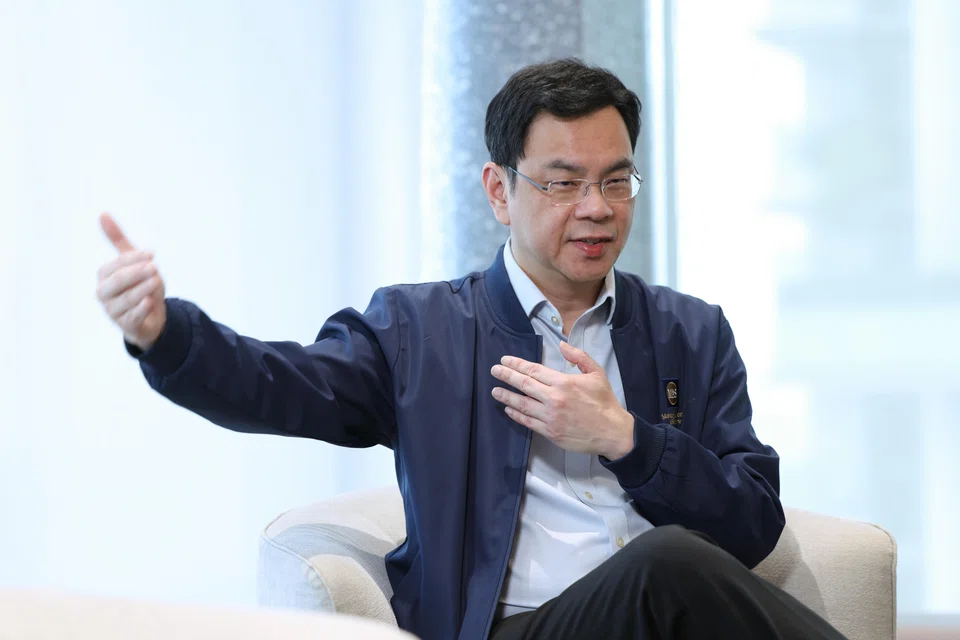
[SINGAPORE] With artificial intelligence having the potential to benefit the entire financial ecosystem, regulators should aim to ensure a level playing field for AI to be adopted by smaller financial institutions as well, instead of reinforcing the dominance of their larger peers, said Chia Der Jiun, managing director of the Monetary Authority of Singapore (MAS).
The Republic is working with the industry to diffuse AI adoption more widely, so that it is not just the large financial institutions that are adopting AI well.
“We don’t want AI to be unlevelling competition too much, such that it becomes a winner-takes-all situation,” Chia said in an interview with The Business Times, ahead of the Singapore FinTech Festival taking place from Nov 18 to 20.
This comes as the city-state’s financial services sector rapidly adopts AI to spur efficiency and productivity gains, amid MAS’ encouragement of further innovation.
Chia noted that large financial institutions are already investing heavily in AI and applying it in many use cases across their organisations, from operations to customer service, credit evaluation and document preparation.
But good AI adoption should not be the preserve of the largest financial institutions – rather, it is also something that can benefit all financial institutions, he said.
Hence, MAS is working on initiatives to make it easier for all financial institutions to discover, adopt and lower the costs of AI solutions that work for them.
For example, the Future of Finance Institute will scale up the PathFin.ai programme to match financial institutions with AI solutions to support their adoption journey, Chia noted.
Nevertheless, he noted that regulation needs to work in tandem with innovation, given the risks that come from the rise of agentic finance and agentic commerce.
Outside of AI, new tech in financial services has also led to risks in the form of outages and scams.
“We don’t want regulation to run ahead of innovation,” said Chia. “Certainly, innovation is important to progress because we want to bring benefits. At the same time, if innovation runs too far ahead of safety and guardrails, clearly sometimes things can go off the rails.”
The financial regulator does not “rush into very prescriptive regulation” when it comes to AI, as it is a fast-moving space where rules can get outdated quickly, he added.
As a result, it has regulations which set and highlight the main risks and the controls that are needed, complemented by industry standards.
MAS does not want to bring in rules in a way that will prematurely or unnecessarily stifle innovation, the managing director noted. “We want to find the right touch, where (they are) broadly in tandem.”
Resilient growth
Commenting on the Singapore economy, Chia expects growth to stay resilient in the next few quarters, supported by the AI investment boom.
But he noted several areas to watch: For one thing, there is concern over the sustainability of these AI investments and a possibility of the AI cycle going on a boom-and-bust path with large investments being committed now. Chia expects that the process of AI-driven productivity gains will take time to play out.
“I don’t think we need to be pessimistic that the productivity data will not come, but it’s something that we watch for because the micro-level data does give some cause to anticipate that AI will bring some productivity gains.”
There is “certainly a path” towards a long period of sustainable investment, he said.
For example, it is already “quite common” for AI to be used in specific cases, such as in coding work and customer service.
AI adoption is still at an early stage for most companies, so aggregate economic data demonstrating productivity gains from AI is not yet apparent.
MAS will watch economic data in the next few years to evaluate the impact of AI implementation. Chia also cautioned that it was important to avoid a boom-and-bust scenario.
Meanwhile, energy markets remain volatile amid geopolitical tensions in the Middle East.
He also flagged volatility in the global bond market as an area to watch, as more acute fiscal risks and more political uncertainty add stress to the bond markets.
“It’s not currently in a disorderly state, but there is a small probability that it could worsen from this point on,” he said.
“And if it does, it could transmit more globally and tighten financial conditions around the world, and generally this will have a negative impact on emerging markets.”