

Asia still ‘under-invested’ despite improving profits, attractive valuations: DBS
Stronger income, growth and valuations point to ‘clear and present’ opportunities in Asia, says senior investment strategist

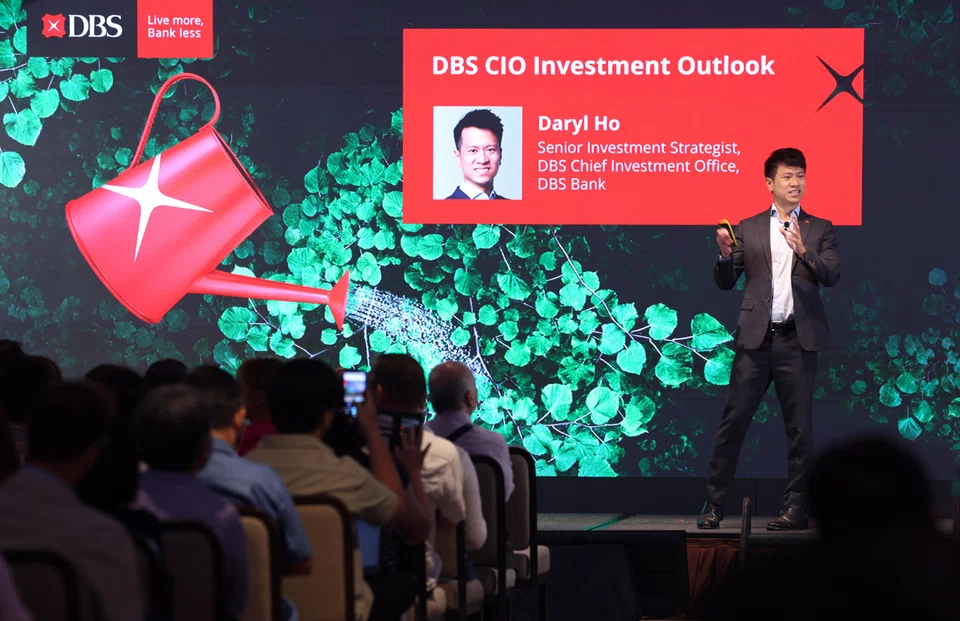
[SINGAPORE] Asia remains “under-invested” despite the region’s strong performance and comparatively attractive valuations, said Daryl Ho, senior investment strategist at DBS’ chief investment office.
Ho attributed this to lingering caution among investors, as Asian markets “had not been doing so well” in the last few years.
Yet, Asia is “painting a rather sanguine picture” lately in terms of market opportunities, he argued in a private-wealth segment at the bank’s Market Outlook 2026: Empowering Businesses for Global Shifts forum on Dec 4.
First, dividend-paying investments in Asia continue to offer solid income.
Ho highlighted dividend yields in Singapore and China in particular, noting that payouts in both markets are around the 5 to 6 per cent range.
In Singapore, yields of around 6 per cent are still common for banking stocks and real estate investment trusts, and are supported by a strong currency.
Second, growth prospects in the region are improving, especially for tech stocks.
Early FY2026 estimates for Asian technology companies, excluding Japan, point to earnings growth in the mid-20 per cent range, said Ho.
In particular, China’s tech outlook is supported by the growing volume of research papers and intellectual property being produced there, which underpins the long-term fundamentals of the sector.

“You would think that for such a strong growth momentum... you should have pretty high valuations. But that’s not observed at all the markets,” he said.
To illustrate, he pointed out that US technology stocks trade at about 36 times earnings. In Asia – excluding Japan – similar stocks trade at less than 20 times earnings, despite what Ho described as “rather decent growth”.
Many well-known US technology stocks have comparable counterparts in China that trade at a “better valuation”, he added.
For example, Amazon’s counterpart is Alibaba, Google’s is Baidu and Tesla’s is BYD – and the “gulf in valuations is extremely stark” despite the similarities in their business models.
He cited how Tesla has been trading at a price-to-earnings ratio of about 277.5 times, compared with 20.8 times for BYD.
Amazon’s ratio stood at 33.8 times versus Alibaba’s 26.9 times, while Google traded at 28.6 times compared with 17.8 times for Baidu.
In summary, Ho said that Asia presents “clear and present” opportunities due to strong earnings, improving growth and comparatively low valuations.
Growth momentum is shifting towards the region and investors “should be happy to be here”, he concluded.
Of bonds and gold
Ho also shared views on other asset classes, including bonds and gold.
On bonds, DBS’ income strategy in recent years has been to avoid both very short and very long duration positions, and instead focus on staying in the middle of the curve.
He gave the example of the bank’s Liquid Plus Fund. This fixed income fund invests in a portfolio of short-duration, high-quality corporate bonds and has delivered low-volatility returns of about 5.5 per cent a year.
He contrasted this with holding cash, which he said would yield less once rate cuts began, and with long-duration global bonds that have suffered multiple drawdowns of more than 7 per cent in recent years – sharp swings he noted were enough to erase a full year of income.
He also highlighted gold as a key asset to hold for the long term.
Since 2022, gold has “completely broken” its historical correlation with the US dollar, he noted.
Central banks have been buying around 1,000 tonnes of gold per year as they shift towards reserve assets that are more “neutral”.
This structural demand, said Ho, has underpinned gold’s resilience even during periods of high rates or a strong US dollar.
DBS has been positive on the metal for several years, and still sees room for further upside, he added. Brought to you by:

Decoding Asia newsletter: your guide to navigating Asia in a new global order. Sign up here to get Decoding Asia newsletter. Delivered to your inbox. Free.
Copyright SPH Media. All rights reserved.
TRENDING NOW

Once staunchly pro-China, Malaysian Chinese businesses are now distancing themselves from Beijing

Looking beyond looming CEO succession, should UOB potentially pursue a transformative merger?

Could stablecoins be the future of money?

Grab CEO’s wife Chloe Tong on life with Anthony Tan and finding her purpose

