

B2K’s second-generation leaders paw a new path in pet products
Once a distributor of such products, the company has since launched its own brands, such as Kit Cat
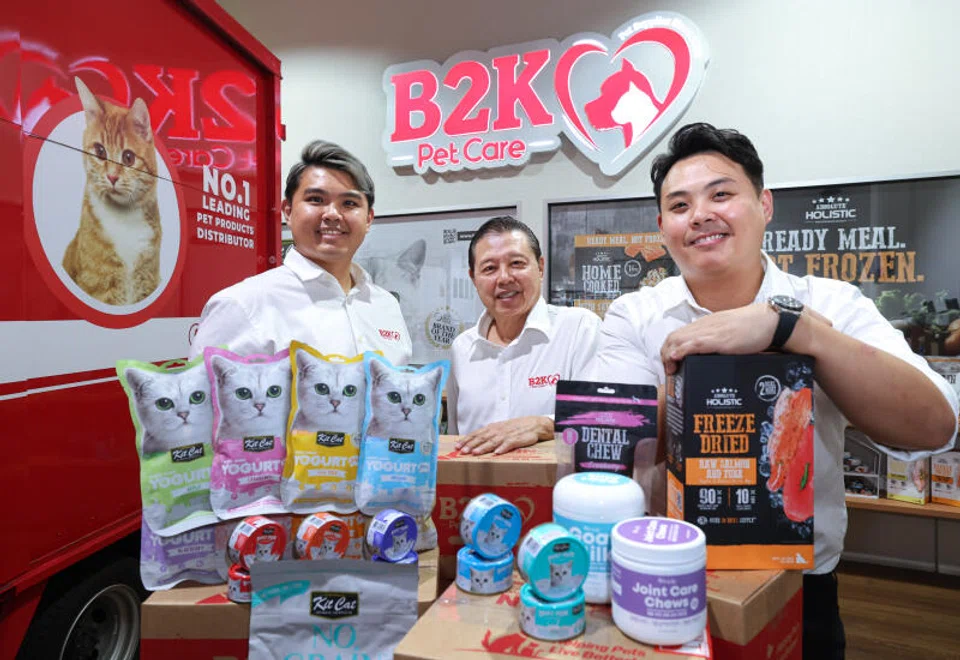
AS CHILDREN, brothers Kenneth and Kevin Koh would sit in the back of a van full of dog food, accompanying their father Koh Hak Boon on his rounds as a delivery driver and salesman for a pet food company.
In 2007, their father founded his own pet products company, B2K – with Kenneth joining him that year, and Kevin, the following year.
“We started off as an import business, importing brands from overseas and distributing them in the local market,” said Kenneth, now B2K’s chief executive officer.
But B2K has since developed six of its own house brands – which account for 85 per cent of its revenue today.
It now exports to over 44 countries, on top of an eight-figure annual revenue in local sales. Overseas, the company is most known for cat-product brand Kit Cat, which brings in 70 per cent of the company’s own-brand export revenue.
Making a name for itself
In the early days, B2K focused on necessities such as pet food and accessories. Said Kenneth: “The pet business was not blooming then. It was a niche market.”
At the start, the company distributed products to fewer than 100 local pet stores. Today, its local business-to-business (B2B) market comprises some 200 to 250 pet stores, veterinarians, grocery stores, animal shelters and cat cafes.
B2K remained a distributor until 2014 – when it launched its first own product, Kit Cat cat litter.
Kenneth had noticed that cat litter was costly for local cat shelters. “At that point of time, cat litter brands were all imported and very expensive.”
This pushed B2K to create its own affordable brand of cat litter. At first, Kit Cat litter was sold at a price that would only cover costs, with six variations on the product.
Today, the brand has gone beyond cat litter, with over 600 products that include cat treats, cat food and grooming supplies.
The company adopts an asset-light model, producing its products in partner factories in Thailand, New Zealand, China, Europe and the US.
This has helped Kit Cat stay affordable, with prices 15 to 20 per cent lower than other imported brands, said Kevin, the company’s chief operating officer.
Yet the brand competes not just on price, but also innovation. In 2014, Kit Cat launched activated charcoal cat litter, which incorporates charcoal as a natural way to eliminate odour.
As demand grew for other cat-related products, B2K expanded its Kit Cat line to include food, treats and grooming supplies.
From 2017, it created five more brands: cat and dog food brand Absolute Holistic, sanitary products line Absorb Plus, treats brand Absolute Bites, cleanliness brand Altimate Pets, and natural food brand Wild Age.
Paw parents demand more
B2K’s innovation efforts have been driven partly by what pet owners demand – and they demand more now. “Paw parents are more educated and research what is good for their pets, and which ingredients are not good. So they avoid (products) made out of cheap ingredients.”
This has made them more willing to pay a premium, he added: “They want something that is natural, and natural products don’t come cheap. But (consumers) are willing to spend.
“When I first started this business, pet owners were buying treats for the dogs at S$3 a bag. But now, people are avoiding the S$3 bags and buying those priced at S$20 or S$30.”
B2K works with nutritionists to formulate cat products that suit the varied nutritional needs of cats in each region. Cats in humid Asian countries have different nutritional needs from those in colder, drier regions like Canada, for example.
In the name of sustainability, Kit Cat also has two ranges of cat litter made from waste such as soybean residue and tea leaves, rather than traditional clay.
“I demand that my research-and-development team (and) my marketing team come up with a new product every six months,” said Kenneth.
A boost from Covid
During the pandemic, demand for pets soared in tandem with the rise of work-from-home arrangements. B2K charted a 25 per cent annual growth in sales, up from the usual annual growth of 10 per cent. Animal shelters, also B2K customers, buoyed this rise in demand when they took in more abandoned pets.
The “circuit breaker” period early in the pandemic, when most retail stores could not open, disrupted the pet retail industry by removing the old “taboo” of B2B (business-to-business) distributors selling directly to end-consumers (B2C, or business-to-consumer).
Before 2019, B2K’s only B2C avenue was to list its products on the e-commerce sites of other pet stores. That year, even as B2K launched its own online shop, it ventured onto platforms.
Then the “circuit breaker” hit, boosting the company’s online sales. Today, 40 per cent of B2K’s local revenue comes from e-commerce sales.
During Covid-19, sales also grew in some markets overseas. B2K had been distributing products in the Middle East since 2017, but sales spiked during the pandemic, growing by millions of dollars after customers there saw Kit Cat products advertised on TikTok.
“During Covid was when we bloomed in the Middle East, which is a very important market for us right now,” said Kenneth.
Annual sales growth has stabilised to the pre-pandemic rate of about 10 per cent, but the brothers are looking to expand further.
B2K hopes to next break into the US – which Kenneth describes “as the most difficult market”, given the variety of existing brands there. They are currently looking for distributors for Kit Cat and Absolute Holistic in the US.
And despite the challenges of local production – such as a lack of raw materials and high labour costs – B2K hopes to have a local factory by 2030.
“We wish that there will be pet products that can proudly say ‘Made in Singapore’ rather than just being a Singaporean brand,” said Kenneth.
TRENDING NOW

Nvidia CEO Jensen Huang’s confession engulfs chip giant in spying controversy

China recruited exec at Singapore data centre firm to spy on Nvidia CEO Jensen Huang: US intelligence

Higher rates, weaker spending: Is the Philippines entering stagflation?

Could Japan trigger the next global financial crisis?

