

Post-Covid, weak demand still main hurdle to Singapore’s ‘30 by 30’ food goal

SINGAPORE remains far from its goal of producing 30 per cent of local food needs by 2030. This is due both to the impact of Covid-19 and a more fundamental lack of demand, said industry players.
The pandemic hit Singapore’s hotels, restaurants, catering and airline industries, as well as the local farms supplying them.
“We used to supply many five-star hotels and Michelin-star restaurants; but during the lockdown, all that kind of disappeared,” said James Kwan, chief executive of aquaculture company Barramundi Group.
“When the airline industry evaporated overnight, we just had tons and tons of fish left. And yet, we had to keep the fish alive until things got better,” he added. “This is how many of (Singapore’s) farms collapsed.”
Local farm The Fish Farmer has seen some recovery in hotel demand, but this is not yet at pre-pandemic levels, said founder Malcolm Ong.
The government’s “30 by 30” goal, announced in 2019, gained greater relevance during the pandemic, as supply chain disruptions highlighted the importance of local production.
Some farms benefited from Covid-era disruptions, as retailers were forced to seek local suppliers. Retail demand also received a boost, as more people cooked while stuck at home.
During the temporary closure of Jurong Fishery Port, shrimp producer Blue Aqua Group was “constantly receiving calls from supermarkets and other vendors”, said CEO and co-founder Farshad Shishehchian.
At the same time, farmers had to deal with compromised supply chains that put pressure on feedstock supplies and costs.
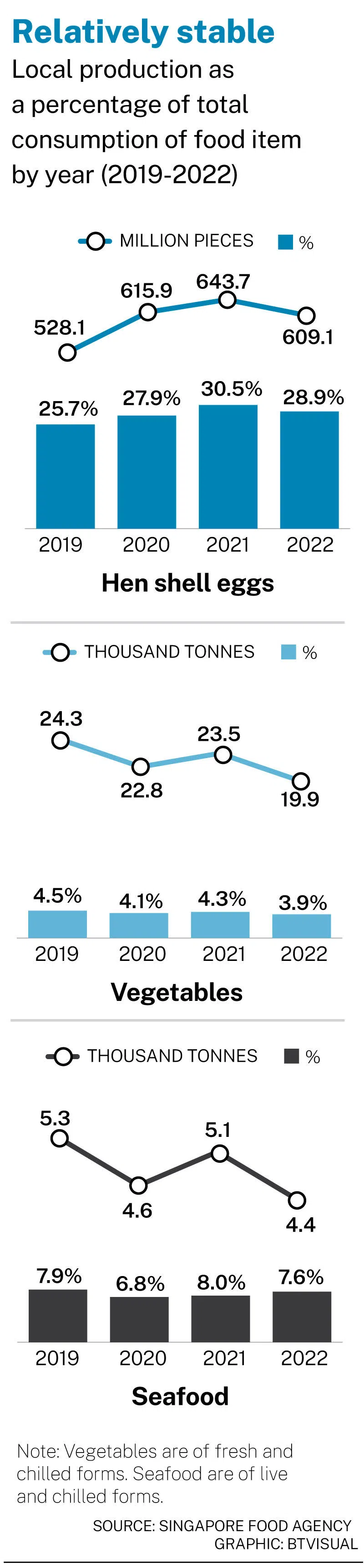
Official figures suggest little progress on the “30 by 30” goal. In 2022, local hen shell egg, vegetable and seafood farms contributed 28.9 per cent, 3.9 per cent and 7.6 per cent of Singapore’s food consumption, respectively, which was comparable with preceding years.
“Over the past three years, local production has remained generally stable with slight fluctuations for seafood and vegetables,” said the Singapore Food Agency (SFA).
Meanwhile, the pandemic delayed the setting up of new farms and upgrading of existing farms.
“There have been delays of one to two years in many cases, which have a consequential impact on farm timelines for reaching full production capacity,” said SFA in response to queries from The Business Times.
“We are working closely with these farms to catch up with their project schedules. Nevertheless, overall, the number of farms and the production of food locally has been increasing over the years.”
Nobody’s biting?
Another key piece of the puzzle is price.
“Singaporeans are very price sensitive. The first question they ask is how much, not where it came from,” said William Ho, whose quail egg farm Lian Wah Hang Quail & Poultry Farm closed recently after it failed to acquire land.
“The problem is the demand is so little, it really deters us from production,” he said.
Allan Lim, founder of commercial rooftop farm ComCrop, said the strong Singapore dollar keeps imports cheap, while cost-of-living concerns mean sustainability and buying local have taken a back seat.
He believes there is a lack of understanding about how the quality of local produce makes it value for money, with existing certification programmes not being well known.
A FairPrice Group spokesperson said: “With recent economic challenges and inflation, we are observing that customers are becoming more budget-conscious across all products in their grocery basket.”
Meanwhile, production costs are rising. Land scarcity and strict farming standards require a move towards advanced technology.
The government favours high-tech farmers in land tenders, said He Jie, associate professor of natural sciences and science education at Nanyang Technological University’s National Institute of Education. High electricity prices, scarce manpower and increased rents mean higher costs for high-tech farms, though.
These costs cannot always be passed on to consumers.
Said Kenny Eng, director of Gardenasia (The Local Farm): “No matter how high-tech it is, you’re still selling vegetables. How much can you sell vegetables for?
“If you keep having very, very high costs, then you have to grow fish that is only for the top-end restaurants. If you want to address the mass market… you cannot be priced two, three, four times what the market is paying.”
Upping the appeal
There have been small victories. At FairPrice Group, local producers account for 47 per cent of eggs sold, 17 per cent of fish and seafood, and 8 per cent of vegetables. Since 2019, its sales of local produce have seen double-digit percentage growth.
The group collaborates with SFA-licensed fish and seafood farms, and has introduced produce from eight local vegetable farms in the past year.
With increased demand, Blue Aqua has doubled its cultivated area since 2019. The company hopes to do so again next year by expanding vertically.
It helps to move up the value chain. The Fish Farmer has not seen an increase in demand for fresh produce, but has for its “heat and eat” instant products. It has ramped up production accordingly, Ong said, hoping to grow “at least another 50 per cent” in the next two years.
Consumers who want to support local farmers tend to be younger and rarely cook at home, said Eng. The Local Farm, too, has launched ready-to-eat foods.
It also runs a farm-to-table restaurant with ingredients from local farms, and has a “Farmpack for a cause” initiative through which donors sponsor packs of local produce for underserved communities.
Government support
Government support for the agri-food industry include funds for capacity increases and investments in technology.
The Fish Farmer is working with the government to increase capacity, focusing on fish nutrition and disease management. Ong hopes for faster, smaller-scale trials.
Noting that research institutions tend to have longer-term plans of five or 10 years, he said: “2030 is around the corner. We cannot wait for that.”
Eng highlighted the SFA-backed, industry-led Alliance for Action for Demand Offtake and Consumer Education, which tackles demand and supply aggregation of local produce and engages in consumer education.
Ho, however, says such programmes cannot sustain the farms in the long term. He believes that the demand issue can only be solved if the government itself buys local produce – to supply the army, prisons or orphanages, for example. This would provide some predictability and stability, rather than leaving farmers at the mercy of fluctuating demand. “There’s no off button in farming,” he noted.
Added Lim: “While we are planning to build capacity, we may have fallen short in planning to pick up the demand.”
TRENDING NOW

Looking beyond looming CEO succession, should UOB potentially pursue a transformative merger?

MAS holds monetary policy settings, pausing after two straight tightenings

Once staunchly pro-China, Malaysian Chinese businesses are now distancing themselves from Beijing

Stocks to watch: Kore US Reit, Parkway Life Reit, Raffles Education, Vin’s Holdings

