Boost for construction tech firms to innovate; developers adopting robotics, automation: Chee Hong Tat
Developers and contractors will gain access to a list of certified technology partners for JTC projects, he adds
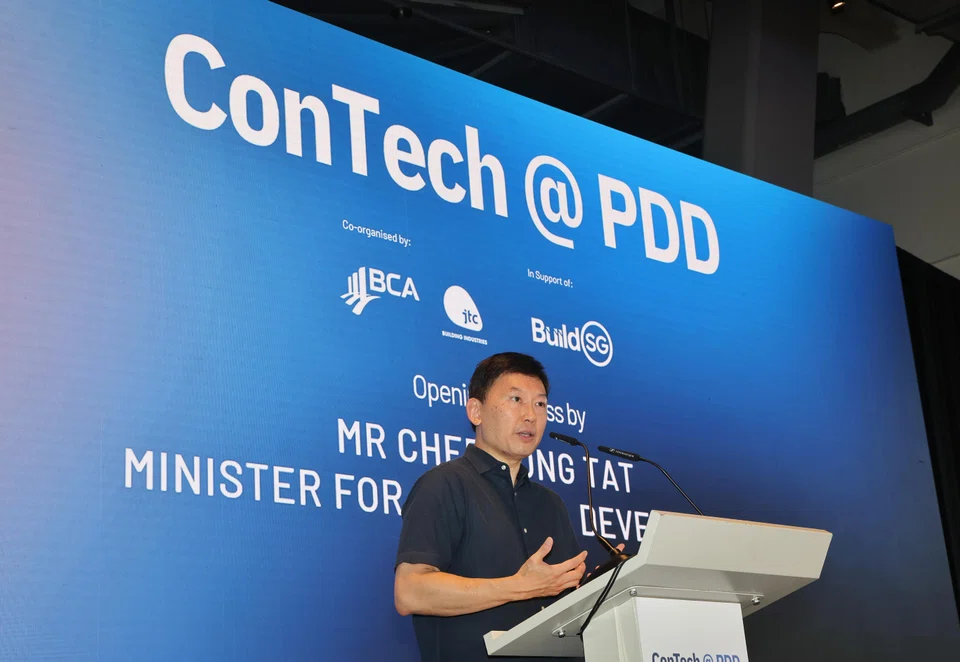
[SINGAPORE] Construction technology companies that are willing to innovate, test and apply their robotics and automation solutions will get more support, said National Development Minister Chee Hong Tat.
Developers and contractors will also be able to access a list of certified technology partners for JTC projects and adopt these technologies with more confidence, he added at the ConTech@PDD construction technology exhibition held at the Punggol Digital District on Friday (Jul 17).
To encourage innovation, rental fees for sandboxes, or spaces to experiment and test bed these technologies, will be waived, and support will also be given to help startups’ proven solutions get adopted by the industry after these have been tested, among other measures.
Chee said: “We have made good progress over the years, for example, in implementing integrated digital delivery and mainstreaming prefabrication construction methods.”
“By gross floor area, new developments adopting these tools have grown from around 20 per cent in 2018 to about 70 per cent in 2025.”
Integrated digital delivery refers to a shared digital data workspace connecting developers, contractors and builders.
“Looking ahead, we have a strong pipeline of development projects, including Housing & Development Board Build-To-Order flats, Long Island at East Coast and Changi Airport Terminal 5, where we will continue to use these tools and other emerging technologies,” Chee said.
With new technologies such as autonomous robotics and artificial intelligence, the built environment sector must continue to push boundaries, so that it can build better, faster and more sustainably, he added.
To that end, the government will continue to share the risks of innovation through pilots and sandboxes, such as through the Built Environment Innovation Hub (BEIH), a space for demonstrating and showcasing new solutions at the Building and Construction Authority’s (BCA) Braddell campus.
To make it less costly for companies to innovate, BCA will waive space rental fees for BEIH technology sandboxes for two years from July.
“For a start, this rental fee waiver will be offered to teams trialling solutions that improve productivity, such as robotics and automation solutions, which are currently the most common types of technologies test bedded at the BEIH,” Chee said.
Rental fees range from about S$15,000 to S$100,000 for the duration of the sandbox, which could span three to six months.
The waiver could be extended to other areas if there is demand for other types of technologies, he said.
Complementing this, JTC will set up a sandbox at the Jurong Innovation District to test large-scale autonomous construction technologies and heavy construction equipment systems. The government agency has made the use of robots compulsory in its construction tenders since late 2025.
Since its launch in 2023, the BEIH has hosted more than 170 technology demonstrations and test beds, of which about 60 are robotics and automation solutions.
The government is also committed to providing clear pathways for proven technologies to be commercially deployed, Chee said.
In the coming months, JTC will launch Innovative Procurement Partnership (IPP) tenders for technologies, such as construction inspection robots and remote-controlled tower cranes.
Introduced in 2025, the IPP is a procurement approach that reduces administrative barriers for pilot testing, while allowing companies to scale up their innovative solutions for commercial deployment by removing the requirement for established records.
“Under this approach, awarded tenderers whose pilots are successful can scale up their innovations to other JTC projects, without the need to go through new tenders,” Chee said.
For the first two IPP tenders launched earlier in 2026, JTC received almost 20 submissions and awarded the tenders to three startups.
These include Vebits AI’s and Invigilo AI’s computer vision solutions that monitor worksite productivity, as well as MyrLabs’ robotics solutions that automate the inspection of covered drains.
Chee added that regulations must keep pace with innovation and technology adoption in the built environment sector, and help businesses reduce costs and save time.
“If there is an outdated rule creating unnecessary red tape for you, please tell us,” he said.
For example, smart hoists are now being deployed at construction sites. As these hoists are automated, operators no longer need to be stationed within the hoists.
Traditional hoists are temporary lifts to transport workers and materials for high-rise construction, and these had to be manually operated.
“Under prevailing workplace safety and health regulations, operators must still be stationed within hoists to ensure safe operations. This limits the cost and manpower savings that can be reaped from deploying smart hoists,” he said.
The Ministry of Manpower and BCA have reviewed this and decided to remove the requirement for companies to station operators within smart hoists, Chee said.
“This has been applied to a first batch of projects. To ensure safety, interlocks will be put in place to keep hoist doors secure,” he said.
To streamline the process further, “agencies may consider whitelisting smart hoist solutions that have proven safety records in future so that there can be pre-approved exemption from the rules”, he said.
Chee added that it is not enough to achieve individual innovation breakthroughs. Scaling up successful innovations across the entire sector is also critical.
He said: “While we are keen to test bed and test pilots, we must not stop there. It is not good enough to stop at projects, that’s an important first step.”
Taking good solutions, commercialising them, and seeing how the government can support the sector for more widespread adoption of successful pilots is also critical, he added.
In that regard, JTC has launched the Integrated Digital Delivery Technology Alliance (IDDTA), which provides JTC’s project partners with proven digital solutions that have been tested and certified by the agency.
“Construction companies looking to digitalise can save time and costs by adopting these proven solutions, instead of going through their own trial and error,” Chee said.
The first batch of proven solutions will be added to the IDDTA on Friday, he added, saying this will bring significant time and cost savings to companies.
These include solutions for logistics tracking to coordinate the production of pre-cast components, as well as technologies that capture a visual record of worksites for project monitoring, and site and defect inspections. THE STRAITS TIMES
Decoding Asia newsletter: your guide to navigating Asia in a new global order. Sign up here to get Decoding Asia newsletter. Delivered to your inbox. Free.
Share with us your feedback on BT's products and services