

Anchored on Asean: UOB eyes disciplined growth in next decade
Its winning strategy banks on regional prospects, wealth, talent and technology
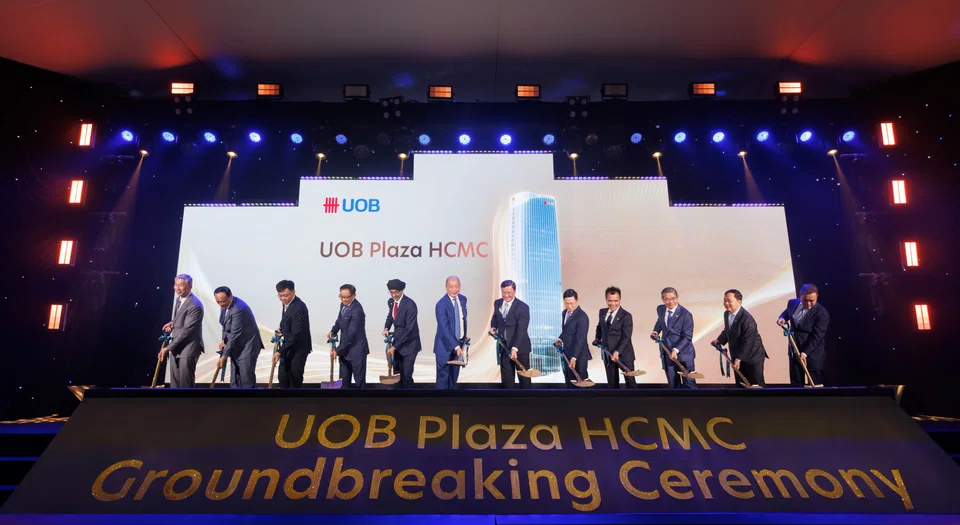
UOB stands on the cusp of a major growth inflection point in its illustrious history.
Fresh from celebrating its 90th anniversary last year, the bank is poised for its next leap as it rides Asean’s growth wave towards its 100-year milestone and beyond. In that time, it has expanded from a local Singapore bank into a regional financial powerhouse.
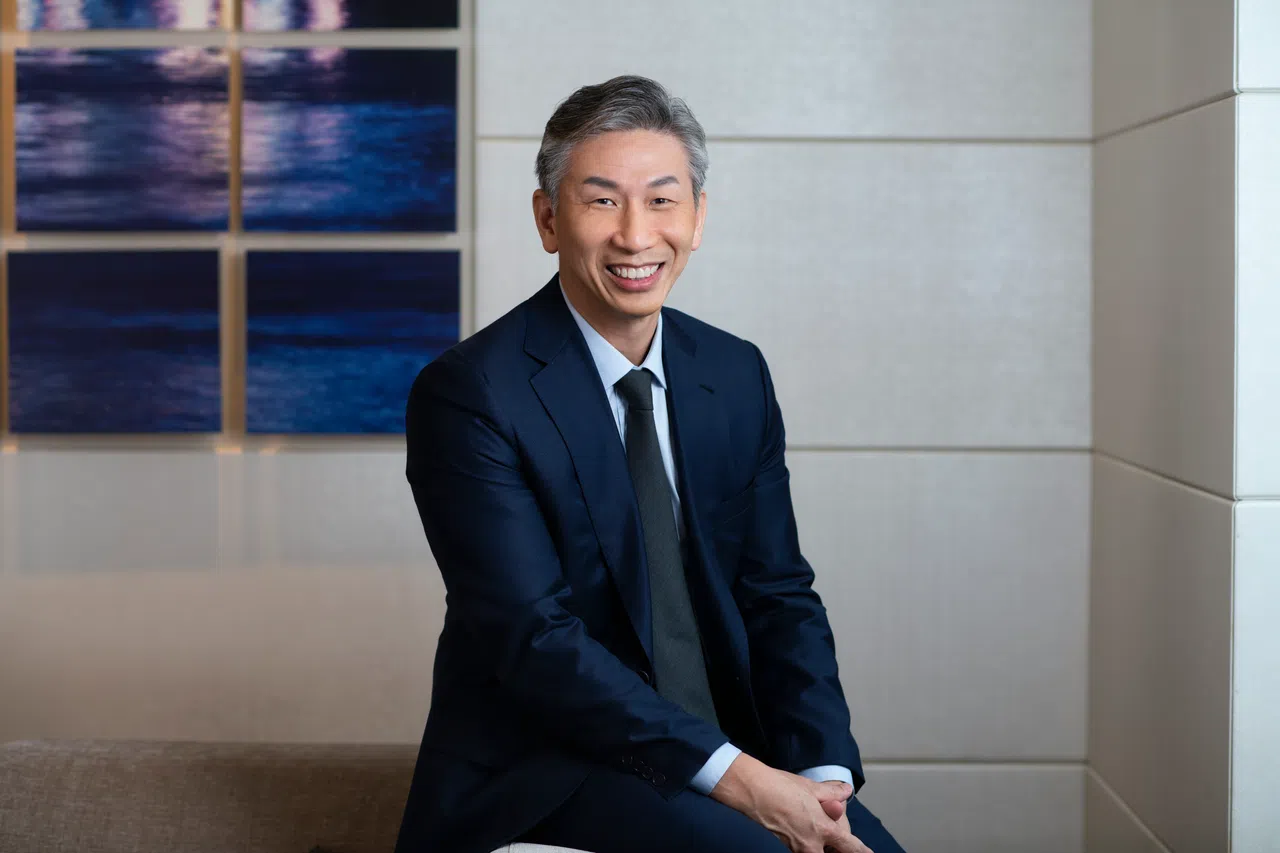
UOB’s group chief financial officer Leong Yung Chee says the bank is in “a sweet spot to capture the region’s next stage of growth”.
He adds: “Our network spans the region’s most dynamic markets, and we continue to invest in people, capabilities and technology so that we can support our customers better. Our strong capital and liquidity positions provide the resilience as we pursue growth with discipline.”
Asean: Its key growth engine
UOB’s next chapter is firmly anchored in the region’s growing wealth, rising trade flows, and global supply chain shifts.
Asean is set to become the world’s fourth-largest economy by 2030 after the US, China and the EU, with intra-Asean trade growth expected to outpace the global annual average of 5 per cent.
The region remains a strong magnet for foreign direct investment (FDI), attracting a record US$244 billion in 2025, or a 10 per cent rise over 2024.
Leong notes that “Asean stands out as one of the world’s most attractive growth regions, as the world becomes more multipolar and supply chains continue to reconfigure… regional integration is deepening across trade, the digital economy and energy security”.
The bank is in the right place at the opportune time.
Leong says: “Asean has always been our strategic focus. We have built one of the most extensive regional networks, with deep local market knowledge that positions us uniquely to help customers capture the opportunities in the region.”
For instance, UOB has spent over S$800 million in the last decade on an integrated regional platform, building capabilities in payments, cash and trade for its wholesale business.
Unlocking growth and synergies post-Citi acquisition
UOB’s Asean ambitions were boosted in 2022 with its S$4.9 billion acquisition of Citi’s consumer banking businesses in Indonesia, Malaysia, Thailand, and Vietnam. This deal has significantly strengthened UOB’s regional consumer franchise, which now serves more than eight million customers.
Having completed much of the integration work, UOB is moving towards unlocking value from this enlarged franchise across Asean.
Leong says: “Having stabilised operations, we are now focused on unlocking the full value of our enlarged franchise, particularly in the emerging affluent and affluent customer segments, where we see significant opportunities to drive wealth and main bank relationships.”
The integration has enhanced UOB’s ability to create more value for customers through “expanded product offerings, exclusive partnerships and cross-border capabilities”, he adds.
UOB’s key Asean-4 markets in Malaysia, Indonesia, Thailand and Vietnam now contribute about 35 per cent of retail banking income and are growing faster than the group.
Its market-leading cards business is also thriving, with higher card billings across Asean. UOB was first in consumer credit card billings for three consecutive years, reinforcing its position as the No 1 card issuer for Visa and Mastercard in Asean.
In the first half of 2026, the bank saw strong wealth momentum across Asean-4, with wealth management income growing 30 per cent year-on-year, led by Malaysia and Thailand.
Overall, Leong notes that the bank is seeing more customers with increased product holdings across deposits, insurance, investments, secured loans and cards.
Winning in wealth and additional priorities
UOB is banking on affluent and emerging-affluent customers as it builds a more diversified, asset-light revenue base post-integration.
Expanding its wealth management business is a core pillar of UOB’s strategy. This is structurally aligned with its Asean long-term growth story and is supported by a large, increasingly affluent consumer base that remains under-penetrated in the region.
Leong says: “Over the next five years, we will double down on wealth by growing our client base, increasing invested assets under management and strengthening advisory-led engagement across our segments, leveraging our regional platforms.”
Supporting these ambitions is UOB’s new long-term strategic distribution partnership with Allianz Global Investors (AGI). By combining UOB’s regional customer reach, advisory expertise, and distribution network with AGI’s global investment capabilities, the partnership will broaden UOB’s wealth offerings and provide customers across Asean with greater access to tailored investment solutions.
This will be supported by “a stronger end-to-end customer experience, combining deeper advisory capabilities with data, digital platforms, and AI to deliver more timely and relevant advice”, Leong adds.
Aside from winning in wealth, UOB has three additional priorities:
- Private bank: Expand with a clear focus on growing AUM and fee income through growing its relationship manager base while broadening regional footprint across North Asia.
- Hong Kong: Renewed growth strategy focused on deepening its capabilities across wholesale banking, treasury and wealth management to help clients expand into Asean, facilitate cross-border trade and investment, and capture opportunities arising from growing regional capital and wealth flows. UOB Private Bank aims to grow Hong Kong AUM and wealth revenue fivefold by 2030 while tripling client advisory headcount.
- Wholesale Banking: UOB’s integrated platforms for payments, trade and cash, and deep sector expertise continue to power growth in trade and transaction banking. The bank will continue to expand its Risk-Weighted Assets (RWA)-light revenue streams through regional connectivity flows.
Future-ready talent equipped with AI tools
UOB is equipping all its staff to deal with the challenges of tomorrow, including AI.
Leong says: “As banking continues to evolve, we are also investing in future-ready capabilities such as AI, data and digital skills, ensuring our people grow alongside the business.”
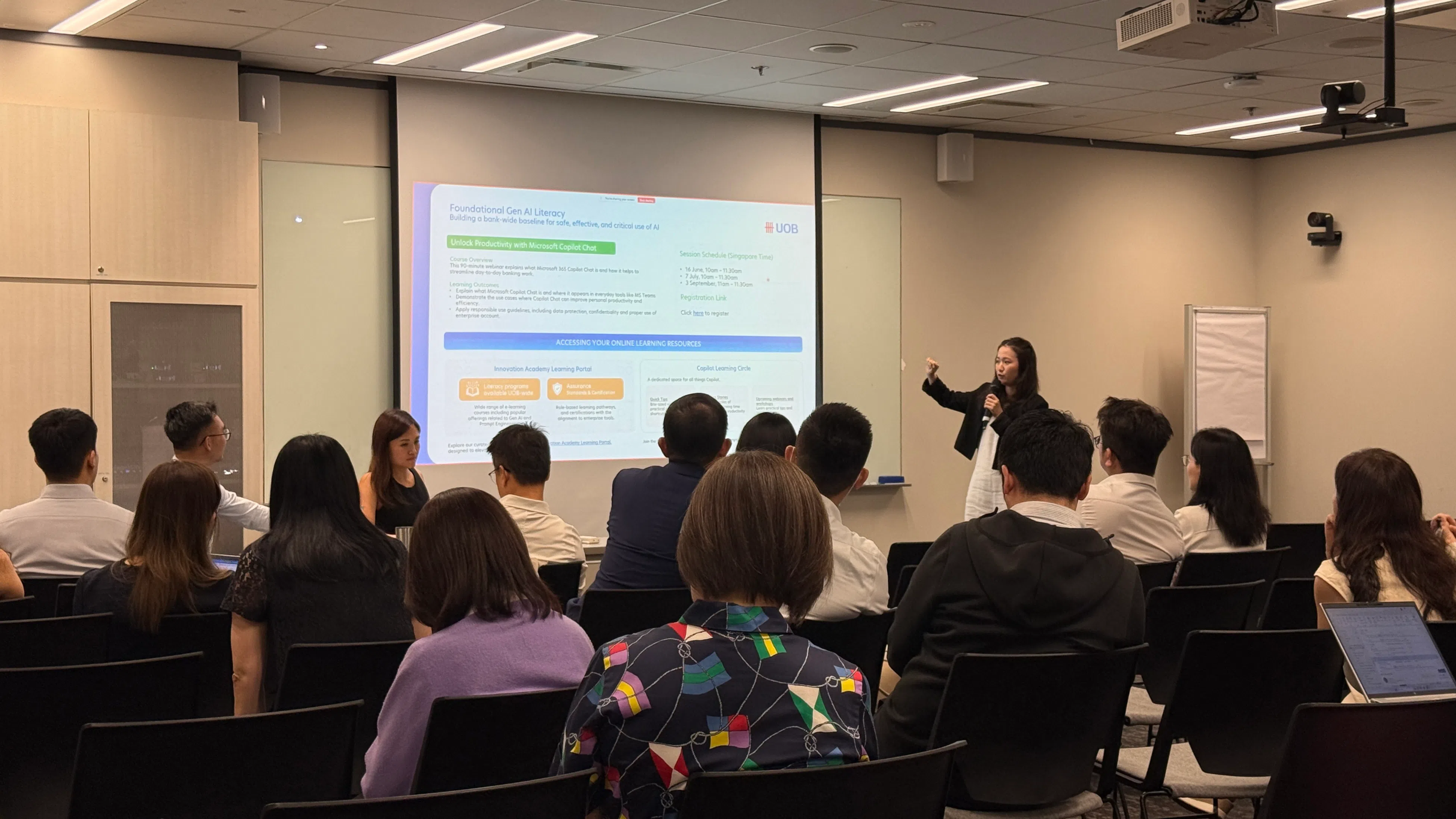
About 30,000 employees across the group have access to Microsoft 365 Copilot to enhance productivity and simplify everyday tasks. UOB employees already use about 14,000 prompts each day.
Last year, UOB launched its Innovation Academy – a capability-building platform that provides employees with structured learning pathways in areas such as AI, data analytics, blockchain and design thinking. To date, about 90 per cent of the bank’s employees have received generative AI upskilling to strengthen enterprise-wide readiness.
Overall, the bank has a robust track record of investing in its people and developing talent from within.
“We believe strongly in growing our own timber by promoting lifelong learning through reskilling and upskilling programmes,” says Leong.
In 2025, UOB invested S$18.3 million in training, and staff have access to a wide range of upskilling and reskilling programmes to strengthen technical, digital, leadership and cross-border capabilities.
For example, its AI and Data Analytics Centre of Excellence is building capabilities in generative AI and automation to enhance customer experience.
UOB’s approach to AI
Despite AI threatening to disrupt banking and affect jobs, the bank views AI as “an enabler and value creator across banking services rather than a threat to (its) model”, says Leong.
UOB is focused on using AI to improve staff productivity, risk controls and customer outcomes while keeping human relationships, trust and judgement at the core.
Leong says: “Our franchise is built on trusted client relationships and human judgement, particularly in complex, regulated and high-value decisions. AI helps elevate productivity, insight and service quality, but does not replace accountability or trust.”
UOB has leveraged AI across many parts of the bank to strengthen risks and controls, improve productivity, and enable data-driven decision-making.
“Our focus is on using technology to enhance client outcomes (and possible revenue opportunities) while keeping banking relationship-led and advice-driven,” Leong explains.
For staff, its focus is on making AI adoption personal, practical and purposeful, freeing staff from routine work so they can focus on higher-value decisions, creativity and human connection.
The bank has more than 300 AI and data analytics live use cases, in addition to the more than 30 domain-specific knowledge chatbots under the Build-Your-Own-Bot platform, which is designed to help employees obtain information faster and support more efficient decision-making.
This capability also extends to UOB’s Singapore branches, where Branch Bot provides frontline staff with quick access to product information such as interest rates, enabling them to respond to customer enquiries more promptly and effectively.
Leong says: “These use cases touch thousands of colleagues and customers daily, with clear impact – simpler work and higher value delivery.”
UOB has also partnered Accenture to harness GenAI and Agentic AI to transform the bank in Group Wholesale Banking Credit, Anti-Money Laundering and KYC (Know Your Customer), Group Retail Relationship Manager enablement, retail collections and branch experience.
Leading for the next lap
Leading towards 100 years requires good succession planning and bench strength.
Leong says UOB has robust processes to identify and develop talent for senior management positions, and adopts a long-term and sustainable approach to leadership development and succession.
“Other than skills, we emphasise teamwork and a values-based culture,” he shares.
Leong’s optimism about the next 10 years stems from UOB’s resilience and adaptability in the past 90 years, as it successfully navigated multiple economic cycles and periods of uncertainty.
He notes: “Backed by a strong balance sheet, robust capital position and disciplined risk management, I am confident the bank is well placed to seize the opportunities ahead and continue creating sustainable value for generations to come.”
The rise of Asean will be central to its success, with Leong saying: “What will differentiate UOB is not the number of features we offer, but the strength and scalability of the ecosystem built across Asean.”
He adds: “We are entering our next phase of growth from a position of strength. We have a clear strategy, a strong Asean franchise and deep regional capabilities to capture the opportunities emerging across Asean.”

Share with us your feedback on BT's products and services
TRENDING NOW

Once staunchly pro-China, Malaysian Chinese businesses are now distancing themselves from Beijing

Looking beyond looming CEO succession, should UOB potentially pursue a transformative merger?

Could stablecoins be the future of money?

Grab CEO’s wife Chloe Tong on life with Anthony Tan and finding her purpose

