

From developer to city shaper: IOI Properties’ vision for Singapore’s downtown
As prime office space becomes more valuable and work, living and leisure converge, Singapore’s Downtown Core is emerging as a more dynamic, connected and compelling urban destination. The next phase will be shaped not simply by how much space is built, but by the quality of the places created around it. IOI Properties Group’s growing presence in the district offers one perspective on how developers can respond
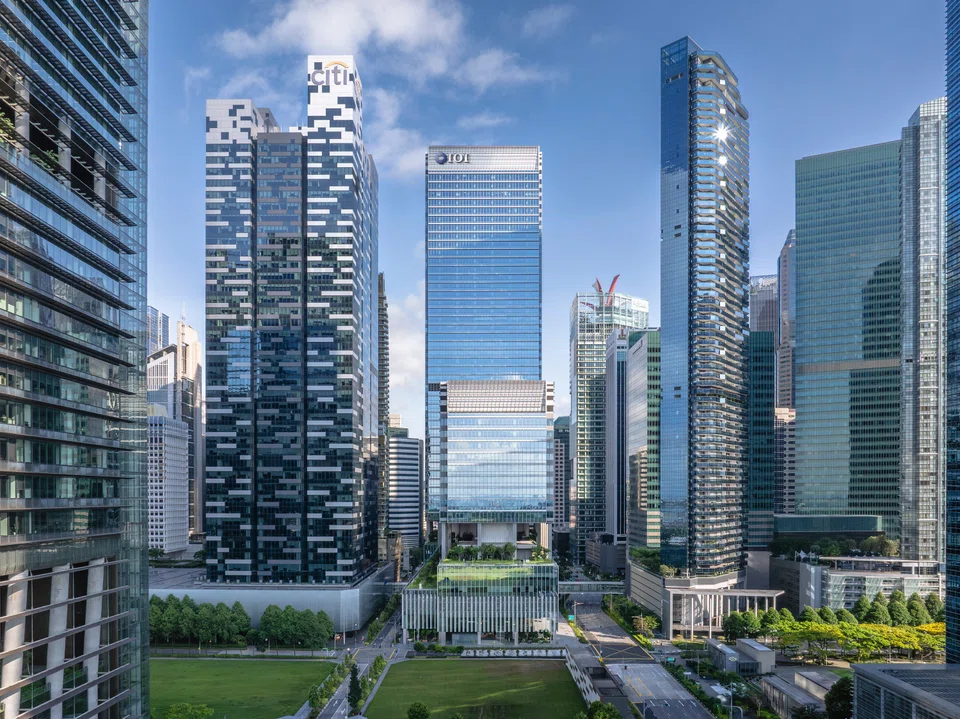
SINGAPORE’S Central Business District (“CBD”) has long benefited from strong fundamentals. Today, an increasingly valuable advantage is emerging: the scarcity of quality office space.
In Marina Bay, the CBD’s prime office submarket, Grade A vacancy tightened for a fifth consecutive quarter to 2.1 per cent in the second quarter of 2026, returning to levels last seen in the third quarter of 2019. Across the wider CBD, Cushman & Wakefield expects no major office completions for the remainder of 2026 and only one project in 2027.
That scarcity is sharpening the value of a broader transformation in what Downtown can become.
Under the Urban Redevelopment Authority’s Master Plan 2025, the Central Area is evolving into a more mixed-use, connected and people-oriented district. While older developments in Raffles Place and Tanjong Pagar are being rejuvenated, Marina Bay continues to extend the city centre through a broader mix of workplaces, homes, hospitality, public spaces and attractions.
The CBD Incentive Scheme reinforces that direction, encouraging the redevelopment of ageing buildings into mixed-use projects that can introduce more residents, amenities and extend activity beyond conventional office hours.
The strategic opportunity extends beyond accommodating growth. Singapore can preserve the CBD’s standing as one of Asia’s premier business addresses while strengthening Downtown Core as a place where people choose to live, stay, meet and spend time throughout the week, not merely pass through on weekdays.
Quality as the new scarcity
The office market offers an early indication of this transformation. Cushman & Wakefield has characterised the market as increasingly two-tiered, with occupiers gravitating towards newer or well-upgraded buildings offering superior connectivity, amenities and workplace experience. CBD Grade A office rents rose 0.9 per cent quarter on quarter in Q2 2026, bringing the first half year growth to 2.2 per cent., while new Grade A supply is expected to remain below historical net demand through 2031.
“Singapore’s office market continues to be shaped by occupiers’ flight to quality and an increasingly tight supply pipeline. CBD Grade A office rents extended their upward trajectory in Q2 2026, marking 21 consecutive quarters of growth, the longest quarterly growth streak since available data from 2000. Supported by healthy leasing activity at new CBD developments, CBD Grade A vacancy rates are expected to fall below 4 per cent by the end of 2026,” says Wong Xian Yang, head of research, Singapore & SEA, Cushman & Wakefield.
For landlords, scarcity creates the opportunity, but enduring advantage comes from the relevance and quality of the asset itself.
Location and floorplate remain fundamental, but companies increasingly assess the entire experience surrounding the workplace: the quality of arrival, access to transport, amenities, greenery, hospitality, services and the extent to which an office can help attract talent and reinforce corporate culture.
This is the context in which IOI Properties Group’s clustered presence in Singapore’s Downtown Core becomes strategically significant.
“Singapore has consistently demonstrated an ability to reinvent itself while preserving the fundamentals that make it one of the world’s most trusted places to invest and do business. Our conviction in its long-term future is reflected in the scale of our commitment to the Downtown Core,” says Dato’ Lee Yeow Seng, Group Chief Executive Officer of IOI Properties Group.
“We are not looking at these assets in isolation. By building a portfolio of complementary properties in close proximity, we have an opportunity to contribute to the next evolution of Downtown – connecting workplaces, hospitality, residences and public spaces into a more complete urban ecosystem.”
From business district to city centre
That distinction matters. A successful global CBD can extend its relevance beyond the working day by becoming a more active, attractive and complete city.
More homes can establish a permanent Downtown population, supporting restaurants, retail and everyday services through evenings and weekends. Successful city-centre living is strengthened when residences connect naturally with transport, greenery, amenities and public space – an idea embedded in URA’s longer-term vision for the Central Area.
Hospitality adds another dimension.
Singapore welcomed 16.9 million international visitors in 2025, up 2.3 per cent from 2024, while average hotel occupancy rose to 81.9 per cent despite the addition of 644 rooms to the market. Marina Bay is well positioned to benefit from this growth, supported by major new investments including the Marina Bay Sands expansion, NS Square and Therme Singapore wellness destination, which will elevate the precinct’s appeal across hospitality, entertainment, wellness and public life.
Hotels serve business travellers, leisure visitors and eventgoers simultaneously. More importantly for the city, they introduce a rhythm of activity that is different from the office cycle.
Together, offices, residences and hospitality create the foundations of a more balanced Downtown economy. Offices anchor commerce, homes establish community and hotels introduce a global flow of visitors. The next opportunity is to connect those uses into a seamless urban experience.
Vibrancy is created in the spaces between them. Strong pedestrian connections, quality public spaces, greenery, curated retail and active programming are what transform a collection of developments into a distinctive and recognisable district.
Thinking at precinct scale
IOI Properties Group’s approach to capital also reflects that long-term ownership philosophy. In August, the Group secured approval from the Securities Commission Malaysia for the establishment and proposed listing of IOIPG Malaysia REIT, with a proposed portfolio valued at approximately RM7.58 billion (S$2.36 billion) across retail, office and hospitality assets.
Beyond the listing itself, the move signals a broader evolution in IOI Properties’ business model – from developing real estate to owning, operating and managing institutional-quality assets through multiple stages of their lifecycle. It also gives the Group additional capital recycling platform to support future growth, including opportunities that require patient capital and active asset management.
That perspective is particularly relevant in Singapore, where IOI has steadily assembled a concentrated portfolio of major Downtown assets. Its CBD holdings include IOI Central Boulevard Towers, South Beach Tower and the recently acquired Asia Square Tower 2, accounting for approximately 2.5 million sq ft of commercial net lettable area.
For a long-term owner, value creation therefore extends beyond developing new buildings. It also involves renewing established assets, improving connections and ensuring that properties remain relevant as the expectations of occupiers – and the city around them – evolve.
That capital and ownership platform is therefore not a detour from the precinct narrative; it helps explain how IOI can invest, renew and connect assets over time.
The proximity of IOI’s assets creates another opportunity: to strengthen value beyond individual property lines.
For IOI, this requires focusing on both the physical platform and experience layered onto it. Internally, the Group describes this through the distinction between “hardware” and “software”. The hardware is tangible – architecture, sustainability, amenities, landscaping and connectivity. The software is experiential – placemaking, programming, tenant engagement and the way individual buildings participate in the life of the wider precinct.
The most successful districts require both.
New buildings, renewed assets
IOI Central Boulevard Towers demonstrates how those ideas can be embedded into a new-generation office development.
The project comprises 1.26 million sq ft of Grade A office space and approximately 30,000 sq ft retail offerings, complemented by 120,000 sq ft of green landscaping, including Central Green, a 60,000 sq ft sky park and communal space in the heart of Marina Bay, complete with a 200m jogging track.
Connectivity is equally deliberate. An underground link provides direct access to Downtown MRT station, while elevated walkways connect the development with One Raffles Quay and Asia Square.
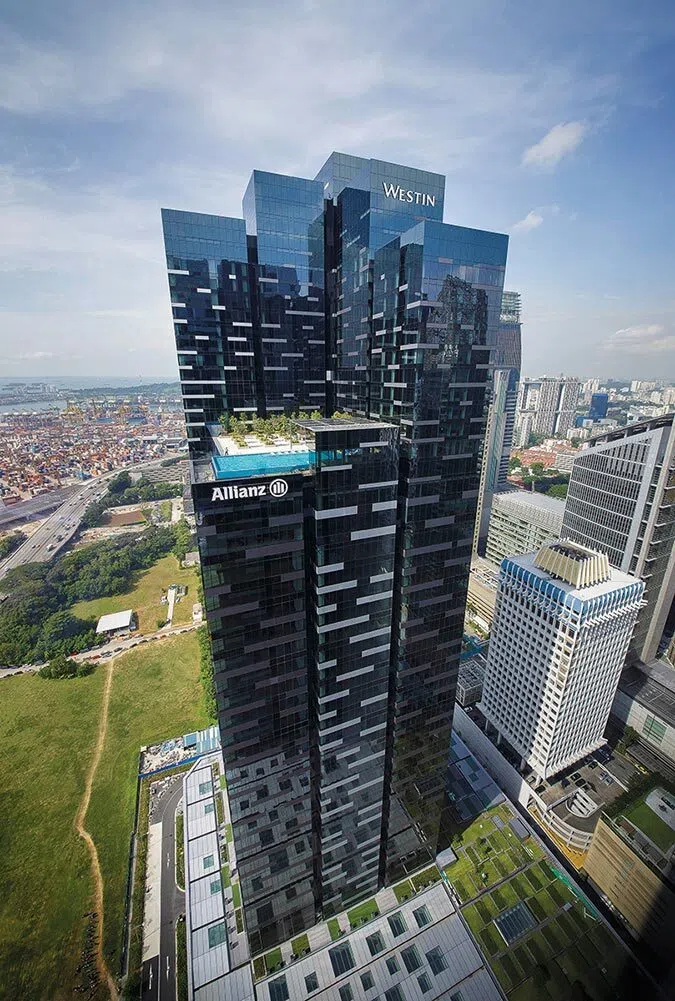
As one of the largest recent office completions in the CBD, IOI Central Boulevard Towers achieved near-full occupancy by the end of 2025, attracting a tenant mix spanning global technology companies and leading professional-services firms. In a market still debating the future of the office, its leasing performance points to a more specific conclusion: demand remains strong for workplaces that combine premium specifications with transport connectivity, amenities and a broader employee experience.
At South Beach Tower, the proposition is complementary. Here, the opportunity lies in showing how an established asset can keep strengthening its appeal and remain competitive when reinvestment focuses not only on the building’s physical condition, but on the experience of arriving, meeting, working and moving through the precinct.
Its recent enhancements focused on the end-user experience, from arrival and common areas to amenities, service standards and connectivity, subsequently supported the tower’s return to full occupancy.
With existing access to Promenade, Esplanade and City Hall MRT stations. Connectivity is expected to strengthen further following the completion of neighbouring Shaw Tower and a planned sheltered pedestrian connection towards Bugis MRT.
The lesson is relevant across mature CBDs: an office tower’s competitiveness is strengthened by what exists inside its footprint and by how successfully it participates in the precinct around it.
Adding new dimensions to Marina Bay
Having established a strong commercial presence, the next phase of IOI’s Singapore portfolio brings living and hospitality uses into the Marina Bay story.
Upon completion, W Residences Marina View will comprise 683 branded residences integrated with the 360-room W Singapore – Marina View hotel alongside a planned Privately Owned Public Space, or POPS, accessible to the public.
Its significance extends beyond the introduction of another mixed-use development. The proposition aligns with the broader direction of URA’s Master Plan: a Downtown Core that is increasingly layered in experience, with homes, workplaces, hospitality, greenery and public spaces operating as parts of a connected urban system.
Detailed plans for the POPS are still being developed, but IOI’s ambition is to transform it into a distinctive urban destination in its own right – a place for people to meet, pause and participate in city life. In a district where some of the most important transformations will happen at street level rather than on the skyline, such spaces can help turn a portfolio of buildings into a more legible and active precinct.
Together with IOI’s established commercial assets, the development broadens the Group’s presence across work, living and hospitality. More importantly, it strengthens the portfolio as an integrated urban ecosystem rather than a collection of standalone assets.
Ultimately, the significance lies in what an integrated portfolio of assets can contribute over decades; stronger connections, richer experiences and a more complete Downtown proposition.
Singapore’s CBD will continue to compete strongly for companies, capital and talent. Increasingly, the world’s leading city centres are also differentiating themselves through the quality of urban life they offer.
That means creating places where offices, homes, hotels, transport, greenery and public spaces reinforce one another; where the city remains active beyond the working week; and where commercial success and urban experience strengthen the same proposition.
“Our ambition is to play a meaningful role in Singapore’s next chapter – creating places that remain relevant not only today, but for the generations that will experience Downtown in the decades ahead,” Lee says.
It is a long view of development, and perhaps a different measure of success: not simply what a developer builds, but what it leaves behind for the city.

Share with us your feedback on BT's products and services
TRENDING NOW

Once staunchly pro-China, Malaysian Chinese businesses are now distancing themselves from Beijing

Looking beyond looming CEO succession, should UOB potentially pursue a transformative merger?

Could stablecoins be the future of money?

Grab CEO’s wife Chloe Tong on life with Anthony Tan and finding her purpose

