

Budget 2025: Incentives for cleaner heavy vehicles will cut carbon, costs, but more details needed
Cleaner heavy vehicles could help businesses cut emissions and running costs, but inducements must be significant enough to push adoption: observers

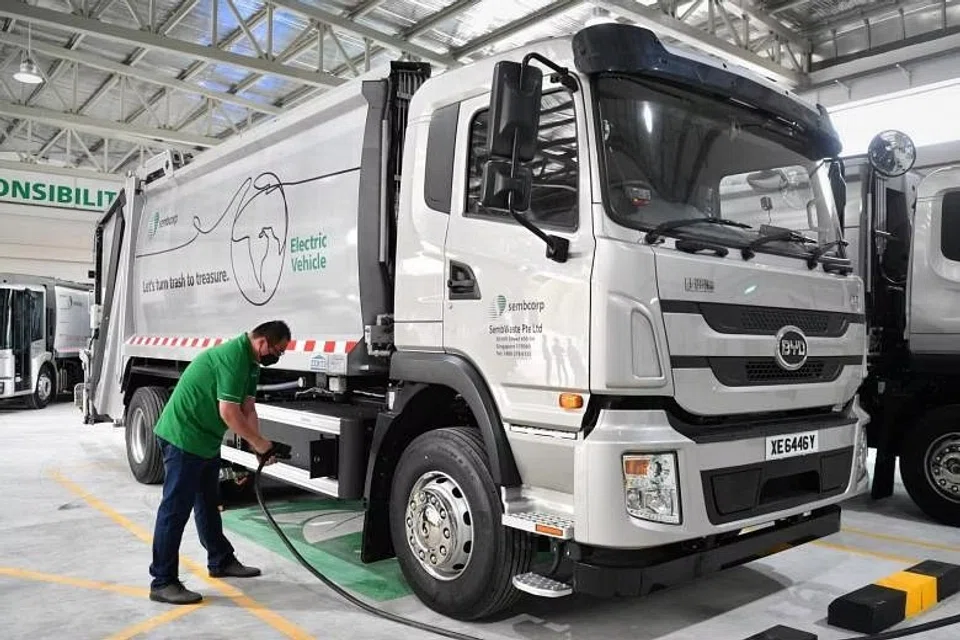
- Incentive scheme for purchasing of low-emissions heavy vehicles
- Grant to co-fund electric vehicle chargers
- Electric heavy goods vehicles and buses to pay additional road tax component from 2026
UPCOMING moves to increase the adoption of cleaner heavy vehicles should help reduce pollution and allow businesses to save costs, said industry observers, though further details have yet to be revealed.
Deven Chhaya, partner for infrastructure advisory at KPMG, said that the initiatives are a “positive and necessary step towards decarbonisation”, but their effectiveness will depend on several factors.
He added: “While details are still forthcoming, the scheme appears to provide targeted support for the logistics and transport industries to accelerate large-scale fleet electrification.”
In his Budget speech on Tuesday (Feb 18), Finance Minister Lawrence Wong announced two moves to accelerate the adoption of clean heavy vehicles: a Heavy Vehicle Zero Emissions Scheme and an Electric Heavy Vehicle Charger Grant.
“These schemes will provide incentives for the purchase of the heavy vehicle, and co-funding of the charging infrastructure,” he said without elaboration, adding that details will be provided at the Ministry of Transport’s forthcoming Committee of Supply debate.
Wong, who is also prime minister, said that Singapore is “making good progress” towards its long-term target of having all vehicles run on cleaner energy by 2040.
In 2024, about a third of all new cars registered were electric vehicles and almost half were hybrids. But adoption of cleaner heavy vehicles has been slower, said PM Wong, due to limited model availability, higher upfront costs, and less accessible charging infrastructure.
Clearing the air
Jimmy Peng, associate professor of power systems at NUS, said the heavy vehicle-related moves will help Singapore meet its emissions targets, as they target an area that “has not yet caught up with decarbonisation”.
A 2021 study by Singapore University of Technology and Design researchers showed that diesel vehicles make up 18.8 per cent of the road vehicle population here, but generate 62.9 per cent of greenhouse gas emissions.
In 2024, 45 per cent of newly registered light goods vehicles (LGVs) were electric, compared to 15.7 per cent that were diesel.
For heavy goods vehicles (HGVs) and buses, only 8.1 per cent were electric, with 91.4 per cent being diesel.
Since 2021, takeup of cleaner vehicles has been boosted by incentives for cleaner LGVs. But before Budget 2025, authorities held off on introducing a similar scheme for heavy vehicles, as alternatives to diesel were limited.
Edward Tan, executive director of Hong Seh Group, a distributor for multiple commercial vehicle brands, said the latest move shows that the government is “listening to the industry and up-to-date with the market”.
He said companies would gain from having electric heavy vehicles, since EV fleets can lower Scope 1 emissions and have lower lifetime running costs.
Unknowns remain
But incentives would need to be significant enough to drive change, and other uncertainties may still slow down adoption.
“The effectiveness of the initiative will depend on factors such as the level of financial support, the availability of charging infrastructure, and whether businesses are incentivised to transition in a commercially-viable manner,” said KPMG’s Dr Chhaya.
Tan added: “Electric heavy vehicles are more expensive than diesels, so the incentives would need to be generous enough – S$20,000 to S$30,000 – to convince fleet owners to switch.”
Some heavy electric goods vehicles can cost twice as much as their diesel counterparts.
Prof Peng said: “Companies are primarily concerned with cargo capacity and range of their fleet, that is, their cost-competitiveness, and that might deter them from switching to electric vehicles.”
Heavy sunk costs, electricity price fluctuations and knock-on factors like increased delivery prices for consumers are all factors that need to be tested, he added.
PM Wong also announced that electric HGVs and buses will pay an additional flat component as part of their road tax, in line with electric passenger cars and LGVs.
This is to maintain parity with usage charges for internal combustion engine vehicles, which pay fuel excise duties that EVs do not.
The additional component will be progressively introduced from 2026, at S$100 a year for electric heavy goods vehicles and up to S$200 a year for electric buses.
From 2028, it will be S$250 a year and up to S$550 a year, respectively.






