

Budget 2026: Raise jobseeker support scheme’s S$5,000 income cap to cover more retrenched PMEs, says NTUC chief
Income cap can be pegged to PMET median monthly income, which was around S$7,600 in 2025: Ng Chee Meng

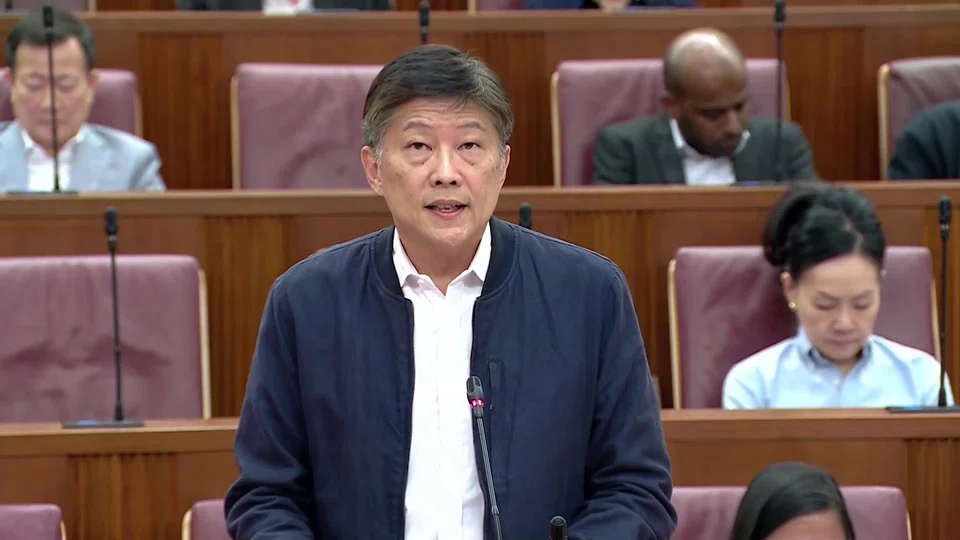
[SINGAPORE] The income cap on a government support scheme for involuntarily unemployed workers should be reviewed so more retrenched professionals, managers and executives can qualify, National Trades Union Congress (NTUC) secretary-general Ng Chee Meng said in Parliament on Wednesday (Feb 25).
Ng, who spoke on the second day of the Budget debate, noted that six in 10 of the 7,200 applications to the SkillsFuture Jobseeker Support Scheme (JSS) were rejected between April and August last year, with many exceeding the S$5,000 monthly income cap.
“As more PMEs (professionals, managers and executives) experience churn, it is timely for the government to review this income threshold, so that the JSS can provide baseline assurance to our middle-income PMEs during retrenchment,” he said.
The labour chief suggested pegging the income threshold to the PMET median monthly income, which was around S$7,600 in 2025.
Introduced in April 2025, the JSS provides temporary financial support of up to S$6,000 over six months to involuntarily unemployed workers while they undergo training or seek new roles.
NTUC assistant secretary-general Patrick Tay echoed the call, specifically proposing that the cap be raised to S$7,600. “By easing financial pressure, JSS helps workers avoid rushing into poor job matches that lead to underemployment,” he said.

Job insecurity was a recurring theme among the labour MPs, with Tay warning that headline-making retrenchments are likely to persist as businesses restructure amid continuing economic uncertainty.
Beyond the JSS, the labour MPs also renewed calls for mandatory retrenchment notifications, pointing to a spate of high-profile retrenchments last year where employers had failed to abide by the Tripartite Advisory on Managing Excess Manpower and Responsible Retrenchment and collective agreements.
Tay called on the government to require that all mandatory retrenchment notifications be made prior to retrenchments taking place, rather than within five working days after employees have been notified – as is currently required of employers with at least 10 staff.



He also called for strong penalties for non-compliance, and for the government to share information with NTUC and unions on sectors and companies at risk of disruption, including expected scale of impact and past retrenchment benefit levels.
Ng similarly called for advance retrenchment notifications, noting that many multinational companies already provide such notifications for overseas retrenchments.
“Our intent is not to constrain firms’ flexibility, but to put our tripartism to work in upholding responsible retrenchment and delivering more coordinated support for our workforce amid disruption,” he said.
Decoding Asia newsletter: your guide to navigating Asia in a new global order. Sign up here to get Decoding Asia newsletter. Delivered to your inbox. Free.
Copyright SPH Media. All rights reserved.
TRENDING NOW

Once staunchly pro-China, Malaysian Chinese businesses are now distancing themselves from Beijing

Looking beyond looming CEO succession, should UOB potentially pursue a transformative merger?

Could stablecoins be the future of money?

Grab CEO’s wife Chloe Tong on life with Anthony Tan and finding her purpose

