

Budget 2026: Singapore expects smaller S$8.5 billion surplus in FY2026, in line with economists’ expectations
Though estimated expenditure outstrips revenue, net investment returns contribution more than makes up for the shortfall

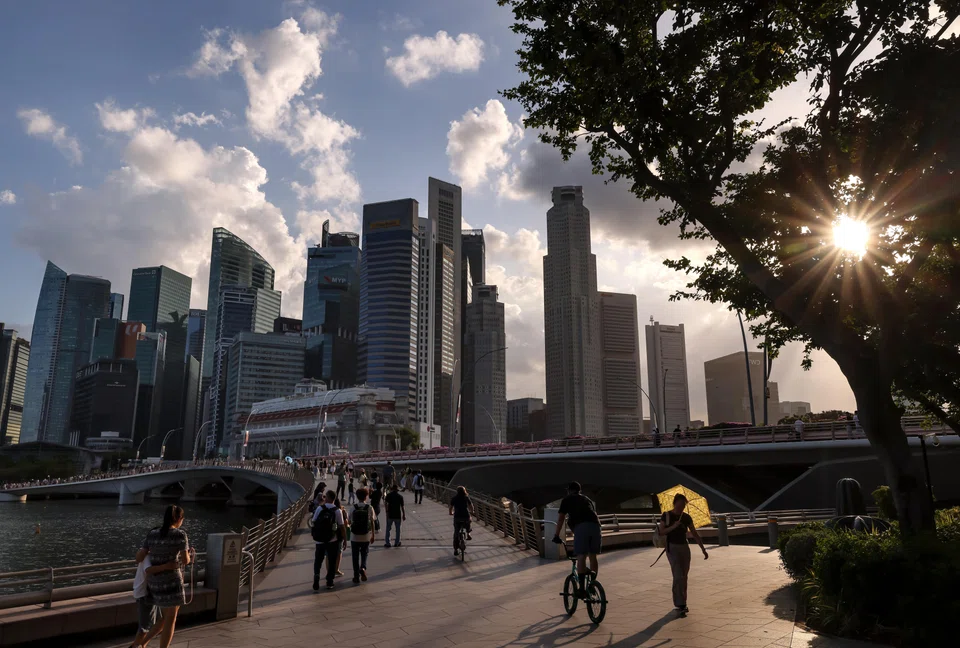
[SINGAPORE] The Republic expects a fiscal surplus of S$8.5 billion or 1 per cent of gross domestic product in its first Budget of the new government term, with the net investment returns contribution (NIRC) more than making up for a primary deficit.
This is smaller than FY2025’s higher-than-expected S$15.1 billion surplus, but in line with economists’ expectations of a third consecutive planned surplus.
“Our approach remains to keep the Budget balanced over time, and across the ups and downs of the economic cycle,” said Finance Minister Lawrence Wong in his Budget speech on Thursday (Feb 12).
Sheana Yue, senior economist at Oxford Economics, said that FY2026’s projected smaller surplus did not come as a surprise.
She noted that revenue growth is expected to slow as the export-led momentum from 2025 wanes, even as the government deliberately steps up spending.
In that sense, the narrower surplus “reflects a policy choice rather than fiscal stress”.

She pointed out that the government is using the room created by earlier surpluses to provide targeted support to households – especially lower-income and senior groups – while continuing to invest in workforce upgrading and skills development “as the economy adapts to technological change”.
Maybank economist Chua Hak Bin said that the government’s prudent fiscal surplus in the first year of the new electoral term preserves “some dry powder” that can be drawn upon in the event of any unexpected shock or downturn.
Both operating revenue and total expenditure are expected to rise in FY2026, though the rise in spending will outstrip that of takings.
SEE ALSO























Operating revenue is estimated at S$134.8 billion, 3 per cent higher than FY2025’s revised S$130.9 billion figure.
Corporate income tax remains the biggest driver at S$37.8 billion, up S$2.5 billion or 7.2 per cent from the revised FY2025 figure.
Collections are also up for major components such as personal income tax, goods and services tax and vehicle quota premiums.
In percentage terms, the largest rises were for motor vehicle taxes – up 17.2 per cent to S$2.8 billion – and vehicle quota premiums, up 8.8 per cent to S$9.4 billion.
Revenue is expected to fall for just three categories: statutory boards’ contributions; fees and charges, excluding vehicle quota premiums; and “other taxes”, comprising the land betterment charge and annual tonnage tax.
The latter sees the largest estimated fall of 59 per cent, to S$1.6 billion.
However, Chua noted that revenue projections are “typically conservative” and expects the actual fiscal surplus for FY2026 to come in higher than forecasted.
Higher spending
Total expenditure, however, is expected to rise by 10.3 per cent to S$137.3 billion, or 16.3 per cent of GDP. This is compared with FY2025’s revised S$124.5 billion figure.
Driving this increase is the Ministry of Trade and Industry, whose outlay is expected to rise by S$4.5 billion – or 68.5 per cent – to S$11.1 billion.
This is on the back of initiatives to enhance Singapore’s economic competitiveness in an uncertain global environment.
The second-biggest bump comes from the Ministry of Health, with its spending set to rise by S$2.1 billion or 10.4 per cent to S$22.5 billion.
This is due to increased subvention to public healthcare institutions; enhancement of long-term care subsidies and schemes; new healthcare facilities; and the Next Generation Electronic Medical Record system.
Also seeing a major rise is the Ministry of Home Affairs’ budget, up S$2 billion or 21 per cent at S$11.7 billion.
This is due to the progress of projects such as the Woodlands Checkpoint and Johor Bahru-Singapore Rapid Transit System Link, and higher grants to the Home Team Science & Technology Agency.
The Ministry of Defence continues to have the biggest individual ministry budget at S$24.9 billion.
In his Budget speech, PM Wong noted that Singapore expects “overall security-related expenditures to rise in the coming years”.
Closing the deficit
The difference between operating revenue and total expenditure yields a primary deficit of S$2.6 billion for FY2026. After special transfers, this widens to a basic deficit of S$5.4 billion.
But S$28.5 billion in NIRC – up S$1 billion or 3.4 per cent from FY2025 – helps to take Singapore to an overall budget surplus of S$4.2 billion.
Despite the primary deficit, Yue said the NIRC provides a “stable and structural” source of funding.
“This allows Singapore to run a supportive fiscal stance while maintaining long-term fiscal sustainability,” she added.
The final overall fiscal surplus of S$8.5 billion also takes into account the Significant Infrastructure Government Loan Act, under which the capitalisation of nationally significant infrastructure is projected to be S$5.02 billion, while factoring in related interest costs and loan expenses.
The fiscal impulse, which measures whether the government is injecting more or less into the economy compared to the previous year, is projected to be mildly expansionary at 0.6 per cent of GDP.
DBS senior economist Chua Han Teng said the overall fiscal surplus of S$8.5 billion extends the positive public financial performance of recent years, even amid the government’s stronger focus on various spending priorities.
He estimates that the government will cumulatively accumulate a “strong, overall positive” fiscal position of S$22.3 billion over its previous term.
This is based on actual outcomes from FY2021 to FY2024, as well as the materially higher revised FY2025 surplus of S$15.1 billion.
“This reflects Singapore’s robust and resilient economic performance despite global turbulence,” he added.
For more of BT’s Budget 2026 coverage, go to bt.sg/budget26
Decoding Asia newsletter: your guide to navigating Asia in a new global order. Sign up here to get Decoding Asia newsletter. Delivered to your inbox. Free.
Copyright SPH Media. All rights reserved.
TRENDING NOW

Once staunchly pro-China, Malaysian Chinese businesses are now distancing themselves from Beijing

Looking beyond looming CEO succession, should UOB potentially pursue a transformative merger?

Could stablecoins be the future of money?

Grab CEO’s wife Chloe Tong on life with Anthony Tan and finding her purpose

