

Capital can flow out of economies where regulation is applied patchily: World Bank Group general counsel
Small firms and job creation in emerging economies suffer when rules are inconsistent, says Christopher Stephens

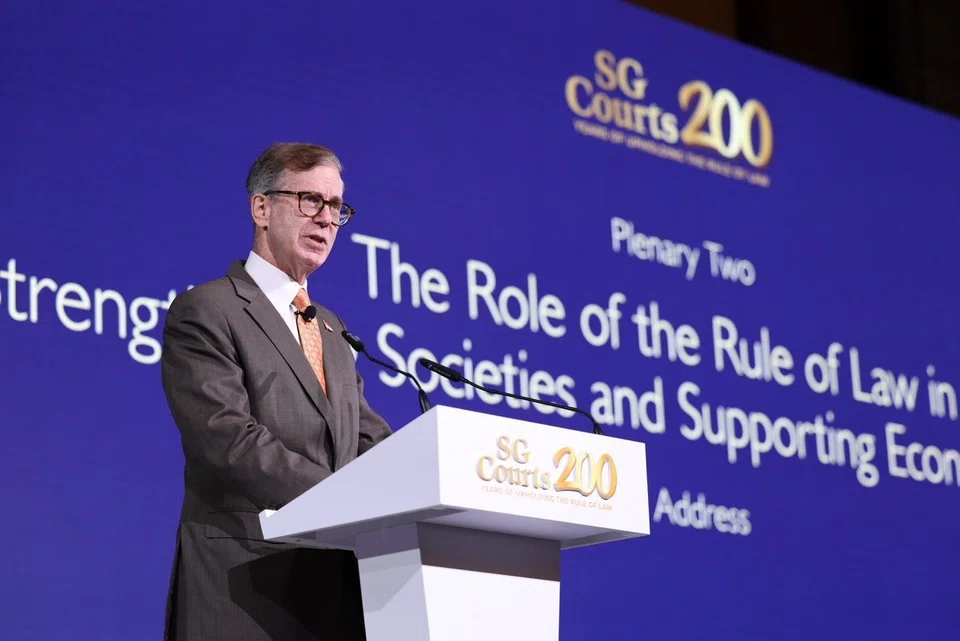
[SINGAPORE] Private capital is fickle and will quickly leave jurisdictions where laws are applied unpredictably, said Christopher Stephens, senior vice-president and group general counsel of the World Bank Group.
Speaking to The Business Times on Wednesday (Nov 25), on the sidelines of the Global Rule of Law Conference in Singapore, he said investors are “very adept at finding regions and jurisdictions where the risks can be clearly assessed and identified and mitigated”.
This “implementation gap” – between how a law is worded and how it is applied – is “probably the biggest concern” for businesses, he said.
When a regulator or court reads a law one way and then differently in a similar case later, it creates “the appearance of an arbitrary application of the law”, and the resulting uncertainty “puts a premium on risk capital”.
Smaller firms are hit hardest. Micro, small, and medium-sized enterprises (MSMEs) lack the lawyers, systems and staff to assess and mitigate such risks, Stephens said.
And those businesses that operate only in their home markets “don’t have the flexibility to simply move to another jurisdiction” if the rules there are applied inconsistently, he added.

Jobs at stake
The impact of these obstacles on MSMEs is especially significant in emerging economies, which is where the World Bank Group focuses its work.
With MSMEs creating more than 60 per cent of jobs in these economies, the overall effect of their struggles with inconsistent rules is “to thwart business development generally across the economy, and that stifles job creation, which obstructs development”, he said.
He noted that about 1.2 billion young people will reach working age in the next decade in those developing countries – but those economies are forecast to create fewer than half that number of jobs, making for a shortfall of about 800 million.
To lighten the compliance burden on MSMEs, governments can simplify regulations, digitalise filings and compliance, and speed up licensing, which he said “should establish a virtuous cycle” of higher compliance.
Businesses are also stepping in to fill the gap. In Latin America, the World Bank Group has invested in a company that provides accounting, legal and human resource services to MSMEs that lack the size or scale to have them in-house.
International commercial courts
International commercial courts could also help reduce investor risk, said Stephens. Cross-border investment normally requires some form of foreign adjudication to remove the risk of local biases or the perception of biases that might exist in national courts, he added.
That is where Singapore, home to the Singapore International Commercial Court, comes in. In his opening remarks at the Global Rule of Law Conference, Stephens said the group hopes to work with the city-state and Chief Justice Sundaresh Menon on broadening such courts.
He called the “Singapore Story” the “ultimate success story”. Singapore joined the World Bank in 1966, took 14 loans in the decade to 1975, and has since become one of its leading donors.
He attributed Singapore’s success to five factors:
- Openness to trade, investment and talent;
- Strong institutions, including rule of law and low corruption;
- State-led, long-term development policy;
- Sustained investment in human capital; and
- Fiscal prudence.
On a discussion panel at the conference, when asked whether the model could be replicated in other developing countries, Stephens replied: “We certainly hope it is.” He added that he had come “to try to borrow lessons from it”.
Asked which of the five factors should take priority, he said the “ultimate goal has got to be stability”, built through public confidence and trust in institutions.
Populism, he added, is fuelled by social discontent and a perception that “the game is rigged”.
Decoding Asia newsletter: your guide to navigating Asia in a new global order. Sign up here to get Decoding Asia newsletter. Delivered to your inbox. Free.
Copyright SPH Media. All rights reserved.
TRENDING NOW
China's premium puffer jacket push meets consumer resistance

BN-PN’s Melaka election landslide puts spotlight on jobs, investments and political divides

As Indonesia picks new vice-president to succeed Gibran, investors see risks and opportunities
LNG, stronger regional power links key to Asean’s energy resilience: Shell

