

CDC vouchers no more? Economists see smaller, targeted relief for Budget 2026
With inflation cooling, the popular voucher scheme could be scaled down, with lower payouts of S$400 to S$500, they say

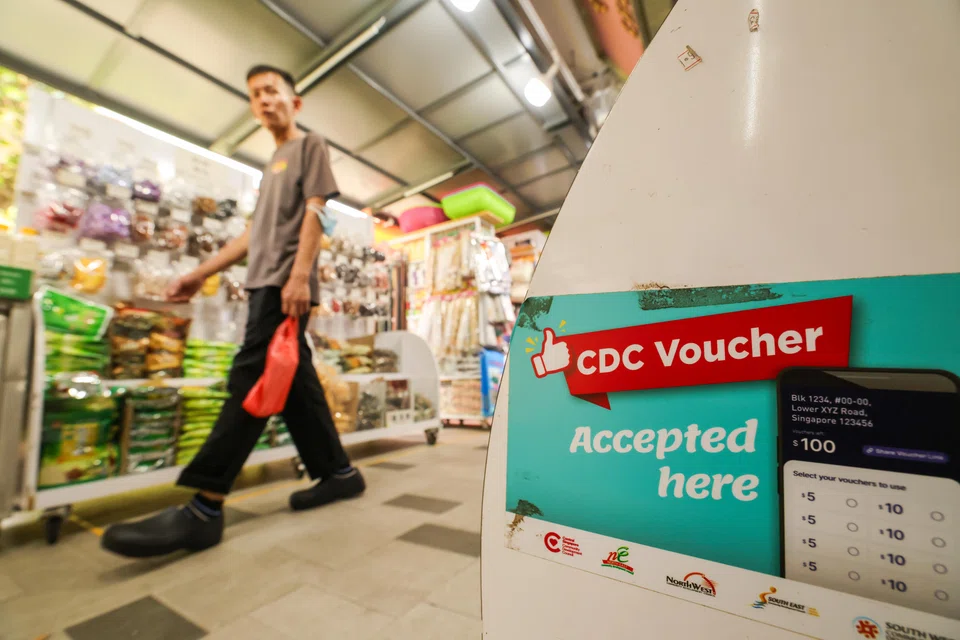
[SINGAPORE] The generous Community Development Council (CDC) voucher scheme that has become a household fixture since the days of the Covid-19 pandemic could be scaled back in Budget 2026, with economists expecting smaller payouts and tighter income criteria.
With core inflation cooling to 0.7 per cent in 2025, from its peak of 6.1 per cent in 2022, economists said the conditions that justified broad-based handouts have largely passed, even as cost-of-living concerns remain an issue for many.
Said OCBC chief economist Selena Ling: “With inflation abating, maybe it’s time to tweak the formula so that they are not taken for granted. So either scaling back or targeting more specifically where best needed.”
Tay Qi Hang, South-east Asia economist at the Economist Intelligence Unit (EIU), expects the CDC voucher scheme to be extended but “in a scaled-down and more targeted form” – with payouts of S$400 to S$500. This is in contrast with the S$800 payout that Singaporean households received in 2025.
“A smaller payout and tighter income targeting would allow the government to provide continued relief while aligning more closely with the more benign inflation environment.”
An abrupt withdrawal of the scheme is unlikely, noted Tay, given that cost-of-living pressures “remain politically and socially salient”.
Agreeing, Moody’s economist Denise Cheok said the government is likely to pull back spending on such short-term relief to focus on long-term priorities, such as climate change, an ageing population and artificial intelligence adoption.
That said, given that cost-of-living concerns are still top of mind of Singaporeans, voucher schemes will likely continue – but with a tiered income system that allocates lower amounts to higher income groups, rather than a general scheme like the SG60 vouchers.
Other observers do not expect big changes to the scheme. Sabrina Sia, global employer services leader at Deloitte Singapore and South-east Asia, said that given Singapore’s stronger-than-expected growth of 4.8 per cent last year, there are expectations that more CDC vouchers will be announced in the upcoming Budget, especially since cost-of-living pressures remain high.
That said, considering the ongoing geopolitical tensions and a sense of realism over whether Singapore’s current pace of growth can be sustained, the government may decide to keep its cards close to its chest for now and provide more broad-based support down the line as needed, should an economic downturn happen, she added.
The end of ad hoc schemes?
Economists were, however, divided on whether Budget 2026 will see the introduction of ad hoc schemes such as the SG Culture Pass and Climate Vouchers.
For instance, economists believe there could be a new tranche of Climate Vouchers given that this supports the government’s push towards decarbonisation and green energy adoption.
Similarly, Tay noted that schemes such as the U-Save and service and conservancy charges rebates – which offset inelastic consumption – are more likely to see further extensions.
On the other hand, the SG Culture Pass will likely be a one-off scheme tied to Singapore’s 60th anniversary celebrations. “The long expiry date, at December 2028, is a clue that it likely won’t be extended again this year,” said Tay.
Cheok believes future tranches of these vouchers would probably be based on the take-up rate of the existing tranche.
On the whole, these ad hoc support schemes may be calibrated to specific policy outcomes, making additional tranches unlikely, said OCBC’s Ling.
“There’s only so many climate-friendly electric appliances one household can buy per year,” she said. “And I do not know if there is data on the utilisation rate for the SG Culture Pass to assess whether it is meeting its target objectives.”
Supportive despite fiscal prudence
Despite the expected pull-back on broad-based handouts, economists said Budget 2026 is likely to remain supportive overall, with spending focused on targeted relief and long-term priorities.
“Given the anticipated larger budgetary surplus, there is no rush to tighten the belt,” added Ling.
Operating revenue was S$98.5 billion for the nine months ended Dec 31, 2025, the Accountant-General’s Department data showed. This amounts to 80.2 per cent of the full-year forecast of S$122.8 billion for FY2025.
“But given the Economic Strategy Review proposals to reset and rethink Singapore’s economic strategies and the need to build both economic and defence resilience, some serious thought and resources will need to go for medium term expenditure,” she added.
EIU’s Tay said that while Prime Minister Lawrence Wong has highlighted persistent global headwinds and the need for medium-term fiscal balance, this does not preclude a generous Budget.
He noted that PM Wong had previously mentioned that spending as a share of gross domestic product is set to rise this term, and fiscal surpluses are expected over the next few years given solid growth and revenue conditions.
“The timing for stronger fiscal support is favourable while buffers remain ample,” Tay said. “The main risk would be a sharper growth slowdown, for example, if the artificial intelligence bubble bursts, which could constrain spending further out.”
“For now, the Budget should remain supportive, albeit more disciplined and targeted,” he said. “With the 2025 general election behind us, the government has greater room to focus on balance-sheet strength and longer-term resilience rather than headline-grabbing giveaways.”
Said Ling: “The wish list is long, but policymakers will have to strike a balance between needs and wants, must haves and good to haves.”
“As far as possible, these groups of low-wage workers, seniors, young parents, sandwich class and displaced workers all have compelling needs, so a policy mix of targeted and broad-based measures are likely. I doubt it will be one or the other.”
For more of BT’s Budget 2026 coverage, go to bt.sg/budget26






