Changi Airfreight Centre in need of hardware, tech improvements: freight forwarders

Tay Peck Gek
THE booming air freight business has left Changi Airfreight Centre with some space constraints, said freight forwarders operating there. They have seen cargo overflowing into open spaces, exposing high-value or temperature-sensitive freight to weather elements and risks of pilferage and damage.
Operators The Business Times (BT) spoke to also said technology infrastructure has not kept up with the times and is unbefitting of the reputation Changi has as a world-class air hub.
The 47-ha centre is operated by Changi Airport Group (CAG) and the two main ground-handling agents, Sats and dnata. In response, CAG said improvements are underway but it is not true that there are space constraints.
A logistics veteran with over 20 years of experience said warehouses in the Cargo Agents Buildings at the centre do not provide adequate space, resulting in forwarders having to store their freight outside. The open space, however, is not sheltered, and presents challenges for storing and securing freight.
The problems became more pronounced during the peak season, when goods piled up in driveways, loading bays and heavy vehicle parking lots – causing traffic congestion and posing safety hazards as well, said a freight forwarder who requested anonymity.
In comparison, the Airport Logistics Park of Singapore, which is in the vicinity, has warehouses that are more spacious, with sheltered open space and clear vehicular flow that facilitates traffic, said the logistics veteran.
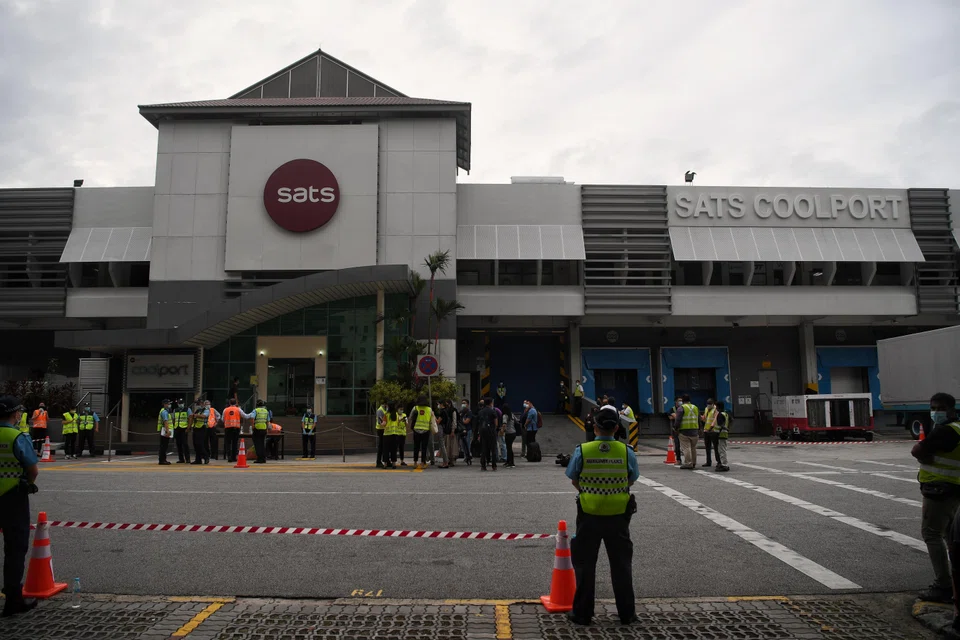
The cold chain was also broken for some cargo, the logistics veteran observed, noting that workers had to load or unload perishables outside Sats Coolport due to insufficient docks at the temperature-controlled facility during peak season. A cold chain requires items to remain within a specified temperature range at all times, even when transported from one temperature-controlled facility to another.
An executive at an international forwarder said automation is also lacking at Changi Airfreight Centre when “it should be the norm”. He noted that most activity in the centre is performed manually and by foreign labour.
“When compared with other airline cargo terminals around Asia-Pacific, Europe and the United States, our facilities are okay; but they can’t be compared to the newer airline freight terminals where automation is driving a good percentage of the activity,” the executive stated.
Vincent Wong, airfreight director for Asia at C H Robinson, told BT that the global logistics player would like to see automated import and export processes for cargoes. This would involve automated release of cargo to agents or truckers, as well as automated acceptance.
Wong said: “These will support in reducing truck waiting times to load or unload cargo, and remove physical document handling in the process.” He proposed using digital mediums, such as an app, for real-time communication and the exchange of information between cargo agents or truckers and the cargo terminals.
Responding to queries from BT, CAG said its centre still has spaces for lease. CAG’s executive vice-president for air hub and cargo development Lim Ching Kiat said: “We welcome forwarders to approach CAG for a discussion should they need more space or have special requirements.”
Prior to the opening of Changi Airport’s fifth terminal and the Changi East Industrial Zone – expected in the mid-2030s – CAG is also exploring the redevelopment of land plots to expand cargo-handling facilities and warehouse spaces within Changi Airfreight Centre to cater to demands for more space.
Lim also suggested that any breaking of cold chains was not because of space issues. He said CAG is aware that some truck drivers, contracted to pick up shipments of perishable items from Sats Coolport, have been making use of the parking spaces within the vicinity to sort items and before transporting them to destinations in Singapore.
“The correct way of handling these shipments is to truck them out to another location or their own facilities to break down the items, before sending them out, in order not to break the cold chain,” Lim said.
On the digitalisation front, CAG is implementing an application called Truck Dock Slot Booking. This allows freight forwarders and trucking companies to book time slots for air cargo pickups.
A pilot scheme has been run with Sats and dnata, as well as freight forwarders and trucking companies. CAG is working with the ground handlers to improve the system and is targeting to implement it community-wide by the end of the year.
Sats and dnata are also in the process of upgrading their facilities to drive productivity and increase handling capacity and capabilities, Lim added.
CAG also noted that Sats has implemented a number of initiatives over the years, such as the digitalisation of import and export processes with online service functions that can be accessed anywhere. These are complemented with self-service kiosks available onsite, CAG said.
Commenting on vehicular traffic at the Cargo Agents Buildings, CAG said it carries out daily patrols and daily targeted enforcement on critical areas where there might be traffic congestion. Offenders are issued with summons for violating traffic rules and regulations and for obstructing roadways, Lim said.