

Changi Airport banks on Apac aviation boom, strong partnerships for growth
Singapore’s air hub will be boosted by South-east Asia’s aviation growth while it also works to reduce costs

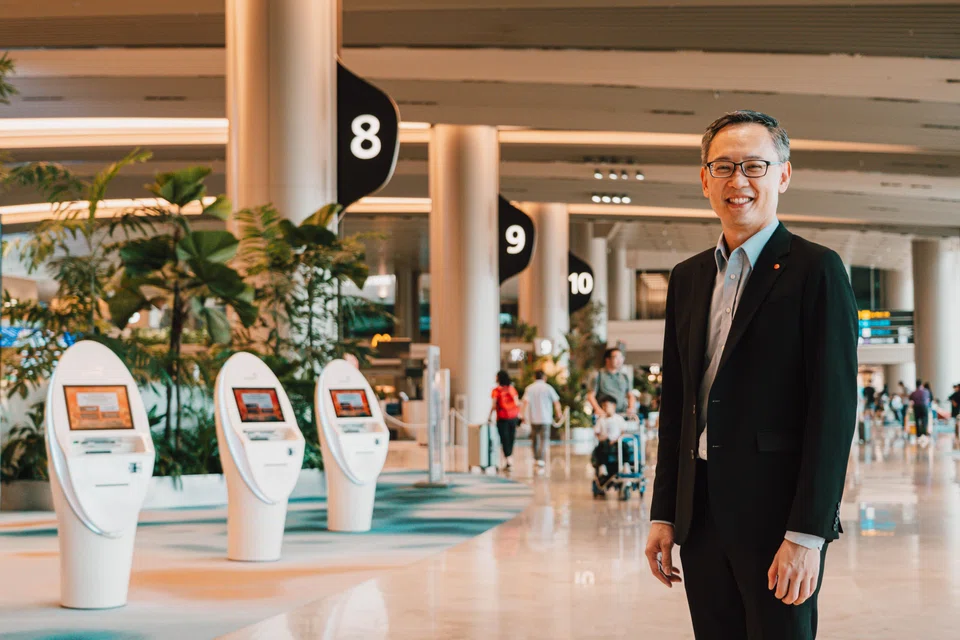
[SINGAPORE] After forty-five years since it began commercial operations, Changi Airport is one of the busiest and most lauded airports in the world.
From just one terminal and 8.1 million passenger movements a year in 1981, the airport has grown to four terminals handling a record 70 million in FY2025/2026 and was ranked the fourth-busiest airport in the world last year.
Its next few decades will be powered by the Asia-Pacific region, which is the world’s fastest growing and largest aviation market. Indeed, Changi Airport is positioning itself at the very centre of the boom: South-east Asia.
At the same time, the airport will take steps to enhance its biggest strength, which is not giant indoor waterfalls or more runways, but partnerships.
“We can’t do it alone. An airport, no matter how luxurious or comfortable, with no strong airlines doesn’t fulfil its dream of being a hub,” said Lim Ching Kiat, the executive vice-president of air hub and cargo development at Changi Airport Group.
Apac engine
Speaking to reporters at a roundtable briefing on Monday (Jul 13), Lim said that Changi’s growth will continue to be driven by Asia-Pacific’s status as the world’s leading aviation market.
For its part, Changi will work closely with airlines and aims to continue as a reliable air hub amid a more volatile global environment.
The airport recently celebrated its 45th anniversary, as it began operations on Jul 1, 1981, replacing Paya Lebar Airport as Singapore’s key passenger aerodrome.
The airport has ambitious plans to keep growing: Terminal 5 will open in the mid-2030s and turn Changi into a mega-airport, which can handle more than 100 million passengers a year, up from its current maximum of 90 million.

At the same time, it aims to boost the number of city links it has to 200 by the mid-2030s, up from around 170 currently.
Asia-Pacific remains the key growth engine.
The global aviation sector is expected to continue to grow steadily in the next few decades, with Asia-Pacific leading as the fastest growing and largest market.
Singapore, Lim said, will benefit from this by virtue of geography. Currently, Apac accounts for around 85 per cent of Changi’s traffic.
South-east Asia will be a focus point of aviation growth with a combined population of 700 million and a younger populace than other parts of Asia, as increasing affluence will drive demand for air travel.
“It happens that our neighbourhood is the one that is growing really fast ... that is the trend, and we being in this geography have to follow that trend.”
Against that backdrop, Changi will continue to prioritise connections to economic centres and global markets. In the region, this means cities in China, Indonesia, India and Vietnam as markets that are primed for aviation growth.
One likely future destination is Haiphong in Vietnam, which has numerous industrial parks with Singapore-linked entities, and is also relatively close to popular tourist destination Ha Long Bay.
Major provincial capitals in India will also be on the cards, like Lucknow, Uttar Pradesh. “Uttar Pradesh’s population is more than 200 million, at some point it will be linked (to Singapore)...India tomorrow will be like China today, and continue to grow many links,” he said.
Singapore has more than 35 city links to China, covering most provincial capitals, while those that are not covered, such as cities in Xinjiang and Inner Mongolia, are likely to be added in future.
Over the last two years, city links to China that were added include Changchun, capital of Jilin province; Harbin, capital of Heilongjiang; and Lanzhou, capital of Gansu.
Wait, a second
Changi also looks to establish routes to so-called secondary cities, which are not key hubs but have good potential for tourism and trade.
Entering early means the chance to build up demand and deploy more flights when the market matures, said Lim, and it has already started.
For example, Scoot’s flights to regional cities with its fleet of newest Embraer E190-E2 aircraft, which fly to cities such as Belitung and Pontianak in Indonesia, are small but fast-growing.
The air hub is also getting an early foot in the door with emerging markets, which include Central Asia and the Middle East. For instance, a new flight between Muscat and Singapore was launched with Oman Air in recent weeks, spurred by Oman’s tourism push.
Lim said it is not just about adding new places, but also constantly monitoring the market to see what opportunities bring, this could be boosting frequency on existing routes or adding a low-cost carrier to one that is already served by a full-service airline.
Changi does not prioritise certain airline types, but aims for “healthy growth” in each segment, to give consumers choice and to cater to different groups.
One example is TransNusa, a full-service Indonesian airline that was formerly a low-cost carrier.
The airline, which began operating from Changi in 2023, was one of the fastest growing – increasing its traffic at the airport by almost 70 per cent year on year in 2025.
Hey partner
Ensuring that Changi remains an attractive place to operate from is another priority.
Changi is one of the more expensive regional hubs for airlines because of its airport fees and taxes, some of which have been raised in recent years to pay for the development of Terminal 5.
Lim said such fees make up a small proportion of the total costs for travellers, including hotel stays and overall cost of the flight.
It is more important, said Lim, to improve efficiency, which saves time and money.
“If we make our operations tighter, and we work closer with the airlines, it can help save costs for everybody, for the airlines and ourselves as well,” he said.
To that end, Changi is using automation and artificial intelligence to improve efficiency and reduce aircraft downtime. This includes automated baggage handling, immigration gates and other systems.
Another example is Aircraft 360, a system being tested at Changi now. It monitors turnaround operations such as refuelling, catering, and baggage unloading and uses historical data to improve performance and reduce lag times.
What next?
Like the wider aviation sector, Changi is placing an emphasis on being flexible and on the pulse, with the effects of the Iran conflict providing a good example.
Changi has lost some flights on the closure of some Middle Eastern airspace and hubs including Doha and Dubai as well as cancellation of flights by some regional carriers on high fuel prices.
But it worked with airlines who increased frequency on European routes to make up for that shortfall, which includes Singapore Airlines, Air France, British Airways and Lufthansa.
Lim noted that the global environment has become more volatile post-Covid, with the Iran conflict just the latest example.
But in such a world, Lim said that Singapore’s reputation and commitments to its air hub will help provide stability that partners find attractive.
“We are trusted. While the external environment changes very volatilely, our policies remain consistent. We remain committed. We don’t take our eyes off our long-term plan. So I think that earns a lot of trust among our partners.”
Decoding Asia newsletter: your guide to navigating Asia in a new global order. Sign up here to get Decoding Asia newsletter. Delivered to your inbox. Free.
Copyright SPH Media. All rights reserved.






