China’s Nanning ‘main gateway’ for ties with Asean; trade corridor opens faster route to Asia: SM Lee
The Pinglu Canal will span 134.2 km from Hengzhou, under the jurisdiction of Guangxi’s capital
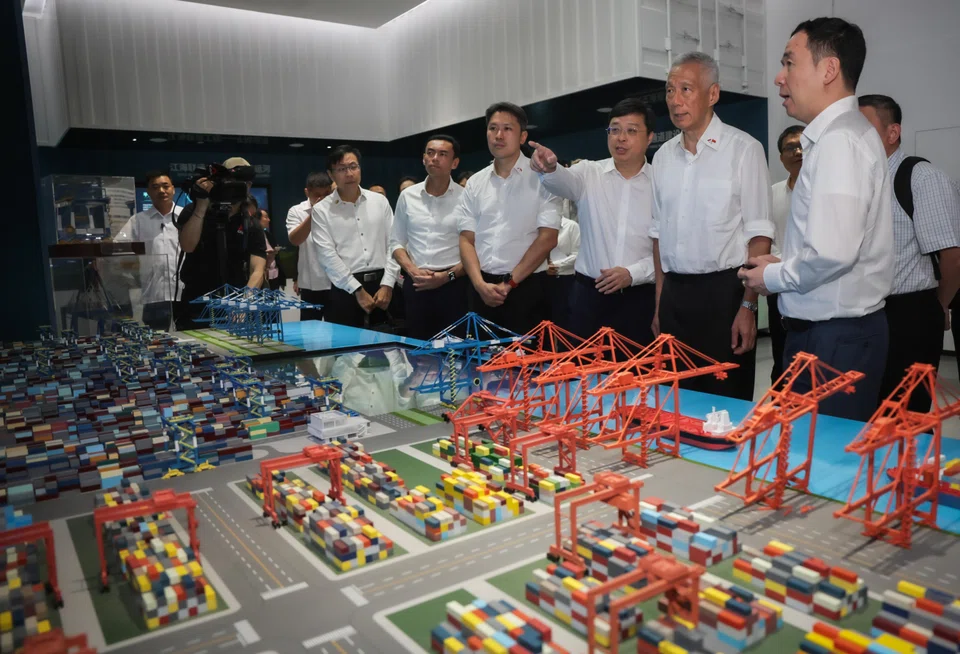
[NANNING] The New International Land-Sea Trade Corridor (ILSTC), a trade corridor connecting China’s western region to Asean, has led to more competitive costs and time efficiency for shipping routes.
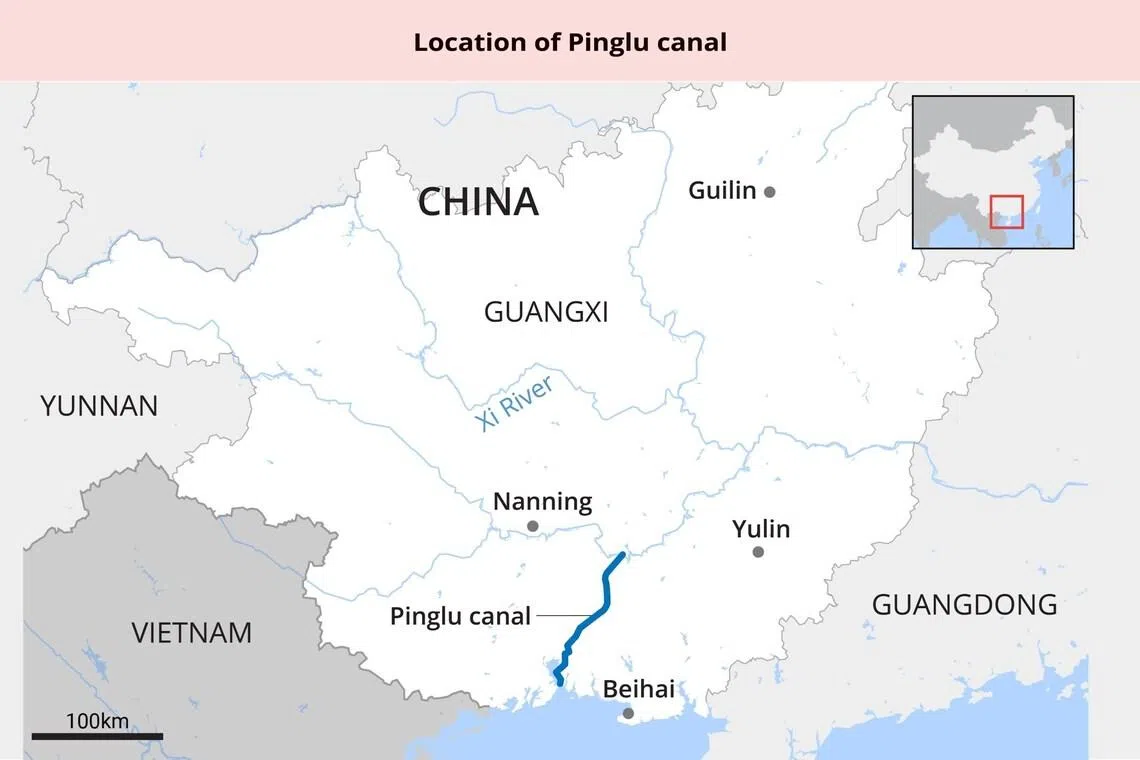
Trade links between China and South-east Asia are also about to get a further boost, with the opening of the over 70 billion yuan (S$13.1 billion) Pinglu Canal that is set to create a direct route for cargo ships from south-western China to the sea.
Senior Minister Lee Hsien Loong, while touring the Beibu Gulf International Port Group’s (BGIPG) headquarters on Monday (May 18) at the start of his five-day visit to China, said that he was “very happy” to see the ILSTC’s success.
“China has a lot of development potential in the western provinces,” he noted, adding that “the connection to the outside world, all the way to (the Yangtze River), to Shanghai, was a very long journey”.
A faster route would be “through Guangxi, through Beibu Gulf, and out to South-east Asia, to North-east Asia or the rest of the world”, he said after the tour.
Speaking on the ILSTC, SM Lee said: “We started on the plan, and after a lot of work by the Chinese side and by Singapore partners too, I am very happy to see that the project has been very successful.”
In 2016, when he was prime minister, SM Lee proposed a study on the construction of a Southbound Transport Corridor from Chongqing to Singapore, in a bid to promote trade development between western China and South-east Asia. This led to what is now known as the ILSTC.
“You briefed me on some of the new investments which you are putting in for the nation, on the Pinglu Canal that you are building, and I wish the project all the best,” the senior minister said. “And I am quite confident that once completed, the port here will continue to grow.”
“Huge market potential”
The Pinglu Canal will span 134.2 km from Hengzhou, under the jurisdiction of Guangxi’s capital Nanning, and flow into the Gulf of Tonkin – known as Beibu Gulf in China – via the Qin River.

In a social media post on Monday, SM Lee said that Nanning – as a regional capital close to South-east Asia – is a “main gateway” for cooperation between Asean and China.
The ports in the Guangxi region are set to benefit, Lianhe Zaobao reported, citing industry watchers.
Guangxi’s ports had lagged significantly in throughput compared to major coastal ports in China. BGIPG, which Singapore’s PSA has a stake in, operates the major ports there: Qinzhou, Fangcheng and Beihai.
Zhou Yan, the deputy general manager of BGIPG, said that the new route will enable a significant jump in cargo loads once it opens in September.
“There’s no doubt the canal’s opening will increase throughput,” he told Singapore media. “Its opening will further optimise logistics costs along the corridor and improve efficiency.”
He added that based on preliminary estimates, it will initially add over three million tonnes of cargo.
That represents less than 1 per cent of BGIPG’s total throughput. Zhou pointed out, however, that estimates show growth could jump to over 150 million tonnes annually in the long run.
The Pinglu Canal route will bring ships on a path nearing Vietnam, whereas some shippers would previously turn to Guangdong in a detour.
Zhou noted that there is “huge market potential” as South-east Asian countries account for over a quarter of the world’s population.
“Our main task is to coordinate industry chains and supply chains among member countries, ensuring everyone finds their niche while working together,” he said.
“Multi-dimensional” cooperation
Operators in Singapore are already preparing for the canal’s opening, Zaobao reported.
A spokesperson for the China operations of PSA International said that the company is working with local partners to handle higher cargo volumes and ensure smooth barge links with the deep-sea terminal.
Zaobao reported the spokesperson as saying that the Pinglu Canal will expand hinterland access while providing a more cost-effective, resilient alternative to road and rail within the New International Land-Sea Trade Corridor.
“There are more opportunities for cooperation with Singaporean companies in vessel design and port operations,” said Zhou.
“PSA is our long-term partner. Our cooperation is multi-dimensional, spanning ports, renewable energy, digitalisation and green logistics,” he added. “We hope to deepen cooperation and attract Singaporean enterprises to invest in Guangxi.”
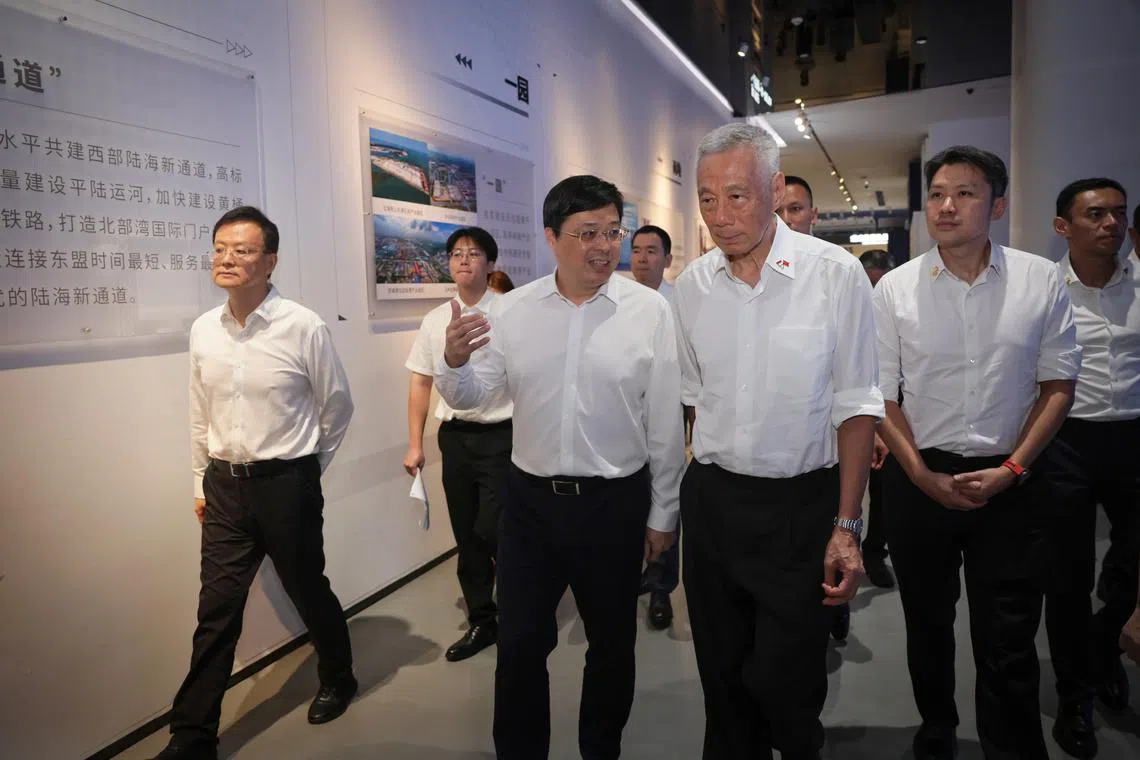
Singapore has long played a role in infrastructure-building in the region. In 2017, a land-sea trade corridor linking Chongqing and Singapore with Beibu Gulf was proposed.
In his post, SM Lee said that he was looking forward to the meetings and visits over the next few days to learn more about Guangxi and explore how both sides could strengthen their ties.
Decoding Asia newsletter: your guide to navigating Asia in a new global order. Sign up here to get Decoding Asia newsletter. Delivered to your inbox. Free.
Copyright SPH Media. All rights reserved.