

Singapore SMEs brace for choppy trade waters as US tariffs rise to 15%
Sustained investment in R&D would enable companies to ‘create foundational values rather than just value-add’, says Asme president

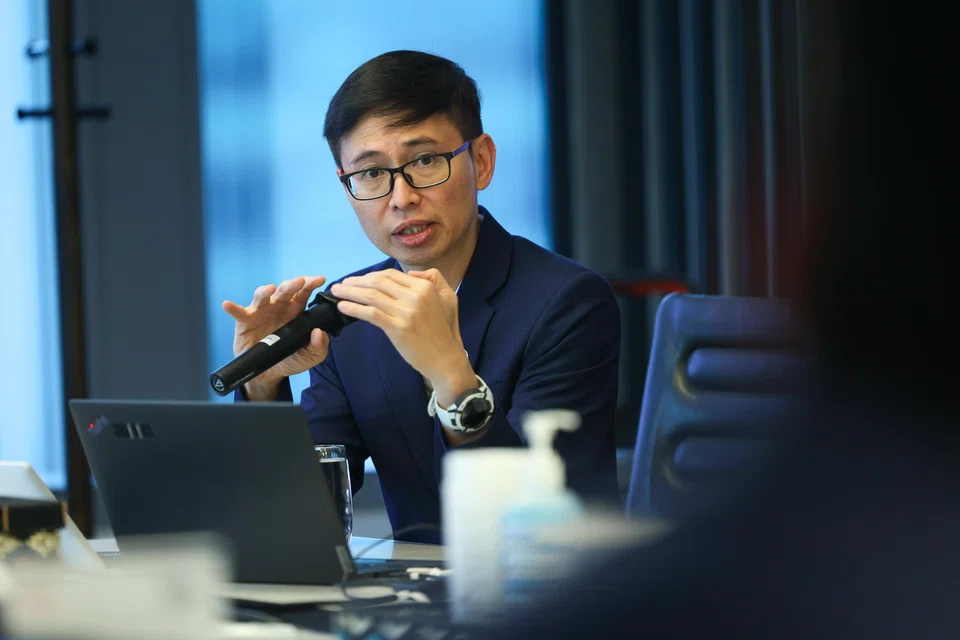
[SINGAPORE] Singapore small and medium-sized enterprises (SMEs) exporting to the US will have to rethink their business strategies in response to the latest US tariff developments.
“For the medium and longer term, it is clear that the US – under the Trump administration – is continuing to push for companies to onshore back to the US,” said Ang Yuit, president of the Association of Small and Medium Enterprises (Asme).
“In that respect, SMEs that are exporting to the US must take into consideration their plans, depending on their businesses.” This could be about building manufacturing facilities in the US and concurrently figuring out how supply chains should be structured, he noted.
Ang’s remarks come after US President Donald Trump on Feb 21 raised the global duty on US imports to 15 per cent from 10 per cent, after the US Supreme Court struck down Trump’s earlier sweeping tariffs
In a 6-3 decision, the court ruled that the president lacks authority under the relevant laws to unilaterally impose tariffs. Shortly after the ruling, Trump imposed the new global levy under another trade law provision.
“It is clear that waters will continue to be choppy for Singapore SMEs that export to the US,” said Ang.
While businesses may need to reconsider their strategies, doing so would involve substantial costs and must be carefully planned in collaboration with US customers and partners, he added.
“For exporters, if they have not already done so, the pressure will be even stronger to consider a two-pronged strategy – export to the US and export to the rest of world,” said Ang, noting that some firms may reduce their reliance on the US and seek alternative markets.
This is especially as Singapore’s export competitiveness could be further affected.
RHB’s group chief economist and head of market research Barnabas Gan told The Business Times: “We do not discount the potential erosion of Singapore’s export competitiveness under a ‘level playing field’, where all South-east Asian economies now face an equal tariff rate.”
Still, he said that he is confident that Singapore retains a competitive edge through its strong technological sophistication – particularly in high-tech manufacturing segments such as precision engineering, aerospace components and pharmaceuticals.
This is complemented by its reputation as a reliable and trusted trading partner, underpinned by an extensive network of free trade agreements, which should help mitigate price-competitiveness pressures, he added.
Kok Ping Soon, chief executive officer of the Singapore Business Federation (SBF), said: “Frequent changes in rates, scope and timelines complicate pricing, contract renewals and production planning, particularly for firms with shipments en route or contracts under negotiation.”
While businesses can plan for a known cost increase, Kok noted that they struggle when the target keeps moving, and some companies are holding back on major investment and routing decisions as a result.
Support measures
To help SMEs navigate these challenges, Asme’s Ang said the government can assist firms in understanding the legal frameworks arising from the new tariffs, while continuing efforts to strengthen Singapore’s brand and international recognition.
He added that sustained investment in research and development (R&D) would enable companies to “create foundational values rather than just value-add”.
“Being a critical piece of the supply chain that cannot be easily replaced will strengthen and help maintain our position as a hub in light of these global trade changes.”
SBF’s Kok said companies should tap available support to strengthen resilience, including the BizAdapt Grant for supply chain and operational adjustments, as well as accelerate efforts to diversify supply and demand.
In response to the latest tariff hike, the government said on Feb 22 that it is monitoring the fresh tariff developments and engaging its US counterparts, and stands ready to introduce more support measures if necessary.
The Ministry of Trade and Industry will work with its tripartite and industry partners through the Singapore Economic Resilience Taskforce to provide timely information to businesses and workers, as well as gather feedback on how they are affected.
At a media doorstop on Feb 22, Deputy Prime Minister Gan Kim Yong said different companies will experience varying levels of impact, and their abilities to respond will also differ.
He added that the government is prepared to engage with them to assess their needs and determine whether additional support is needed.
“But for the immediate future, I think the measures announced at Budget 2026 will be sufficient for them to weather the immediate impact,” said DPM Gan.
These measures include a 40 per cent corporate income tax rebate for the 2026 year of assessment, with a maximum cap of S$30,000 and a minimum benefit of S$1,500 for eligible firms.
Grant support levels under schemes such as the Market Readiness Assistance Grant and the Business Adaptation Grant were also raised to help companies better navigate the tariff environment.
TRENDING NOW

Once staunchly pro-China, Malaysian Chinese businesses are now distancing themselves from Beijing

Britain’s mansion tax shows the difficulty of targeting wealth
Three hats, one goal: How Ng Kian Swan runs sustainability at NUHS
COE review: The gap between luxury and mass-market cars isn’t the only one worth bridging

