

Strong demand drives COE spike as mainstream car premium hits S$118,000, commercial vehicles at S$80,001
Stock clearing by legacy brands and continued demand for EVs prompt healthy sales
 Add BT as a preferred source
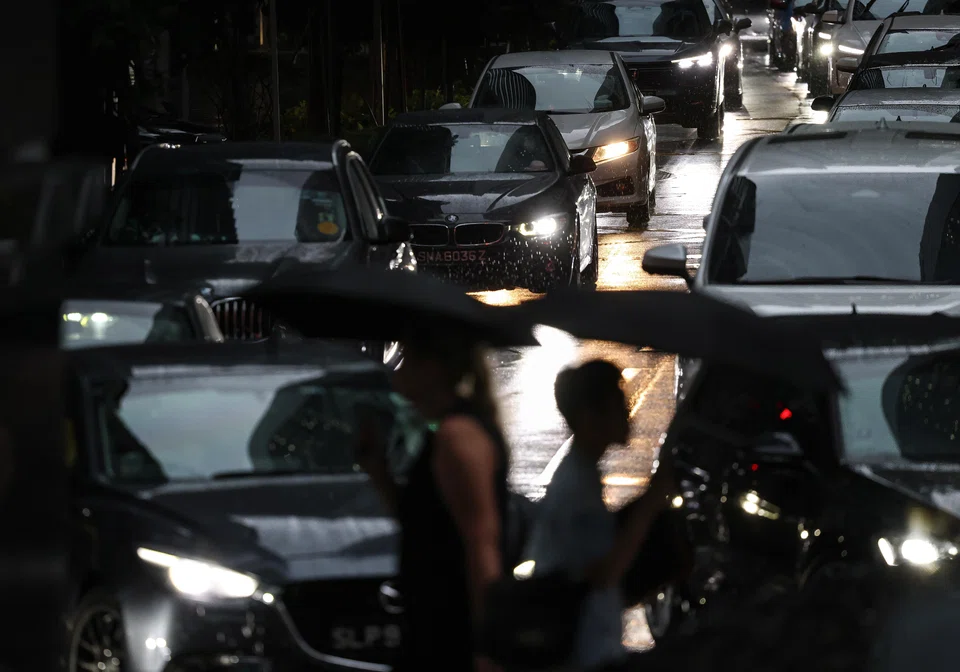
[SINGAPORE] Premiums for all Certificate of Entitlement (COE) categories rose in April’s first round of bidding, which closed on Wednesday (Apr 8).
Passenger cars led the increases, while the commercial vehicle and motorcycle categories reached levels not seen for many months.
Industry observers said that there has been strong car-buying demand in recent weeks, driven by both electric vehicle (EV) and internal combustion engine (ICE) car sales. They also said that the commercial category rise was the result of increased bidding competition over the past months.
“We had a perfect storm of legacy brands clearing stock, and China EV brands (being) flooded with heightened demand,” said Say Kwee Neng, an automotive consultant and former managing director of multiple car dealerships. “It all came together.”
Category A, for mainstream cars, rose 5.5 per cent or S$6,110 to S$118,000.
This applies to cars that have engines of up to 1,600 cubic centimetres (cc) in capacity or with up to 97 kilowatts (kW) of power, or for EVs with up to 110 kW of power.
The Category B premium increased 4.7 per cent or S$5,432 to S$121,000.
This applies to larger, more powerful cars with engines of more than 1,600 cc in capacity or that have more than 97 kW, or for EVs with more than 110 kW.
Category E, the open category which can be used to register any type of motor vehicle except motorcycles, was up 2.4 per cent or S$2,882 at S$121,001.
SEE ALSO





Both the commercial vehicle and motorcycle categories reached levels not seen in recent months.
The premium for commercial vehicles in Category C rose 2.6 per cent or S$2,001 to S$80,001. The figure has climbed steadily since the middle of 2025 and has now reached a level not seen since October 2023’s second round of bidding, when it was S$84,790.
The motorcycle category, D, was up 4.3 per cent or S$411 at S$10,000. The category’s premium has risen sharply since February’s second round of bidding, when it was S$7,989.
The latest bidding round marks the first time Category D has hit the S$10,000 mark since October 2024’s first round of bidding, when it was S$10,001. It hovered near the level last year – at S$9,889 in April 2025 and S$9,810 in October 2025, for example.
Buying power
Say noted that distributors of legacy Japanese and German brands may have been attempting to offload excess stock in the wake of changes to the Preferential Additional Registration Fee (Parf).
In February, the government reduced the Parf rebate for cars by 40 percentage points and capped it at S$30,000.
The rebate is given to car owners who deregister their cars before the 10-year COE lifespan ends, but the reduction effectively reduces the on-paper value of cars, including trade-in values.
Luxury cars are most affected by the cap, while EVs are less affected because their rebate level is lower, due to how incentives are calculated here.
“This premium increase was a result of legacy brands dumping stock,” Say added. “The Parf rebate cut came along, and now, nobody is sure of their sales runway.”
A typical automotive distributor holds around three months’ worth of stock in Singapore. But with the Parf change clouding the outlook, many distributors chose to clear stock first, rather than lose money later.
“The trade has a dictum of ‘first loss is best loss’: If you hesitate, chances are you will take a bigger loss down the road,” Say said. “So (distributors) bite the bullet and decided to flush excess stock now rather than hold it later.”
Electric drive
On the other hand, demand for EVs – especially from mainstream Chinese marques – has remained strong, especially in Category A, where incentives and cost-effectiveness have sustained their popularity.
Lee Hoe Lone, managing director of Premium Automobiles, distributor for Avatr, Deepal, XPeng and Zeekr, said: “We are in a situation where demand is chasing supply. For example, many existing cars are reaching the end of their COE lifespan.”
He added that more affordable Chinese brands such as GAC Aion, Jaecoo and MG are achieving healthy sales. This could indicate that owners of mainstream cars from Japanese or legacy brands could be switching to Chinese EVs, which are the most affordable models now.
Raymond Ng, managing director of subsidiary Eurokars EV, which distributes MG, said the brand had done well in sales in the past weeks.
“For sure, we can see what the government has done to nudge buyers towards EVs; we’ve had more footfall and conversions, compared to hybrids or ICE cars from Japanese or Continental carmakers,” he said.
Meanwhile, the commercial vehicle premium has crept up since last year with the end of the Early Turnover Scheme (ETS), resulting in more bidders for a small pool of COEs.
“Category C has been on the increase steadily,” said the sales manager of a commercial and passenger vehicle brand. “Each round it’s up S$2,000 to S$3,000, and that’s because ETS is gone, so now everyone has to bid and compete for a COE.”
ETS gave commercial vehicle owners a discount on the COE premium as an incentive to replace older vehicles with newer, cleaner models.
The scheme replaced vehicles directly, without the need to bid for a new COE.
The scheme ended for light commercial vehicles in March 2025 and for heavy commercial vehicles in December 2025.
Decoding Asia newsletter: your guide to navigating Asia in a new global order. Sign up here to get Decoding Asia newsletter. Delivered to your inbox. Free.
Copyright SPH Media. All rights reserved.
TRENDING NOW
DBS completes US$1 billion significant risk transfer deal, in first for Singapore bank

Malaysian tycoon Vincent Tan’s sell-downs point to pruning rather than an exit plan
Singapore private housing is ‘decoupling’ from HDB market as buyer pools diverge: NUS survey

Not in education, employment or training: Why more Hong Kong youths are opting out of work

