

Core inflation climbs to 2% in July; electricity prices rise sharply
Meanwhile, headline inflation picks up to 2.2% in July from the preceding month’s 1.9%.

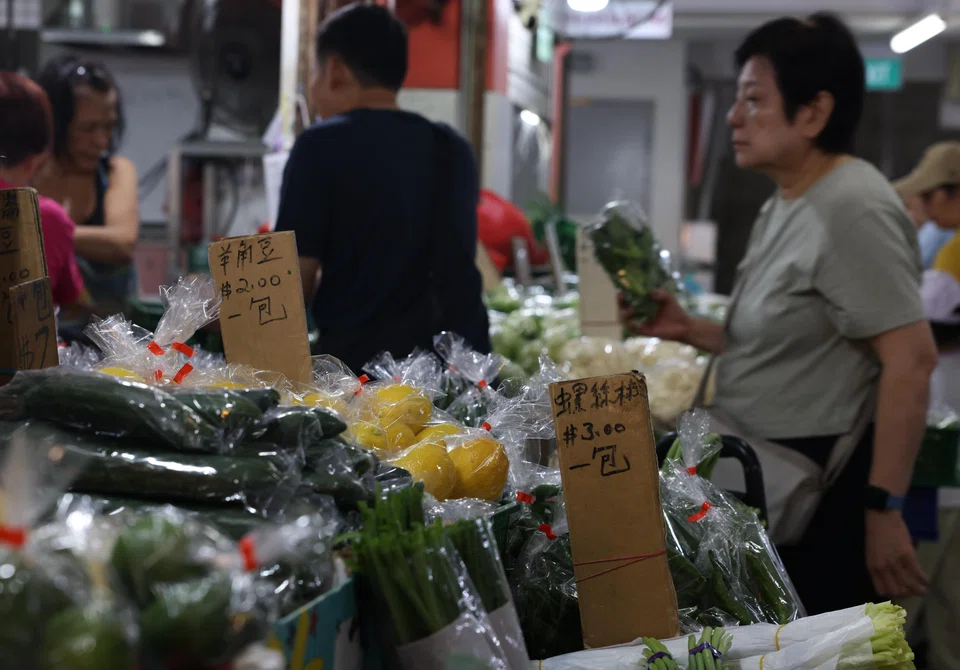
[SINGAPORE] Core and headline inflation picked up in July, with the core figure rising largely due to electricity and gas, services and food segments, the Monetary Authority of Singapore (MAS) and the Ministry of Trade and Industry (MTI) said on Monday (Aug 24).
Core inflation, which excludes accommodation and private transport, rose to 2 per cent in July from June’s 1.6 per cent. Still, it was below the median 2.2 per cent predicted in Bloomberg’s poll of private sector economists.
Barclays’ estimates suggest that the 17 per cent adjustment in electricity tariffs accounted for 0.3 percentage point of the increase, said Brian Tan, its head of non-China EM Asia economics research.
Its spillover to the rest of the consumer price index (CPI) basket looks modest, he noted, adding that there were also offsetting sources of disinflation, particularly in communications.
Meanwhile, headline inflation picked up to 2.2 per cent in July from the preceding month’s 1.9 per cent, driven by an increase in accommodation inflation alongside higher core inflation. The headline figure also came in under the median economists estimate of 2.4 per cent.
The latest core inflation figure represented the highest year-on-year increase since October 2024, and the headline one, since August 2024, said DBS senior economist Chua Han Teng.
Inflation trends across CPI categories were mixed in July. Electricity and gas prices reversed the decline in June to post a large increase, and services, accommodation and food inflation rose.
However, retail and other goods, as well as private transport inflation eased.
On a month-on-month basis, the core CPI was up 0.3 per cent, while the all-items CPI fell 0.2 per cent.
“The build-up in underlying price pressures likely validated MAS’ decision to very slightly increase the appreciation pace of its currency policy band during its July review, although actual inflation readings undershot estimates,” explained Chua.
Inflation outlook
MAS and MTI maintained their 2026 full-year forecast range for both core and headline inflation at 1.5 to 2.5 per cent.
Standard Chartered (StanChart) chief economist Edward Lee and senior economist Jonathan Koh noted that the inflation statement was “notably more hawkish versus the June CPI statement”. They added: “That said, the gist of the July inflation statement was largely aligned with the July monetary policy statement (MPS).”
MAS and MTI noted: “Elevated global energy prices have led to increases in Singapore’s electricity and gas tariffs and higher transportation fares.”
This is compared with previous mentions of higher energy costs expected to pass through global supply chains with a lag.
They also flagged that adverse weather conditions could raise imported food prices, and that second-round inflation effects may be stronger if robust IT investments generate positive demand spillovers.
But while these were missing in the June CPI, the additions were already included in the July MPS, the StanChart economists noted.
The authorities made the new point that enhanced government subsidies will continue to have a dampening effect on services inflation domestically.
MAS said that core inflation should remain elevated into 2027 before moderating more discernibly from around mid-2027.
Bank of America (BOA) economists Ang Kai Wei and Rahul Bajoria said: “While discussions on the medium-term trajectory had already appeared in the July MPS, MAS does not typically comment on inflation dynamics beyond the following calendar year in its CPI outlook publications at this stage of the year.”
They believe this points to MAS staying vigilant to upside inflation risks, even as core inflation could come in below its forecasts from July.
For now, the BOA economists tentatively see the central bank steepening the policy slope “very slightly” by 25 basis points (bps) in October.
Most other watchers think that MAS will leave its monetary policy settings unchanged then.
StanChart’s Lee and Koh expect the central bank to hold, with the primary risk being another “very slight” tightening.
They said: “Broadness of inflation will remain a key indicator we watch out for.”
Barclays’ Tan said: “The uncertainty over whether the output gap is exerting the same degree of inflation pressures as before likely restrained the MAS from a fuller 50 bps slope increase on Jul 27 – which suggested to us that more inflation undershoots will likely further raise doubts over how much monetary policy tightening is needed.”
Its base case is for MAS to hold off on further tightening, even if economic growth continues to outperform.
Though the risk remains, the likelihood of another increase in the slope in October has fallen, given that core inflation is not rising as much as feared – and any tightening move is likely to be in the form of another 25 bps adjustment, he added.
TRENDING NOW

LTA proposes combining car COE categories, adding rebate-surcharge system

StarHub to acquire MyRepublic’s mobile business amid ongoing telco consolidation

DBS, OCBC, UOB rout lops billions off STI as inflation, rate concerns spook investors

Grab CEO’s wife Chloe Tong on life with Anthony Tan and finding her purpose

