Countries must strengthen trust at home before building a resilient world order: President Tharman
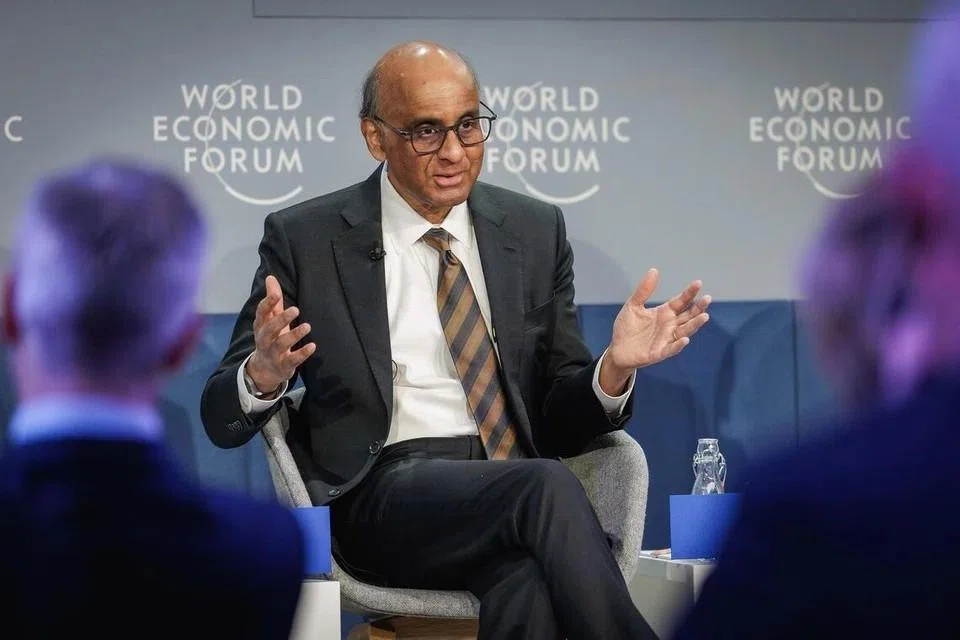
[SINGAPORE] Before trying to build a resilient world order where countries are interested in cooperating for the global good, each country has to first look inward, said President Tharman Shanmugaratnam on Jan 21.
Countries have to first strengthen trust and the interest their people take in one another, including those across different socio-economic circumstances, he said.
“It is significant that people who trust each other in their own countries have greater interest and faith in cooperation internationally,” he said during a panel discussion titled “Who Brokers Trust Now” at the World Economic Forum (WEF) in Davos, Switzerland.
This can be done by tackling people’s hopes and fears, he added. Most people want a good job, career security and the dignity of knowing they are contributing.
These considerations must then be the centre of public policy in all societies, said Tharman.
This is especially so in an era when technology can be both a very powerful enabler and displacer at the same time.
“We’ve got to act pre-emptively – through more effective skilling, more real-time feedback to ensure that skilling meets market demands,” he said. “And by giving people the sense they are not on their own once they leave school and enter the workforce – there will be repeated opportunities to build up new skills.”
More attention also has to be paid to those who lose out as a result of economic competition and the creative destruction that comes with innovation, he said.
“Don’t let problems fester. If someone is displaced, or if a local community is displaced from work, address it quickly through public-private sector cooperation to bring in new economic activities,” he said.
This, he said, is a lesson of the last 20 to 30 years, when globalisation led to a remarkable increase in living standards everywhere, but left pockets of people who were dislocated from jobs, and who were left on their own.
“The real lessons lay in domestic policy failure,” he said.
“So we have to rebuild trust domestically, with everyone knowing that they can contribute to national prosperity, to have a better chance at building resilient international alliances for the global good.”
Tharman also spoke on the broader challenges of creating a new world order and the pressing need to do so. This comes amid flux in the existing rules-based system as some countries have been taking a might-makes-right approach.
The starting point is not a bad one, Tharman said. There are gains from the old world order – a vast majority of countries believe in the international rule of law and that collective problems require collective solutions.
Surveys also show that many people worldwide, including in the United States, still believe in global cooperation and even compromise between nations in order to serve national interests.
The new “Plan B” should be one that recognises that even as national interests prevail, there is enough of an intersection between national interests and the global good, he added.
This means building plurilateral alliances around the challenges that countries face in common, he said.
These common interests can be found in artificial intelligence (AI) safety, in safety from a climate that is getting less liveable with each decade, and in open trade and investment.
He warned that it would be dangerous for the world to assume it can reboot only after conditions deteriorate, as this risks a self-reinforcing slide into disorder.
Domestic polarisation can beget further polarisation and even turn violent, while global rifts may widen and harden into rivalry across entire industries. Financial fragility, too, may lead to a gradual and then sudden loss of trust in reserve currencies, unleashing global instability.
In addition, AI agents can go rogue, and runaway misinformation and deep fakes can undermine trust in democracy itself. Climate change can also push the planet into uncharted territory once critical tipping points are crossed, said Tharman.
“So we have to bend the trajectory and not wait to see how things play out in the hope that when things get more damaging, the world wakes up and we start building a new world order,” he said. “That is too dangerous a path.”
Even as the world builds up plurilateral alliances under Plan B, it should not repudiate Plan A, or multilateralism itself, said Tharman.
This is even as the multilateral institutions need to be strengthened and reformed.
“The global system still needs a centre of gravity in international institutions and the international rules and norms that have governed us, not perfectly, but well enough for 80 years,” he said.
He added: “And let’s not be too tempted by the idea that multipolarity will suddenly appear and sort out the problems in the world. It can just as well be a more unstable world.”
Other speakers on the panel were United Nations General Assembly president Annalena Baerbock, UN Development Programme administrator Alexander De Croo, Cisco chairman and chief executive officer Chuck Robbins, and International Crisis Group president and chief executive officer Comfort Ero.
They discussed what form future international cooperation will take as trust in established multilateral institutions and governments erodes, and new alliances and coalitions emerge. The session was moderated by The Washington Post’s global affairs columnist, Ishaan Tharoor.
In her address before the panel discussion, Baerbock said that truth, as well as common rules and principles, is important for trust to be built and maintained.
“I want to be crystal clear. Standing up for the rules-based international order is not only the right thing to do – it is an act of self-interest,” she said, adding that the alternative, where might makes right, can only result in chaos and war.
“Our forebearers learnt the hard way how chaotic a world without trust is. A world in which everyone pursues their interest, rules be damned – this world ended in complete disaster,” she said.
“Can we act in the same spirit and take similar steps together like 80 years ago? Because there won’t be a magic wand for someone to fix this.” THE STRAITS TIMES
Decoding Asia newsletter: your guide to navigating Asia in a new global order. Sign up here to get Decoding Asia newsletter. Delivered to your inbox. Free.
Share with us your feedback on BT's products and services