

To court the young, a Hakka clan association in Singapore is offering overseas internships
Char Yong (Dabu) Hakka clan association is not the only clan that is trying to mix tradition with modern support

[SINGAPORE] Chinese clan associations in Singapore are typically seen as organisations for business owners to network, but some of these associations are now increasingly looking at support that is relevant for a younger generation of Singaporeans.
In early July, the Char Yong (Dabu) Hakka association signed a memorandum of understanding (MOU) with Business China, a non-profit organisation launched by Singapore’s late founding prime minister Lee Kuan Yew in 2007, to deepen networks with China.
As part of the agreement, the Char Yong (Dabu) Hakka association is committing S$60,000 a year to Business China to support two programmes in China that target the younger generation.
The first is a Singapore-China Youth Interns Exchange Scheme, which will support up to 10 Singaporean young people on their internships in China every year. The second is a Business China Summer School Scholarship, which supports Singaporean undergraduates attending short-term summer academic programmes in Chinese universities.
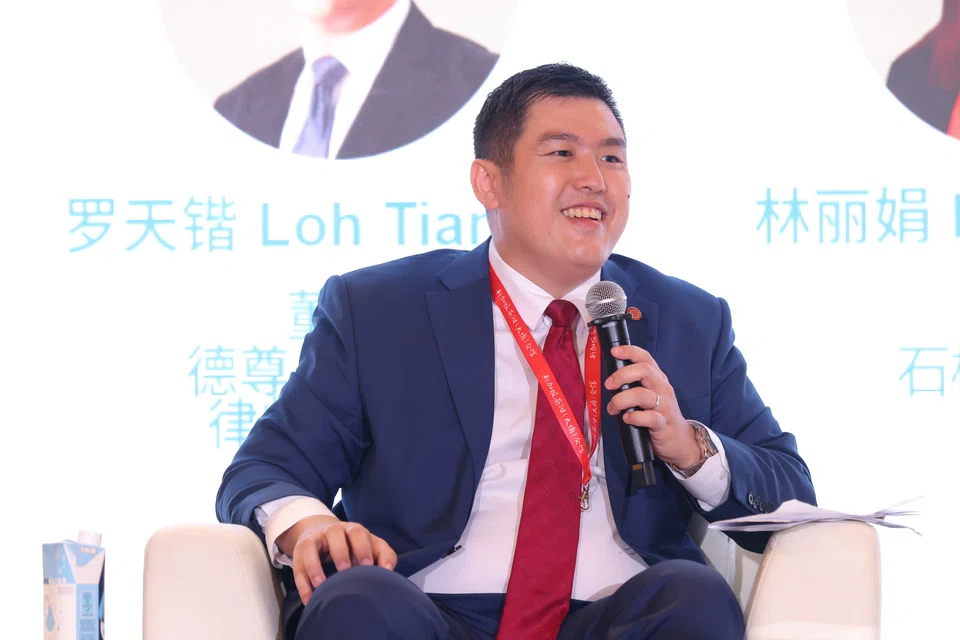
Loh Tian Kai, a director at law firm Drew & Napier, and a volunteer at the association for over a decade, said the MOU that covered the immersion programme is part of a wider initiative to come up with new ways to support members in the 21st century.
“Business China has agreed it would prioritise our members, even though it’s not limiting the eligible applications to members of our association only,” he shared.
Historically, these clan associations often offered help to first-generation immigrants to settle in Singapore by providing a range of services from accommodation to even burial.
But Loh said the Singapore government has, over the decades, “done a good job” in taking care of these basic needs.
“Where I think the associations are right now is thinking about how they can continue to be relevant and benefit members,” Loh said.
Supporting generations of members
There are some 300 Chinese clan associations in Singapore, according to the Singapore Federation of Chinese Clan Associations.
Many of these associations tend to offer some form of support for education, often through bursaries for children of members. The Hokkien clan association also offers a pathway for the children of members to certain schools such as Nan Chiau Primary.
Some go beyond education-related support. For instance, Benny Wong, who chairs the Toishan Wong clan association, shared that his association gives “very generous” baby bonuses to clan members.
Melody Tan, second-generation business owner of the Yum Cha Restaurant group who initially joined the Teochew Poit Ip Huay Kuan association for business reasons, has pioneered several activities to drive women participation.
Yet many clan association activities still revolve around the culture of the dialect group, and while culture is important, Loh argued that more relevant activities can be organised to change the perception of these associations.
Loh became associated with the Char Yong (Dabu) Hakka association because he received a scholarship for university through the association, and he wanted to “do something to give back”. He now gives advice on legal matters to the association and some of its members, and also sits on a committee that creates activities that can appeal to youth.
Even before the MOU with Business China, Loh shared that the association leveraged its Hakka connections to organise business missions to China.
The association visited enterprises in Shenzhen in 2024 and Guangzhou last year. Each trip had a participation of about 30 members, and Loh said the group was split equally between small and medium-sized enterprise owners and tertiary-age people who wanted to interact with Chinese firms for job-seeking purposes. The association is planning to visit Hainan this year.
“In recent years, one definite direction our association has decided upon is to help further professional and business development for all our members,” Loh said. “We want to explore what can be done for our members with regards to advancing their careers so clan associations aren’t just seen as a place for retirees.”
Decoding Asia newsletter: your guide to navigating Asia in a new global order. Sign up here to get Decoding Asia newsletter. Delivered to your inbox. Free.
Copyright SPH Media. All rights reserved.






