Curasia wants to be the ‘Grab’ of colorectal cancer detection
Acting as a middleman, it connects patients with partner specialists for scopes in its facilities

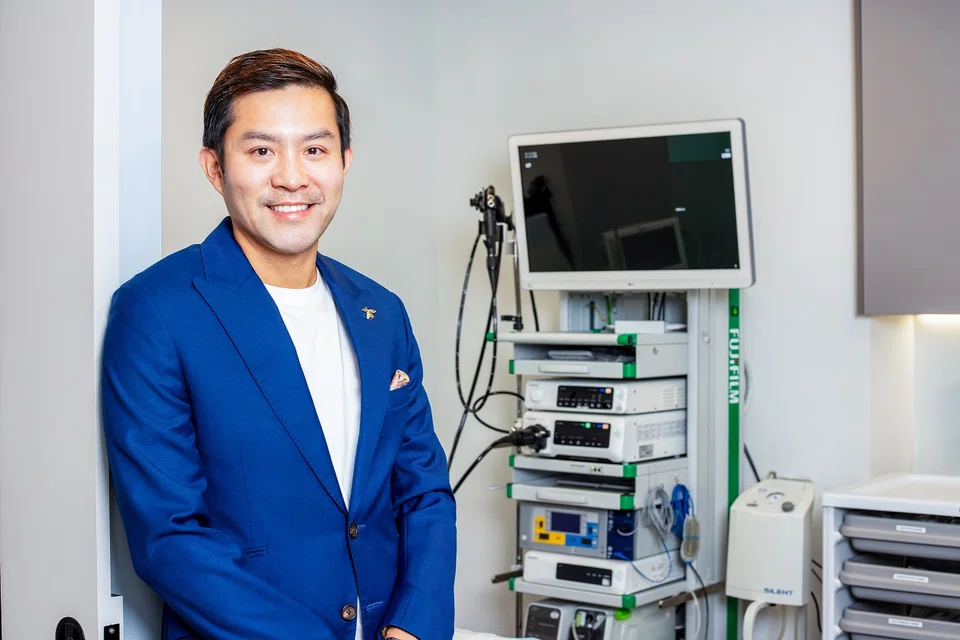
FIVE years ago, preschool operator Don Poh learned that a student’s parent – only in his 30s – had died from colon cancer. Shocked, Poh researched the topic and found that movie star Chadwick Boseman – “six-pack, looks perfect” – died of the same cause.
Timely screenings can prevent such deaths, but inefficiencies in Singapore’s medical system meant that screening rates were low.
Poh thus set up Curasia Endoscopy to provide both a way for patients to find doctors for such screenings, and facilities where these can happen.
Likening it to ride-hailing platform Grab, Poh said: “I have my customer base, I have the system – the doctors are just my drivers.”
From 2018 to 2022, colorectal cancer was the second most common cancer in the city-state, based on National Cancer Centre Singapore data.
The government has pushed for greater screening through colonoscopies, in which a camera is sent through a patient’s colon. But insufficient facilities at public hospitals meant long queues, said Poh.
In 2021, the median waiting time for a colonoscopy was about 38 days, up from 31 days in 2019. Based on hospital data for the preceding three years, about six subsidised patients per hospital each year waited more than five months for a first appointment for colonoscopy.
Said Poh: “One, two months’ wait will determine whether or not your cancer spreads.”
Colonoscopy facilities are not prioritised in private hospitals – which are ultimately businesses with shareholders – as the procedure is of comparatively low value, Poh added. Wait times are also significant, and procedures more expensive.
Recognising these bottlenecks, Poh founded Curasia in 2021, with a colonoscopy facility in Jurong where patients’ symptoms, needs and means are assessed by an in-house doctor.
After the consultation, a suitable specialist is identified from the firm’s panel and patients can get checked within 36 hours, at prices 30 to 40 per cent lower than those of private hospitals.
“It’s not just that we’re in the medical business. We are in the service business as well,” Poh said. As commuting – especially post-treatment – can be taxing, Curasia improves the patient experience by covering transport to and from the screenings.
Screening costs can be offset through MediSave. As the company is MediSave accredited, lower-income patients can choose to be redirected to the public health system if surgery is needed, Poh said.
Partnering experts
As for doctors, Curasia does not hire its own. Instead, specialists from private hospitals are paid about S$2,000 for every scope that they perform at the company’s facilities – similar to what they would earn in a private hospital, even though patients pay more there.
Working with Curasia can help doctors reach more patients, said Poh.
And if a scope performed with the firm uncovers the need for surgery, these specialists will be able to perform it for the same patients. “If you scope for me, you find cancer, you operate for S$40,000, S$50,000.”
Curasia pays its specialists only after receiving payments from insurance companies, so the company’s cash flow is good, said Poh.
By sourcing rather than hiring specialists, Curasia’s wage costs are also restricted to those of nurses and in-house doctors for pre-screening consultations.
Opening its first centre in the heartlands also meant lower rent, while the location – in a residential neighbourhood – made treatment seem less intimidating and more accessible, Poh added.
But in the beginning, business was slow. For nearly a year, the centre was burning S$50,000 a month.
Then, in March 2022, The Straits Times reported on a woman who turned to the private sector after a five-month wait for a colonoscopy.
“When I read this, I wasn’t scared anymore, because I knew I was solving a problem,” recalled Poh. “And I knew, eventually the business would turn around.”
The Jurong centre broke even in April 2023, bringing in about S$150,000 per month. In that financial year, revenue exceeded S$1 million.
In 2024, Curasia was financially able to open a second outlet in Lucky Plaza. This central location catered to those who found Jurong too far away, and placed it close to other medical players, such as standalone operating theatres and medical labs.
With both centres operating, takings increased to about S$400,000 each month.
Today, Curasia has turned profitable and is debt-free, despite still running at just 30 per cent of capacity.
Poh hopes to expand the business even further, whether geographically – going further east – or by broadening its services.
Journey to the East?
As colorectal cancers are more common in older people, Poh is considering a third branch in Bedok – the planning area with the highest population of residents aged 50 and above, based on official statistics.
But it has been a struggle to find a suitable space, as the screenings require room to fit all the machines and radiation-protected walls.
An alternative is for Curasia to diversify into additional specialisations, with a new centre in Newton.
“I have plans to rebrand Curasia Endoscopy into Curasia Medical Group, with the same notion – there are still gaps in other specialities – I want to find the gap and then give a solution,” he said.
Beyond Singapore, Poh hopes the company can live up to its name – a portmanteau of “cure” and “Asia” – by going regional in the next five years, to markets such as Thailand, Vietnam or Malaysia.
Whether in Singapore or abroad, each outlet needs to be financially stable before the next is opened, Poh said.
“But I believe that if I continue to serve the public first, the money will come in,” he added. “For the medical business, if you’re doing good, giving back to society, (profitability) is inevitable.”