

Don’t let the CFO take over retrenchments, urges HR expert
Exit-management handbook co-author says HR leaders have more power to shape layoffs than they realise

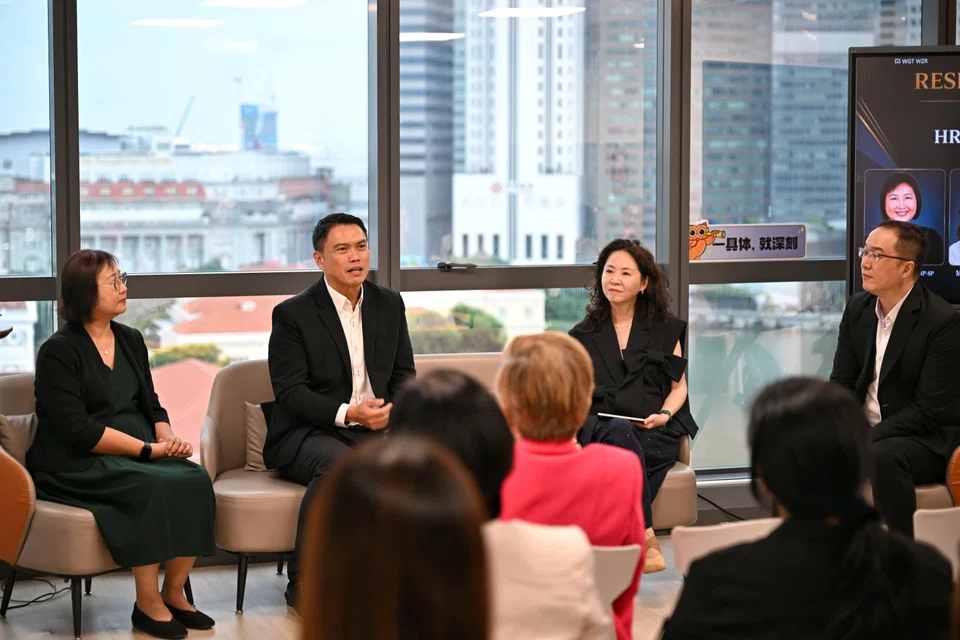
[SINGAPORE] Human resources (HR) leaders have more power than they may realise to push back against retrenchments, including by pressing employers to consider redeployment and retraining before cutting jobs, said the co-author of a handbook on good exit-management practices on Thursday (Jul 30) evening.
Their role could become more important next year, as Career Agility International founder and CEO Adrian Choo anticipates a further rise in retrenchments after his firm saw a sharp increase in companies seeking help with layoffs and outplacement this year.
Against this backdrop, Choo and his co-author Chee Sze-Yen, who is also the company’s co-founder and executive director, launched the second edition of Responsible Retrenchment.
The first edition was published in 2019, and there have been several changes to Singapore’s labour landscape since then.
The book, which guides HR practitioners and business leaders on conducting retrenchments responsibly and sensitively, has been updated with recent case studies, expanded best-practice guidance and legislative developments, including the landmark Workplace Fairness Act that takes effect in late 2027.
White-collar workers more susceptible
Speaking to an audience comprising mostly HR practitioners, National Trades Union Congress (NTUC) assistant secretary-general Patrick Tay said that retrenchments were increasingly affecting professionals, managers and executives (PMEs).
Government data showed that the number of PMEs and technicians retrenched has risen in every quarter since the beginning of 2025, from 2,730 in the first quarter of last year to 3,320 in Q1 2026.
Even highly qualified workers are now at risk, noted Tay, who is also the Member of Parliament for Pioneer. “Young and old, nobody is spared.”
In contrast, the number of retrenched production and transport operators, cleaners and labourers fell from 630 to 200 over the same period.
SEE ALSO



This reflects a reversal from previous periods of cyclical weakness, when older, less-qualified and blue-collar workers were generally more vulnerable, Tay noted.
This shift, together with the “fearmongering” surrounding generative artificial intelligence (GenAI), makes the updated handbook timely, he said.
Companies, particularly those in the technology sector, can sometimes overlook the emotional and “softer” aspects of conducting retrenchments responsibly, he added.
Choo said that HR practitioners are generally not formally taught how to conduct retrenchments, while some are uncertain about how much authority they had in such exercises.
Yet HR practitioners have “a seat at the table” and should become involved from the start, he noted, rather than allow retrenchment exercises to be driven primarily by cost considerations.
“Because if you come in too late, someone’s going to want to take over, and God help you if he’s the CFO (chief financial officer),” explained Choo.
Citing one example involving 40 employees, he said that HR took a back seat and the CFO assumed control. Discussions consequently centred on how much the company could save, including whether commissions and other payments could be withheld.
“Suddenly, it became very clinical. Suddenly, it became a financial project, and, needless to say, it had a lot of negative repercussions about it,” recalled Choo.
He added that HR practitioners can better influence the process by establishing themselves as subject-matter experts and understanding alternatives to layoffs, such as redeployment and retraining. “Retrenchments should not be the first tool that you reach for,” he pointed out, adding that employers could instead “retool” and reskill their workers.
HR teams should also be prepared to challenge how and when layoffs are carried out, said Choo. “Sometimes doing the right thing is not easy, and doing the easy thing is not always right. So you need to be able to push back – on the processes, and on the timing as well.”
He cited a company that had planned a retrenchment a week before Chinese New Year because the exercise had been planned from the US, until its HR director objected.
Choo also identified two other common mistakes made by HR teams: underestimating the time and effort needed to plan a retrenchment, and neglecting the employees who remain after it.
Poor communication with remaining employees could cause productivity to fall and prompt valued workers to look for other jobs because they fear further layoffs, he noted.
Bracing for change
Speaking to The Business Times after the event, Tay said that he could not provide a retrenchment forecast for next year, given the uncertainties including geopolitical tensions, continuing wars and trade disputes.
For the rest of this year, however, he expects retrenchments to remain at around 3,000 to 4,000 per quarter, as some previously announced layoffs would be carried out in phases during the second half.
While this is broadly consistent with normal pre-Covid cyclical levels, he reiterated that the profile of affected workers had changed, with more PMEs being retrenched.
Tay said this came as companies reorganised, restructured and rethought their strategies, including by reviewing their workflows and deciding where their operations should be located.
“It may not be purely because of GenAI,” Tay pointed out, adding that a “multitude of factors” could be involved.
Asked how the labour movement was preparing for further retrenchments and what advice he had for workers, Tay said that unions were working through the Tripartite Jobs Council and the AI-Ready SG programme to equip workers with basic AI literacy.
Union leaders were trained in the first phase, while subsequent efforts would reach workers across different sectors and age groups, he noted. Workers in roles requiring deeper knowledge of the technology would also be trained in AI fluency.
Tay urged workers to focus on what he called the “three Rs”: readying themselves with new skills, remaining relevant to emerging jobs and building the resilience needed to weather periods of unemployment.
A digital copy of Responsible Retrenchment is available for free on Career Agility International’s website. Choo described the book as a “living document”, with readers receiving updates as regulations and responsible-retrenchment practices evolve.
Decoding Asia newsletter: your guide to navigating Asia in a new global order. Sign up here to get Decoding Asia newsletter. Delivered to your inbox. Free.
Copyright SPH Media. All rights reserved.






